BEIJING: Oil prices paused recent advances to trade in a range on Tuesday, after a surge of more than 7 percent in the previous three sessions, on supply concerns prompted by fears of a wider Middle East conflict and the potential shutdown of Libyan oil fields, according to Reuters.
Brent crude futures was up 3 cents at $81.46 a barrel by 09:30 a.m. Saudi time, while US West Texas Intermediate crude futures dropped 6 cents to $77.36 a barrel.
“Losses in oil prices may seem contained in today’s session, which suggests prices taking a breather following a sharp rally over the past few days,” said Yeap Jun Rong, market strategist at IG.
“With the jump in oil prices pricing for geopolitical risks in the Middle East and a production halt in Libya, market participants are now in some wait-and-see to assess further developments.”
The rise of the previous three sessions was driven by expectations of US interest rate cuts that could boost fuel demand, military assaults between Israel and Hezbollah in Lebanon over the weekend that threaten a wider Middle East conflict, disrupting supply from the key producing region and the risk of Libyan closures.
Over that period, WTI gained 7.6 percent and Brent gained 7 percent.
Oilfields in eastern Libya responsible for almost all its production will be closed and production and exports halted, the eastern-based administration said on Monday, after a flare-up in tension over the leadership of the central bank.
There was no confirmation from the internationally recognized government in Tripoli or from the National Oil Corp, which controls the country’s oil resources.
The political dispute could affect almost all of the 1.17 million barrels per day of output from the North African country, based on data from the latest Reuters survey of production by the Organization of Petroleum Exporting Countries in July.
While bearish demand sentiment could weigh on oil prices, with Chinese demand having an outsized impact, the potential closure of Libya’s oil fields would tighten supply and brake declining oil prices, said Vortexa analyst Serena Huang.
“Other oil producers would be rejoicing at the higher oil prices, and may not necessarily bring in additional supply immediately.”
Oil has also been supported by the escalation of the conflict between Israel and Hezbollah, with a major exchange of missiles between them as Hezbollah attempts to retaliate for the killing of a senior commander last month.
“Markets remain on edge as skirmishes between Israel and Hezbollah intensify,” ANZ analysts said in a note.
A top US general said on Monday the danger of a broader war had eased somewhat but that an Iran strike on Israel remained a risk.

Oil Updates — prices pause gains after surging on Libyan outages, Middle East tension
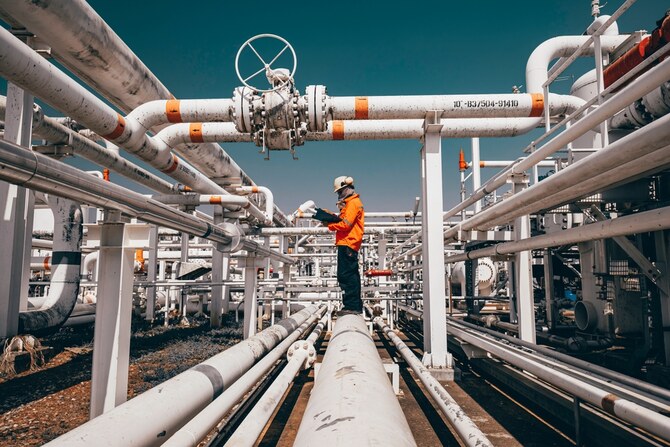
https://arab.news/5d6wn
Oil Updates — prices pause gains after surging on Libyan outages, Middle East tension
- Brent crude futures was up 3 cents at $81.46 a barrel
- US West Texas Intermediate crude futures dropped 6 cents to $77.36 a barrel
Saudi ports brace for cargo surge as shipping lines reroute
RIYADH: Preliminary estimates suggest that several global shipping lines could reroute part of their operations to Saudi Arabia’s Red Sea ports, potentially adding 250,000 containers and 70,000 vehicles per month, according to Rayan Qutub, head of the Logistics Council at the Jeddah Chamber of Commerce, in an interview with Al-Eqtisadiah.
“Any disruption in the Strait of Hormuz not only affects maritime traffic in the Arabian Gulf but could also reshape global trade routes,” Qutub said, highlighting the strait’s status as one of the world’s most critical maritime chokepoints for energy and goods transport.
With rising regional tensions, international shipping companies are reassessing their routes, adjusting shipping lines, or exploring alternative sea lanes. This signals that the current challenges extend beyond the Arabian Gulf, impacting the global supply chain as a whole.
Limited impact on US, European shipments
The effects of these developments will not be uniform across trade routes. Qutub noted that goods from China and India, which rely heavily on routes through the Arabian Gulf, are most vulnerable to disruption. In contrast, shipments from Europe and the US typically traverse western maritime routes via the Suez Canal and the Red Sea, making them less susceptible to regional disturbances.
Saudi Arabia’s strategic location, he emphasized, strengthens the resilience of regional trade. The Kingdom operates an integrated network of Red Sea ports — including Jeddah, Rabigh, Yanbu, and Neom — that have benefited from substantial infrastructure upgrades and technological enhancements in recent years, boosting their capacity to absorb increased cargo volumes.
Red Sea bookings
Several major carriers, including MSC, CMA CGM, and Maersk, have already opened bookings to Saudi Red Sea ports, signaling a shift in operational focus to these strategically positioned hubs.
However, Qutub warned that rerouted shipments could increase sailing times. Cargo from Asia, which normally takes 30-45 days, might now require longer voyages via the Cape of Good Hope and the Mediterranean, potentially extending transit to 60-75 days in some cases.
These changes are also reflected in rising shipping costs, driven by longer routes, higher fuel consumption, and increased insurance premiums — a typical response when global trade patterns shift due to geopolitical pressures.
Qutub emphasized that Saudi Arabia’s transport and logistics sector is managing these developments through coordinated government oversight. The Ministry of Transport and Logistics, the Logistics National Committee, and the Logistics Partnership Council recently convened to evaluate the impact on trade and supply chains. Regular weekly meetings have been established to monitor developments and implement solutions to safeguard the stability of supplies and continuity of trade.
He noted that the Kingdom’s logistical readiness is the result of long-term strategic investments, encompassing ports, airports, road networks, rail systems, and logistics zones. Today, Saudi logistics integrates maritime, land, rail, and air transport, enabling a resilient response to global disruptions.
Qutub also highlighted the need for the private sector to continuously review logistics and crisis management strategies, develop alternative plans, and manage strategic stockpiles. Such measures are essential to mitigate temporary fluctuations in global trade and ensure smooth supply chain operations.


