

Pakistan says committed to improving investment climate as it seeks external financing avenues

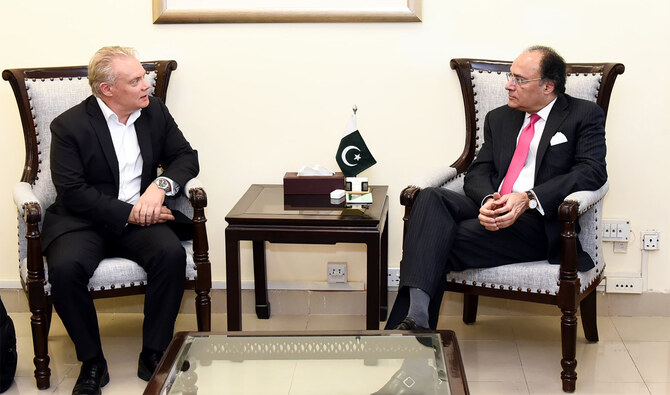
A representative from Finn Fund, Antti Partanen (left), calls on Pakistan's Finance Minister Muhammad Aurangzeb in Islamabad, Pakistan on August 27, 2024. (@Financegovpk/X)
Short Url
Updated 27 August 2024
Follow

Pakistan says committed to improving investment climate as it seeks external financing avenues

  • IMF loan approval depends on “confirmation of necessary financing assurances from development and bilateral partners”
  • Pakistan is also fighting a growing militancy problem which experts say threatens business and investment climate 

ISLAMABAD: Finance Minister Muhammad Aurangzeb on Tuesday reiterated the federal government’s commitment to make Pakistan’s investment climate “favorable and conducive” for foreign investors as the South Asian country struggles to meet external financial needs to get approval for a $7 billion IMF bailout loan and fights a growing militancy problem. 

Last month, Aurangzeb said Pakistan will focus on meeting its external financing needs by speaking with foreign governments and lenders to draw foreign investment as well as seeking loan rollovers. The government is also seeking to focus on more sustainable forms of external financing such as direct investment and climate financing.

Pakistan and the IMF reached an agreement for the 37-month loan program last month. The IMF has said the program is subject to approval from its executive board and obtaining “timely confirmation of necessary financing assurances from Pakistan’s development and bilateral partners.”

On Tuesday, Aurangzeb met Antti Partanen, a representative from Finn Fund, a Finnish development financier, who called on the finance minister in Islamabad. 

“The meeting focused on exploring potential investment opportunities in Pakistan,” Radio Pakistan reported. “The Finance Minister highlighted the government’s focus on transforming Pakistan into an export-led economy and attracting Foreign Direct Investment to enhance the country’s export base.”

Radio Pakistan said Partanen presented an overview of FinnFund’s profile and investment initiatives in Pakistan, emphasizing the firm’s interest in digital infrastructure, renewable energy, agriculture, and forestry.

“He noted that Pakistan’s growing young population makes it an attractive destination for financing and expressed the Fund’s willingness to explore investments in various sectors of the country.”

Aurangzeb has held a flurry of meetings with heads of foreign banks and companies in recent weeks in a push to bring in more investment. Last week he held meetings with top officials of Dubai Islamic Bank and Mashreq Bank to “discuss the economic outlook and explore investment opportunities in Pakistan.”

Pakistan is in talks with Saudi Arabia, the United Arab Emirates and China to meet gross financing needs under the IMF program, Aurangzeb said in July following a trip to China to seek energy sector debt reprofiling.

Rollovers or disbursements on loans from Pakistan’s long-time allies, in addition to financing from the IMF, have helped Pakistan meet its external financing needs in the past.

Tough conditionalities placed by the IMF, such as raising tax on agricultural incomes and lifting electricity prices, have prompted concerns about poor and middle class Pakistanis grappling with rising inflation and the prospect of higher taxes.

Bringing in foreign investors might also become harder as Pakistan’s security situation deteriorates. On Sunday, separatist militants launched several coordinated attacks in the southwestern province of Balochistan, killing over 53 people, including at least 19 soldiers and police. Attacks across the country by religiously motivated groups like the Pakistan Taliban have also been on the rise in recent months. 


Pakistan explores other export markets as potato price slump persists after Afghan border closure

Updated 8 sec ago
Follow

Pakistan explores other export markets as potato price slump persists after Afghan border closure

  • Fierce clashes between Islamabad, Kabul triggered border closures in October 2025, leading to oversupply of potatoes in Pakistan
  • Pakistan produces potatoes in large quantities and exports most of it to Afghanistan, Central Asian countries through its neighbor

ISLAMABAD: The National Food Security Ministry and Research (MNFSR) said on Wednesday that Islamabad is exploring alternative export markets to address the slump in potato prices triggered by the closure of key border passes between Pakistan and Afghanistan. 

Pakistan closed its Chaman and Torkham border crossings with Afghanistan in October 2025 after fierce clashes between both forces left dozens dead. 

The suspension of trade with Afghanistan, a huge market for Pakistani potatoes, has created an oversupply of the vegetable in Pakistan. The prices of potatoes in the country have since then recorded a sharp decline, with Pakistani farmers complaining of heavy losses. 

“To resolve this issue, MNFSR, in collaboration with the Ministry of Foreign Affairs (MoFA) and the Ministry of Commerce, is actively exploring alternative export destinations and trade routes to ensure continuity of exports and market access for Pakistani potatoes,” the food security ministry’s statement said. 

Pakistan exports vegetables, particularly potatoes, a big chunk of which goes to Tajikistan, Kazakhstan, Kyrgyzstan, Turkmenistan, Uzbekistan and beyond via Afghanistan.

The MNFSR said it has directed the commerce ministry to identify foreign importers to facilitate and accelerate potato exports.

“The ministry has identified 36 countries as potential export markets for Pakistani potatoes and has shared the list with exporters,” it said. 

Federal Food Security Minister Rana Tanveer Hussain reaffirmed the government’s commitment to protecting farmers, enhancing Pakistan’s agricultural exports, and ensuring sustainable solutions through market diversification and effective inter-ministerial coordination, the statement added. 

Pakistan’s agriculture sector accounted for 24 percent of the country’s gross domestic product (GDP) and employed more than 37 percent of its labor force in 2024, according to the Economic Survey 2024-25.

Pakistan’s Federal Committee on Agriculture (FCA) targets the production of 8.9 million tons of potatoes during the 2025-26 Rabi crop season that begins in October and lasts till April.

Malik Nusrat Mahmood, a potato trader in Islamabad, told Arab News in December that the wholesale price of a 5-kilogram bag of potatoes had declined by as much as 60 percent to Rs80 (less than a dollar) due to the border closures. 

Landlocked Afghanistan has also leaned more heavily on trade routes via Iran and Central Asia since the border closures last year, as it aims to reduce its dependence on Pakistan amid surging tensions between the neighbors.