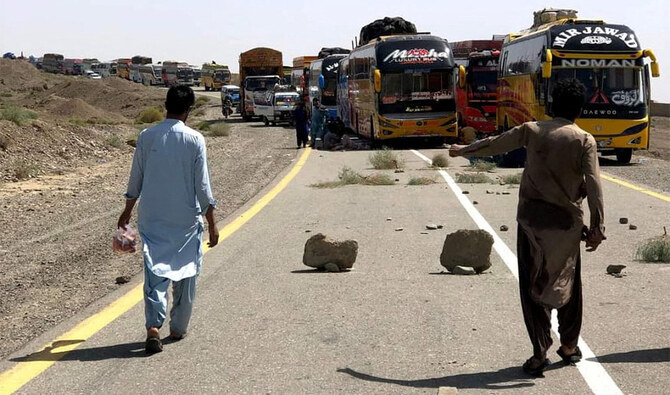

KARACHI: Experts have decried a “major security failure” and warned of a threat to foreign investment in Pakistan after separatist militants launched several coordinated attacks in the southwestern province of Balochistan, killing over 53 people, including at least 19 soldiers and police.
In the most widespread assault by ethnic insurgents in years, militants launched attacks in several districts across Pakistan’s largest but most impoverished province. The attacks included pulling passengers off trucks and buses and killing at least 23, attempting to storm a military camp and a paramilitary Levies station, blowing up a bridge, and blocking roads as well as a major highway connecting Balochistan to other provinces.
Balochistan — a key region bordering Iran and Afghanistan and host to major China-led infrastructure projects such as a strategic port and a gold-copper mine — faces a decades-old separatist insurgency, with ethnic Baloch militants fighting for independence, alleging exploitation of the province’s mineral and gas resources by the central government. The Pakistani state denies this and says it is working for the uplift of the region through various development schemes.
Security experts say the fresh attacks highlighted enhanced strategic planning and tactical capabilities of the Baloch Liberation Army (BLA), the most prominent of the separatist groups, and other armed groups operating in the southwestern province. The BLA, they argue, is getting better at mobilizing fighters in different areas.
“Attacks of this magnitude and nature constitute a major security failure,” Abdul Basit Khan at the S. Rajaratnam School of International Studies in Singapore told Arab News, highlighting that militants “effectively choked” strategic entry points into Balochistan.
“They were able to sustain their activities for at least an entire night.”
The effective blockade of key highways leading to the Sindh and Punjab provinces showed that separatist militants in Balochistan numbered around 4,000 now and their operational capabilities have increased “tremendously,” according to Khan.
He said the attacks would potentially undermine China’s confidence in the capability of Pakistan forces to protect its interests in Balochistan and negatively impact efforts to bring more international investment to Pakistan. The province is home to key mining projects, including Reko Diq, run by mining giant Barrick Gold, and believed to be one of the world’s largest gold and copper mines. China also operates a gold and copper mine in the province and is building a deep sea port at Gwadar as part of the over $60 billion China-Pakistan Economic Corridor.
In the past, the BLA has specifically targeted Chinese interests — in particular the strategic port of Gwadar on the Arabian Sea, accusing Beijing of helping Islamabad exploit the province. It has killed Chinese citizens working in the region and attacked Beijing’s consulate in Karachi.
The BLA showed its muscle when it audaciously stormed army bases in 2022 and then a navy base later that year.
Expanding its traditional use of guerrilla gunmen, it has also recently begun using women suicide bombers, seen in an attack on Chinese nationals on a university campus in Karachi.
The group has since targeted both military and Chinese officials, including launching an attack on Gwadar in March.
The BLA was at the center of tit-for-tat strikes earlier this year between Iran and Pakistan over what they called militant bases on each other’s territory, which brought the two neighbors close to war.
Islamabad says it has struck BLA bases inside Iranian territory from where the militants plotted attacks in Pakistan.
“NOT THE FIRST TIME”
Syed Ali Shah, a Quetta-based journalist covering militancy in Balochistan, said this was not the first time BLA had carried out such coordinated attacks, but agreed they would have a “far-reaching impact” on foreign investments at a time the South Asian country is struggling to meet external financial needs as part of a $7 billion bailout loan that is pending approval by the International Monetary Fund (IMF) executive board.
“It will have an impact on the investors, particularly the Chinese,” Shah said. “For investment, the first condition is peace and security. If such incidents are taking place, as currently a surge is seen in such attacks, it would impact Pakistan’s efforts to attract and secure international investment.”
The latest attacks coincided with the 18th anniversary of the killing of Nawab Akbar Khan Bugti, a prominent Baloch politician and a tribal chief who was killed in a military operation in August 2006, inflaming the insurgency in Balochistan. The province saw major attacks till 2012, followed by a period of relative calm for around seven years when reconciliation efforts resulted in many separatist leaders laying down arms.
“But the militants have again intensified their activities in Balochistan,” Shah said.
The surge in violence also comes amid protests led by young ethnic Baloch against what they describe as a pattern of enforced disappearances and other human rights abuses by security forces, who deny the charge.
The insurgency and the protests continue to keep the mineral rich province of some 15 million people unstable and have created security concerns around Pakistan’s plans to access untapped resources under Balochistan’s desert and mountainous terrain.
Speaking to Arab News, a Pakistani intelligence official who requested anonymity, accused “hostile intelligence agencies,” a veiled reference mostly to India and Afghanistan but also Iran, of conspiring to disrupt investments and development in Balochistan.
“Enemies of peace want to disrupt the stability in Balochistan with agenda-driven moves to sabotage the development projects under CPEC,” he said.
Separatists, he added, wanted to push the province into the “stone age” by destroying roads, highways and other infrastructure.
“On behest of inimical and hostile forces, these cowardly acts of terrorism were aimed at disrupting the peaceful environment and development of Balochistan by targeting mainly the innocent civilians,” the Pakistan army said in a statement on Monday.
“Security forces and law enforcement agencies of Pakistan in step with the nation, remain determined to thwart attempts at sabotaging peace, stability and progress of Balochistan.”