

Denmark to close its embassies in Mali, Burkina Faso

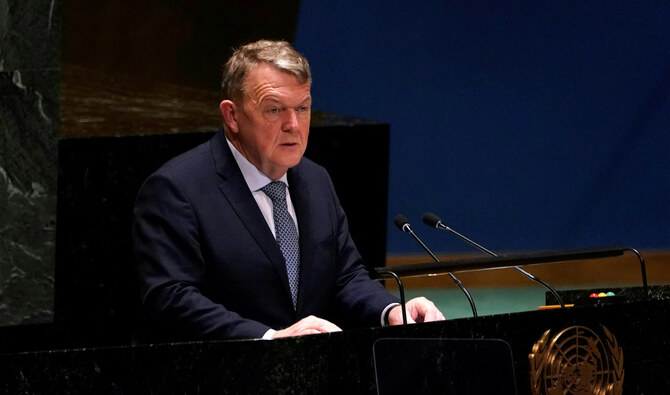
Danish Foreign Minister Lars Loekke Rasmussen speaks during the Eleventh Emergency Special Session of the General Assembly on Ukraine, at UN headquarters in New York City on February 23, 2023. (AFP/File)
Short Url
Updated 27 August 2024
Follow

Denmark to close its embassies in Mali, Burkina Faso

COPENHAGEN: Denmark will close its embassies in Mali and Burkina Faso after a series of military coups over the past few years, the Danish Foreign Ministry said on Monday, as it formally launched a new strategy for its cooperation with the African continent.

Ruled by a military junta since 2020, Mali has been battling ethnic Tuareg rebels in its north alongside Russia’s Wagner mercenary group after it cut military cooperation ties with Western powers including EU countries.

Since then, relations between Mali, Niger and Burkina Faso and Western powers have deteriorated as the three turn to Russia for support.

Frustrations over authorities’ failure to restore security have contributed to coups in Mali and Burkina Faso, which the ministry said had created very limited room for maneuver in the Sahel region.

At the same time, the Danish ministry said it would open embassies in Rwanda, Senegal and Tunisia, and increase its diplomatic workforce in its embassies to Egypt, Kenya, South Africa, Nigeria and Ghana.

Separately, at least 100 villagers and soldiers were killed in central Burkina Faso during a weekend attack on a village by Al-Qaeda-linked terrorists, according to videos of the violence analyzed by a regional specialist, who’s described the assault as one of the deadliest this year in the conflict-battered West African nation.

Villagers in the Barsalogho commune which is 80 kilometers from the capital city were helping security forces dig trenches to protect security outposts and villages on Saturday when fighters with the Al-Qaeda-linked JNIM group invaded the area and opened fire on them, said Wassim Nasr, a Sahel specialist and senior research fellow at the Soufan Center security think tank.

Al-Qaeda claimed responsibility for the attack on Sunday, saying in a statement that it gained “total control over a militia position” in Barsalogho in Kaya, a strategic town security forces have used to fight off terrorists that have over the years tried to close in on the capital, Ouagadougou.


Single ‘digital nation-state’ is not a far-fetched notion, Melania Trump tells UN Security Council

Updated 5 sec ago
Follow

Single ‘digital nation-state’ is not a far-fetched notion, Melania Trump tells UN Security Council

  • US first lady argues that AI and global connectivity could reshape education, help reduce conflict and empower children worldwide
  • Societies rooted in knowledge foster innovation, tolerance and moral reasoning, while those shaped by ignorance risk disorder and conflict, she says

NEW YORK CITY: The idea of a single digital nation-state is “not so far-fetched,” US First Lady Melania Trump told the UN Security Council on Monday.
She argued that artificial intelligence and global connectivity could reshape education, help reduce conflict and empower children worldwide.
The US holds the rotating presidency of the council for March, and as she presided over its first meeting of the month Trump said technology was erasing borders and creating what she described as a shared intellectual future.
“Perhaps this idea isn’t so far-fetched,” she said, pointing to the rise of digital currencies, blockchain-based payment systems, and AI-driven databases she argued were already transforming media and financial markets.
Trump thanked the US’s fellow council members — the UK, France, Russia, China, Greece, the Democratic Republic of Congo, Denmark, Panama, Liberia, Somalia, Colombia, Pakistan, Bahrain and Latvia — for their role in efforts to maintain international security.
The responsibility for preventing conflict “must be applied evenly and should never be carried out lightly,” she said. Her remarks focused in particular on the role of education as the foundation of peace and stability.
“A nation that makes learning sacred protects its books, its language, its science and its mathematics. It protects its future,” Trump said, arguing that societies rooted in knowledge foster innovation, tolerance and moral reasoning, while those shaped by ignorance risk disorder and conflict.
Education is widely recognized as a fundamental human right, she added, yet many children and young adults around the world remain barred from the chance to attend high school or university. The losses arising from this squandered potential, from potential medical breakthroughs to possible advances in food security and technology, are borne not only by the individual countries involved but by humanity as a whole, she said.
Trump called for the expansion of global access to technology to help bridge the digital divide, noting that about 6 billion people, 70 percent of the world’s population, now use mobile devices and the internet.
“If our nations band together, we can close the technological divide,” she said, describing a world in which a farmer on a remote Greek island, a student in Somalia and a resident of New York City can all tap into centuries of accumulated human knowledge.
AI was democratizing access to information once confined to university libraries, she added, and redefining participation in the global “economy of ideas.”
She continued: “Conflict arises from ignorance. Knowledge creates understanding, replacing fear with peace and unity.”
Trump called on council members to safeguard learning and promote access to higher education, urging them to “build a future generation of leaders who embrace peace through education.”
She added: “The path to peace depends on us taking responsibility to empower our children through education and technology.”