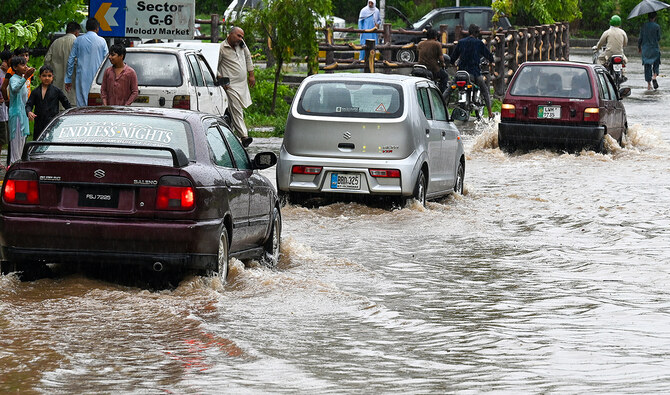
ISLAMABAD: The National Disaster Management Authority (NDMA) on Monday warned of heavy showers and flash floods in Pakistan’s Punjab and Khyber Pakhtunkhwa (KP) provinces over the next two days, urging the masses to exercise caution during this period.
Heavy monsoon rains since July have triggered floods and landslides in many parts of the country, notably Pakistan’s eastern Punjab and northwestern Khyber Pakhtunkhwa (KP) provinces, which have reported the highest number of casualties.
Since July 1, Punjab has reported 92 deaths from rain-related incidents, while KP has reported 74 deaths, according to the NDMA. The Sindh and Balochistan provinces have reported 48 and 21 deaths, respectively.
On Monday, the NDMA said it anticipated more monsoon showers and thunderstorm in most parts of the Punjab and Khyber Pakhtunkhwa provinces from August 26 to August 28.
“Heavy downpour may cause urban flooding in low lying areas of Islamabad/Rawalpindi, Gujranwala, Lahore, Sheikhupura, Kasur, Sialkot, Sargodha, Faisalabad, Multan districts of Punjab and increase in flows are expected in major nullah/streams of the Swat, Dir, Mardan, Kohistan, Buner, Galliyat, Peshawar, Swabi, Kohat, Karak, Lakki Marwat, Mansehra, Batagram, Kohat, Orakzai, Khyber, D.I. Khan districts of Khyber Pakhtunkhwa,” it said in a statement.
“Heavy downpour/windstorm and lightning may affect daily routines, weak structures like roof/wall collapse of Kacha houses, electric poles, billboards, vehicles and solar panels etc during the period.”
The NDMA urged local administrations and public to take necessary precautions to mitigate potential impact of flash and urban flooding. It asked relevant departments to alert emergency response teams and mobilize resources to ensure a swift response to any emergency situation.
“Tourists and travelers are advised to avoid traveling to these areas during forecast period,” the NDMA said. “The public is advised to remain vigilant and follow instructions from local authorities.”
Pakistan is recognized as one of the most vulnerable countries to climate change effects in the world. This year, the South Asian country recorded its “wettest April since 1961,” with 59.3 millimeters of rainfall while some areas of the country faced a heat wave in May and June.
In 2022, unusually heavy rains triggered flash floods in many parts of the country, killing over 1,700 people, inflicting losses of around $30 billion, and affecting at least 30 million people.
Scientists have attributed Pakistan’s erratic weather patterns to climate change effects and called on countries around the world to take urgent steps to tackle the crisis.


![]()

Authorities warn of heavy rains, flash floods in Pakistan’s Punjab, Khyber Pakhtunkhwa
Short Url
https://arab.news/5wwuu
Authorities warn of heavy rains, flash floods in Pakistan’s Punjab, Khyber Pakhtunkhwa
- People have been advised to exercise caution and avoid unnecessary travel over the next few days
- Torrential rains in Pakistan have killed 243 people and injured 447 since July 1, official data shows
Latest updates


© 2026 SAUDI RESEARCH & PUBLISHING COMPANY, All Rights Reserved And subject to Terms of Use Agreement.