

Pakistani sixth-grader builds AI assistant robot called Muhammad Ali 

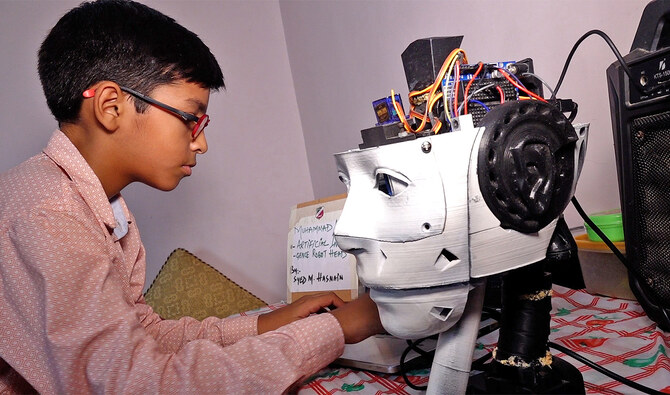
Pakistani sixth-grader Muhammad Hasnain is seen writing a command for his AI assistant in Karachi, Pakistan on August 24, 2024. (AN photo)
Short Url
Updated 26 August 2024
Follow

Pakistani sixth-grader builds AI assistant robot called Muhammad Ali 

  • 11-year-old’s robot operates home appliances, plays films, does online searches following voice commands
  • Hasnain pursued his passion for robotics and game development at free training program at Karachi institute 

KARACHI: Muhammad Hasnain typed for a brief moment on his laptop, then asked a question out loud:

“Muhammad Ali, what is Arab News?”

A blue-eyed robot, so far a white head with a mesh of wires for hair, spoke back in a computer-generated voice:

“Arab News is a Saudi English language daily newspaper. It covers news and events in Saudi Arabia, the Middle East and around the world.”

Ask Muhammad Ali how to make biryani or fix a piping hot cup of tea and he’ll have an answer. He can also operate home appliances, play movies or do online searches following a voice command. 
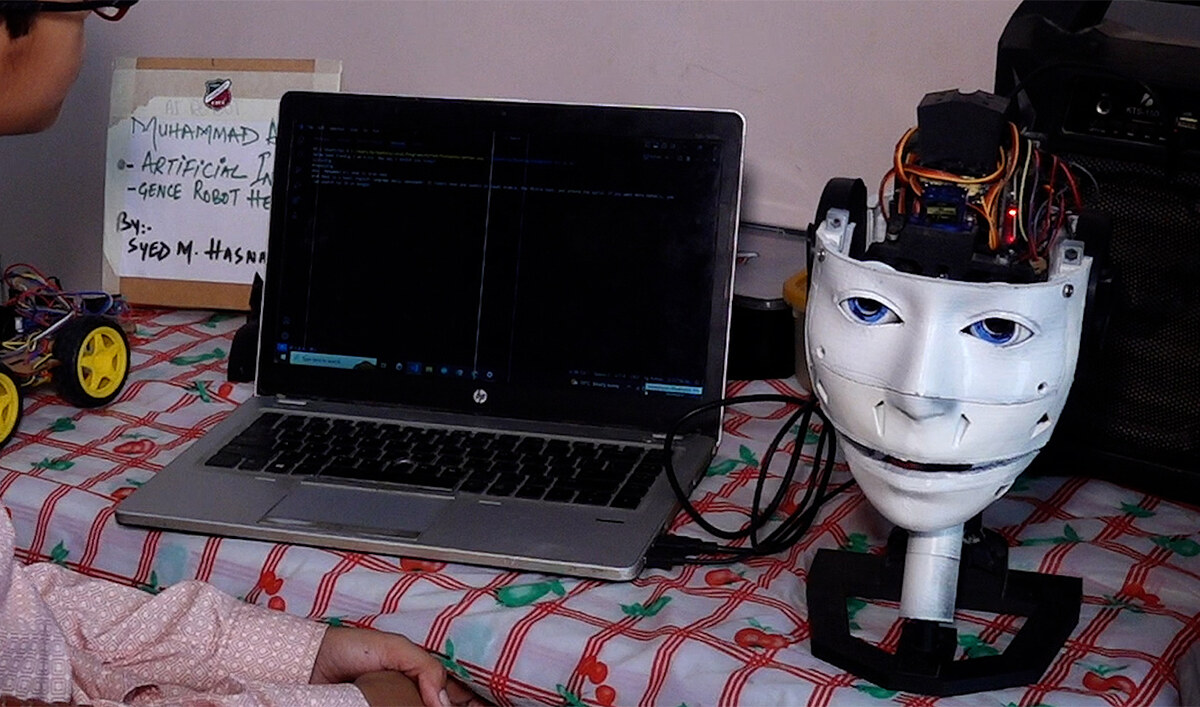


The picture taken on August 24, 2024, shows an AI assistant robot created a Pakistani sixth-grader Muhammad Hasnain in Karachi, Pakistan. (AN photo)

He was created by Hasnain, an 11-year-old who recently passed the sixth grade and built the AI assistant as part of a summer project for a free training course in robotics he attended in his hometown of Karachi. 

“This is an AI assistant robot and its name is Muhammad Ali,” Hasnain told Arab News at his home this month. “This AI has a personality [and] a face so you feel like you are talking to a person.”

“It has some extra features such as home automation through which it can control home appliances or open [search] anything on your command. Apart from that, it is also an assistant for me, so if I am making some other projects, it can be helpful there too.”

The tweener’s obsession with science and technology began when he was very young but it was in 2022 that he made a Bluetooth-powered car as a summer project, followed by a virtual reality game in 2023. 

Now, Hasnain has built Muhammad Ali, who he says is different from other AI chatbots because he has a “personality and a face.”

There is “something missing” in leading AI chatbots such as GPT, Gemini and Claude, the boy said. 

“What today’s AI lacks is personality, it looks like there is a robot stuck in your smartphone who can talk to you via texts. Some have a voice feature too. This one has a personality [and] a face.”

Hasnain says the robot is a Muslim and a Pakistani, and its main goal was to be “kind and helpful.”

“When it was under development and just the eyes were created, he knew about that too,” Hasnain said. “He knows what’s going on around him.”

Hasnain’s father Syed Faraz Haider said his child had always been inclined toward interests that were “unusual” for his age.

“He was extraordinary in terms of his learning capabilities since he was very young,” Haider told Arab News. 

“His memory was very sharp. Once you tell him something, [he will not forget it],” he added, describing how Hasnain was able to read entire chapters and write them down from memory.

Hasnain’s teacher Shakeel Abbas, who runs the institute where he enrolled in the robotics class, said he had helped him procure the equipment for the robot but the rest was all him.

“The entire idea and coding has been done by Hasnain,” Abbas said. “We initially provided the guidelines and training for the courses. He is self-sufficient now.”

In the future, Hasnain wants to pursue a career in robotics and game development, he said. He also hopes to give his robot, for now just a head full of wires, a full body. He is also planning a virtual reality project for next year. 

“I would want to add a camera to it [Ali] so he knows who he is talking to,” Hasnain said. “Or create his entire body, that will be a great task to take up.”


Pakistan offers Kyrgyzstan Arabian Sea access as two states sign 15 cooperation accords

Updated 05 December 2025
Follow

Pakistan offers Kyrgyzstan Arabian Sea access as two states sign 15 cooperation accords

  • Pakistan and Kyrgyzstan sign MOUs spanning trade, energy, agriculture, ports, education, security cooperation
  • Kyrgyz president is on first visit to Pakistan in 20 years as both sides push connectivity and CASA-1000 power links

ISLAMABAD: Pakistan on Thursday offered Kyrgyzstan the shortest and most economical route to the Arabian Sea as the two countries signed 15 agreements and memoranda of understanding aimed at boosting cooperation across trade, energy, agriculture, education, customs data-sharing and port logistics.

The accords were signed during a visit to Islamabad by President Sadyr Zhaparov, the first by a Kyrgyz head of state to Pakistan in two decades, and part of Islamabad’s renewed push to link South Asia with landlocked Central Asian economies through ports, power corridors and transport routes.

For Pakistan, Kyrgyzstan offers access to hydropower through CASA-1000, a $1.2 billion regional electricity transmission project designed to carry surplus summer electricity from Kyrgyzstan and Tajikistan through Afghanistan into Pakistan. For Bishkek, Pakistan provides overland access to warm-water ports on the Arabian Sea, creating a shorter commercial route to global markets.

“President Asif Ali Zardari has reiterated Pakistan’s readiness to offer Kyrgyzstan the shortest and most economical route to the Arabian Sea,” Radio Pakistan reported after Zhaparov met the Pakistani president. 

The two leaders also discussed expanding direct flights to deepen business, tourism and people-to-people ties.

Zardari welcomed Kyrgyzstan’s completion of its segment of the CASA-1000 project and “reaffirmed Pakistan’s commitment to completing its part of the project, which is now at an advanced stage,” the state broadcaster said. 

Zhaparov thanked Islamabad for supporting Bishkek’s candidacy for a non-permanent UN Security Council seat and invited Zardari to visit Kyrgyzstan at a time of his convenience. Both sides expressed satisfaction with progress under the Quadrilateral Traffic in Transit Agreement, designed to facilitate road movement between Pakistan, Kyrgyzstan, Kazakhstan and China.

Earlier, both governments exchanged 15 sectoral cooperation documents covering commerce, mining, geosciences, power, agriculture, youth programs, the exchange of convicted persons, customs electronic data systems and a sister-city linkage between Islamabad and Bishkek.

According to APP, the MOUs were signed by ministers representing foreign affairs, commerce, economy, energy, power, railways, interior, culture, health and tourism. Agreements also covered cooperation between Pakistan’s Foreign Service Academy and the Diplomatic Academy of Kyrgyzstan, as well as collaboration between universities, youth ministries and cultural institutions.

“Our present mutual trade, comprising of about $15–16 million will be enhanced to $200 million in the next two years,” Prime Minister Shehbaz Sharif said after the agreements were signed, calling them “a framework for structured, result-oriented engagement and closer institutional linkages.”

Sharif said Pakistan was ready to serve as a maritime outlet for the landlocked Central Asian republic, offering access to Karachi, Port Qasim and Gwadar to help Kyrgyz goods reach regional and global markets.