


No agreement in Gaza ceasefire talks in Cairo, but US national security adviser says work continues

1 / 2
White House national security adviser Jake Sullivan speaks during a press briefing at the White House, in Washington. (AP file photo)
2 / 2
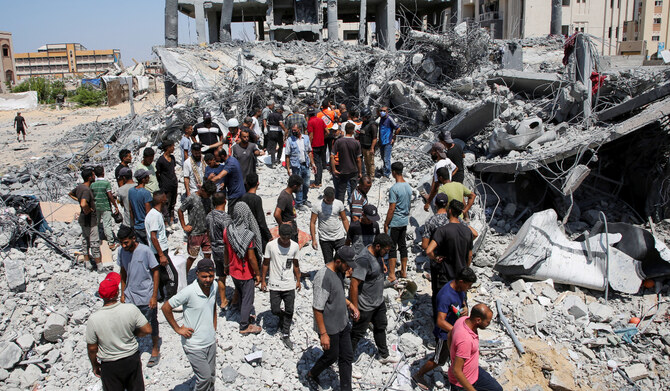
Palestinians inspect damage in Qatari-funded Hamad City, following an Israeli raid, amid the ongoing conflict between Israel and Hamas, in Khan Younis, in the southern Gaza Strip, August 24, 2024. (REUTERS)
Short Url
Updated 26 August 2024
Follow

No agreement in Gaza ceasefire talks in Cairo, but US national security adviser says work continues

  • Mediators put forward a number of alternatives to the presence of Israeli forces on the Philadelphi Corridor and the Netzarim Corridor which cuts across the middle of the Gaza Strip, but none were accepted by the parties, Egyptian sources said

CAIRO/WASHINGTON: There was no agreement on Sunday in the Gaza ceasefire talks that took place in Cairo, with neither Hamas nor Israel agreeing to several compromises presented by mediators, two Egyptian security sources said, casting doubt on the chances of success in the latest US-backed effort to end the 10-month old war.
A senior US official, however, described the talks as “constructive,” saying they were conducted in a spirit on all sides to reach “a final and implementable agreement.”
“The process will continue over the coming days through working groups to further address remaining issues and details,” said the official, speaking on the condition of anonymity, adding that the teams would remain in Cairo.
Months of on-off talks have failed to produce an agreement to end Israel’s devastating military campaign in Gaza or free the remaining hostages seized by Hamas in the militant group’s Oct. 7 attack on Israel that triggered the war.
Speaking at a news conference in Halifax, Canada, US National Security Adviser Jake Sullivan said Washington was still “feverishly” working in Cairo to get a ceasefire and a hostage deal.
Key sticking points in ongoing talks mediated by the United States, Egypt and Qatar include an Israeli presence in the so-called Philadelphi Corridor, a narrow 14.5-km-long (9-mile-long) stretch of land along Gaza’s southern border with Egypt.
Mediators put forward a number of alternatives to the presence of Israeli forces on the Philadelphi Corridor and the Netzarim Corridor which cuts across the middle of the Gaza Strip, but none were accepted by the parties, Egyptian sources said.
Israel also expressed reservations on several of the Palestinian detainees Hamas is demanding the release of, and Israel demanded their exit of Gaza if they are released, the sources added.
There has been much back and forth between the teams from Israel, the United States and Egypt since Thursday to narrow the remaining gaps, the senior US official said, in preparation for Saturday, when Qatar and Egypt met with senior representatives of Hamas to walk through the proposal in detail.
On Sunday, senior officials from Israel joined the talks to address outstanding issues with the support of mediators, the senior US official said but did not provide a definitive assessment on whether there was a breakthrough or not.
Hamas said Israel has backtracked on a commitment to withdraw troops from the Corridor and put forward other new conditions, including the screening of displaced Palestinians as they return to the enclave’s more heavily populated north when the ceasefire begins.
“We will not accept discussions about retractions from what we agreed to on July 2 or new conditions,” Hamas official Osama Hamdan told the group’s Al-Aqsa TV on Sunday.
In July, Hamas accepted a US proposal to begin talks on releasing Israeli hostages, including soldiers and men, 16 days after the first phase of an agreement aimed at ending the Gaza war, a senior Hamas source has told Reuters.
A Hamas delegation left Cairo on Sunday after holding talks with mediators, senior official Izzat El-Reshiq said, adding that the group had reiterated its demand that any agreement must stipulate a permanent ceasefire and a full Israeli withdrawal from Gaza.


Deadly attacks by Sudanese paramilitary forces on a Darfur town displace over 3,000, group says

Updated 2 sec ago
Follow

Deadly attacks by Sudanese paramilitary forces on a Darfur town displace over 3,000, group says

  • Misteriha is a stronghold of Arab tribal leader Musa Hilal, who also hails from the Rizeigat Arab tribe as do the majority of the members of the RSF
  • In October, the RSF overran el-Fasher, the provincial capital of North Darfur, after 18 months of siege
CAIRO: Deadly attacks by Sudanese paramilitary forces on a town in Sudan’s western Darfur region have displaced more than 3,000 people in the past few days, a doctors group said Thursday as the war in the African country nears its three-year mark with no end in sight.
The statement from the Sudan Doctors Network, which tracks the country’s brutal war, followed a statement earlier this week on Facebook in which the group said that the latest attack on Misteriha in North Darfur province left at least 28 people dead and 39 wounded.
The group said at the time the casualty tolls were an initial finding and that the real number of killed and wounded is likely higher.
The town is a stronghold of Arab tribal leader Musa Hilal who also hails from the Rizeigat Arab tribe as the majority of the members of the paramilitary Rapid Support Forces, or RSF. Motives for the attack were not known and the RSF could not be contacted for comment.
The conflict between the RSF and the Sudanese military erupted into war in April 2023 that has so far killed at least 40,000 people and displaced 12 million, according to the World Health Organization. Aid groups say the true toll could be many times higher, as the fighting in vast and remote areas impedes access.
The doctors group said the displaced families fled from Misteriha in the night, without any belongings and now lack shelter and food. It said most of the displaced are women, including pregnant women, facing “extremely severe” health conditions. It appealed for “immediate and urgent assistance.”
The paramilitary RSF on Monday intensified their attack on the town and subsequently seized it, a takeover that is likely to strengthen the RSF fighters’ hold over Darfur.
In October, the RSF overran el-Fasher, the provincial capital of North Darfur, after 18 months of siege. The paramilitary killed more than 6,000 people between Oct. 25 and Oct. 27 in the city — atrocities that UN-backed experts say bore ” the hallmarks of genocide.”
Meanwhile, UN High Commissioner for Human Rights Volker Türk said Thursday that his office has documented a sharp spike — more than two and a half times — in killings of civilians in 2025 in Sudan, compared with the previous year with thousands still missing or unidentified.
“This war is ugly. It’s bloody. And it’s senseless,” Türk said during a human rights council session in Geneva. “If much of the international community continues to act as a passive bystander, then something is fundamentally wrong with our collective moral compass.”
Repeated efforts by various countries and organizations to broker peace have failed to end the war.