PESHAWAR: The health department in Pakistan’s northwestern Khyber Pakhtunkhwa (KP) province has set up isolation wards at several hospitals for patients with mpox symptoms, officials said on Sunday, days after authorities confirmed two cases in the region.
The mpox virus is primarily found in Central and West Africa, where it is transmitted from animals, such as rodents and primates, to humans. Human-to-human transmission can occur through direct contact with body fluids, respiratory droplets or contaminated materials like bedding. The disease is characterized by fever, swollen lymph nodes and a distinctive rash.
In the past week, health authorities confirmed two mpox cases in Khyber Pakhtunkhwa, saying that both the patients had a travel history. One of the infected individuals belonged to the Mardan district and was isolated at home, while the other hailed from Nowshera and had been under treatment at the Police Service Hospital [PSH] for the last four days.
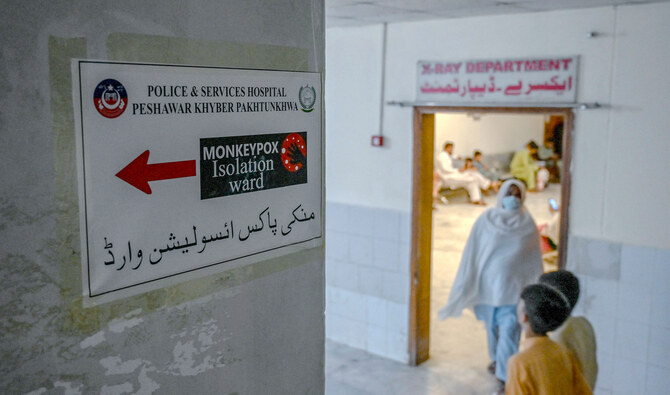
No one is allowed to go inside the isolation ward at the PSH, however, the hospital management granted special permission to Arab News to visit the ward, following standard operating procedures (SOPs).
“The patient admitted here right now is stable. He was screened from airport so [he] came to our hospital, our hospital is isolated for mpox disease,” Dr. Abrash Khan, medical officer at the PSH, told Arab News, without disclosing the identity of the person as per the protocols.
“He has no fever and he has no throat infection, but he has a rash on the body and that is the typical sign of mpox.”
Provincial authorities have been on an alert since KP reported two cases of the virus. Isolation wards have been established at various medical teaching institutes, including Lady Reading Hospital, Khyber Teaching Hospital, Hayatabad Medical Complex and Qazi Medical Complex, to prevent the disease’s spread.
“As per the capacity of each Medical Teaching Institute [MTI], isolation wards have been established,” KP health department spokesman Attaullah Khan told Arab News over the phone. “Isolation wards and beds have [also] been allocated for mpox patients at District Headquarter Hospitals [DHQs], including in merged or tribal districts.”
The health department spokesman said authorities had toughened up the screening process at airports and border crossings since the two infected individuals had a travel history.
“Screening has been going on 24/7 at the airports and border crossings,” he said. “More than 12,000 individuals have been scanned at the airport and more than 7,000 have been screened at the Torkham border crossing over one week.”


![]()

Pakistan’s Khyber Pakhtunkhwa sets up isolation wards after authorities confirm two mpox cases
Short Url
https://arab.news/26yby
Pakistan’s Khyber Pakhtunkhwa sets up isolation wards after authorities confirm two mpox cases
- The two cases reported in Khyber Pakhtunkhwa’s Mardan and Nowshera districts had a travel history
- Official says they have toughened up screening at airports and border crossings to prevent virus spread
Latest updates





© 2026 SAUDI RESEARCH & PUBLISHING COMPANY, All Rights Reserved And subject to Terms of Use Agreement.