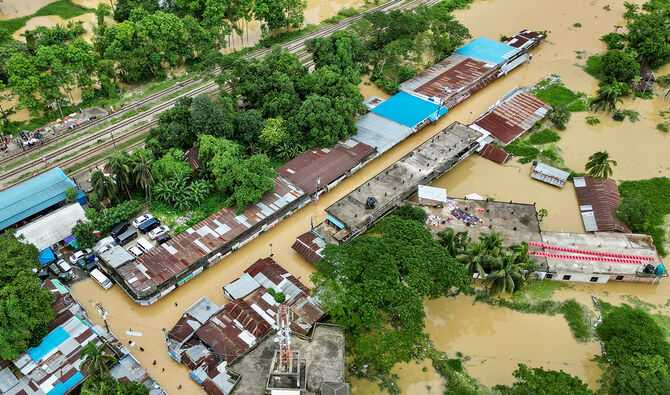
FENI, Bangladesh: River waters in low-lying Bangladesh are receding after days of deadly floods but 300,000 people are still in emergency shelters requiring aid, disaster officials said Sunday.
The heavy floods, which killed at least 18 people in Bangladesh, have added to the challenges of a new government who took charge early this month after a student-led revolution.
Rescue teams — including joint forces of the army, air force and navy — are helping those forced from their homes and bringing aid to those who have lost all, said Faruk-e-Azam, the disaster management minister.
“The flood situation is improving as the flood water started to recede,” Azam told AFP.
More than 307,000 people are in shelters and more than 5.2 million have been affected by the floods, the ministry said.
“Now we are working to restore communication in the affected areas so that we can distribute relief food,” Azam added.
“We are also taking steps so that contagious diseases don’t spread.”
It adds to the woes of a nation still reeling from weeks of political turmoil, which culminated in the toppling of autocratic leader Sheikh Hasina, who fled to India by helicopter.
With an interim government led by Nobel Peace Prize laureate Muhammad Yunus still finding its feet, ordinary Bangladeshis have been crowdfunding relief efforts.
Highways and rail lines were damaged between the capital Dhaka and the main port city of Chittagong, making access to badly flooded districts difficult and disrupting business activity.
Monsoon rains cause widespread destruction yearly, but climate change is shifting weather patterns and increasing the number of extreme weather events.
The nation of 170 million people is crisscrossed by hundreds of rivers and has seen frequent floods in recent decades.
Much of the country is made up of deltas where the Himalayan rivers the Ganges and the Brahmaputra wind toward the sea after coursing through India.
It is among the countries most vulnerable to disasters and climate change, according to the Global Climate Risk Index.
Floods across the border in upstream India have also left a trail of destruction, with at least 24 people have been killed in Tripura state since Monday.


![]()

Floods ease in Bangladesh but 300,000 still in shelters
Short Url
https://arab.news/w4q8h
Floods ease in Bangladesh but 300,000 still in shelters
- Heavy floods which have killed 18 have added to challenges of new government in the country
- Highways and rail lines between capital Dhaka and main port city of Chittagong remain damaged
Latest updates


Recommended


© 2026 SAUDI RESEARCH & PUBLISHING COMPANY, All Rights Reserved And subject to Terms of Use Agreement.