

Pakistan forecasts torrential monsoon rains till Aug. 29 as downpours kill 243 since July 

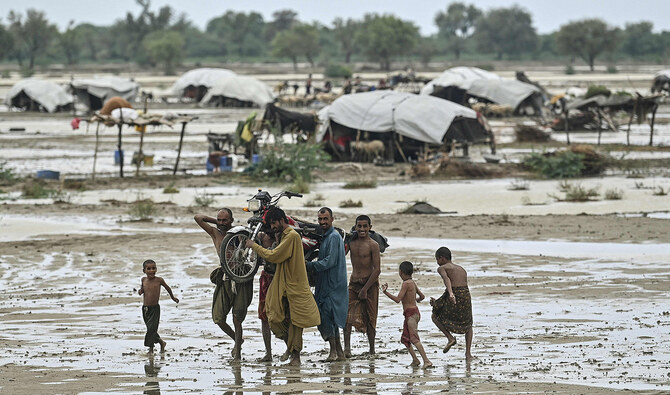
In this photograph taken on August 4, 2024, people carrying a motorcycle, walk across an agricultural land following rain in the aftermath of monsoon floods at Johi, Dadu district in Sindh province. (AFP/File)
Short Url
Updated 25 August 2024
Follow

Pakistan forecasts torrential monsoon rains till Aug. 29 as downpours kill 243 since July 

  • Met department warns of floods in low-lying areas of Sindh, Balochistan and Punjab
  • Pakistan is recognized as one of the most vulnerable countries to climate change effects

ISLAMABAD: The Pakistan Meteorological Department (PMD) this week forecast torrential rains in many parts of the country till Aug. 29, warning they could trigger flash floods and landslides as the nationwide death toll from rain-related incidents since July surged to 243. 

In a press release issued on Friday, the PMD said a low pressure located over west Bengal may approach southern parts of the country on Aug. 25 due to which strong monsoon currents are likely to enter the country, especially its southern parts, from Aug. 25.

“Pluvial flood/inundation may occur in low-lying areas of Sindh, Balochistan and southern Punjab,” the PMD said. 

As per the latest situation report released by the National Disaster Management Authority (NDMA), 243 people have been killed while 447 have been injured in rain-related incidents across the country from Jul. 1-Aug. 24. 

The PMD said it expects rain and thundershowers in Karachi, Hyderabad, Dadu, Thatta, Badin, Sajawal, Shahed Benazirabad, Jamshoro, Tando Allayar, Tando Muhammad Khan, Tharparkar, Nagarparkar, Mithi, Mirpur Khas, Umarkot, Matiari, Sanghar, Sukkur, Ghotki, Shikarpur, Kashmore, Khairpur, Larkana, Jacobabad and Nausheroferoze areas in Sindh from Aug. 25-29 with occasional gaps. 

Meanwhile, it said rain and thundershowers are also expected to take place in Islamabad/Rawalpindi, Murree, Galliyat, Attock, Chakwal, Tala Gang, Jhelum, Mandi Bahauddin, Gujrat, Gujranwala, Hafizabad, Wazirabad, Sahiwal, Jhang, Toba Tek Singh, Nankana Sahib, Chiniot, Faisalabad, Lahore, Sheikhupura, Sialkot, Narowal and Okara areas of Punjab from Aug. 25-28. 

From Aug. 26-30, it said rain and thundershowers are expected in Khuzdar, Kalat, Lasbella, Awaran, Naseerabad, Sibbi, Jaffarbad, Kohlu, Harnai, Dera Bugti, Zhob, Quetta, Ziarat, Sherani, Qila Abdullah, Qila Saifullah, Barkhan, Musa Khel, Loralai, Mastung, Bolan, Jhal Magsi, Kech, Panjgur, Gwadar, Jiwani, Pasni and Ormara in the southwestern Balochistan province. 

The weather department said that rains and thundershowers were also expected to take place in Chitral, Dir, Swat, Kohistan, Malakand, Shangla, Battagram, Buner, Kohat, Bajaur, Mohmand, Khyber, Mansehra, Abbottabad, Haripur, Peshawar, Swabi, Nowshera, Mardan, Charsadda, Hangu, Kurram, Orakzai, Waziristan, Bannu, Lakki Marwat and Dera Ismail Khan areas of the northwestern Khyber Pakhtunkhwa province from Aug. 26-28. 

Pakistan is recognized as one of the most vulnerable countries to climate change effects. This year, the South Asian country recorded its “wettest April since 1961,” with 59.3 millimeters of rainfall while some areas of the country faced a severe heat wave in May and June.
In 2022, unusually heavy rains triggered flash floods in many parts of Pakistan, killing over 1,700 people, inflicting losses of around $30 billion, and affecting at least 30 million people. Scientists have attributed Pakistan’s erratic weather patterns to climate change effects and called on countries around the world to take urgent steps to tackle the crisis.


Pakistan reports current account surplus in Jan. owing to improved trade, remittances

Updated 17 February 2026
Follow

Pakistan reports current account surplus in Jan. owing to improved trade, remittances

  • Pakistan’s exports crossed the $3 billion mark in Jan. as the country received $3.5 billion in remittances
  • Last month, IMF urged Pakistan to accelerate pace of structural reforms to strengthen economic growth

ISLAMABAD: Pakistan recorded a current account surplus of more than $120 million in January, the country’s finance adviser said on Tuesday, attributing it to improved trade balance and remittance inflows.

Pakistan’s exports rebounded in January 2026 after five months of weak performance, rising 3.73 percent year on year and surging 34.96 percent month on month, according to data released by the country’s statistics bureau.

Exports crossed the $3 billion mark for the first time in January to reach $3.061 billion, compared to $2.27 billion in Dec. 2025. The country received $3.5 billion in foreign remittances in Jan. 2026.

Khurram Schehzad, an adviser to the finance minister, said Pakistan reported a current account surplus of $121 million in Jan., compared to a current account deficit of $393 million in the same month last year.

“Improved trade balance in January 2026, strong remittance inflows, and sustained momentum in services exports (IT/Tech) continue to reinforce the country’s external account position,” he said on X.

Pakistan has undergone a difficult period of stabilization, marked by inflation, currency depreciation and financing gaps, and international rating agencies have acknowledged improvements after Islamabad began implementing reforms such as privatizing loss-making, state-owned enterprises (SOEs) and ending subsidies as part of a $7 billion International Monetary Fund (IMF) loan program.

Late last month, the IMF urged Pakistan to accelerate the pace of these structural reforms to strengthen economic growth.

Responding to questions from Arab News at a virtual media roundtable on emerging markets’ resilience, IMF’s director of the Middle East and Central Asia Jihad Azour said Islamabad’s implementation of the IMF requirements had been “strong” despite devastating floods that killed more than 1,000 people and devastated farmland, forcing the government to revise its 4.2 percent growth target to 3.9 percent.

“What is important going forward in order to strengthen growth and to maintain the level of macroeconomic stability is to accelerate the structural reforms,” he said at the meeting.

Azour underlined Pakistan’s plans to privatize some of the SOEs and improve financial management of important public entities, particularly power companies, as an important way for the country to boost its capacity to cater to the economy for additional exports.

“This comes in addition to the effort that the authorities have made in order to reform their tariffs, which will allow the private sector of Pakistan to become more competitive,” the IMF official said.