

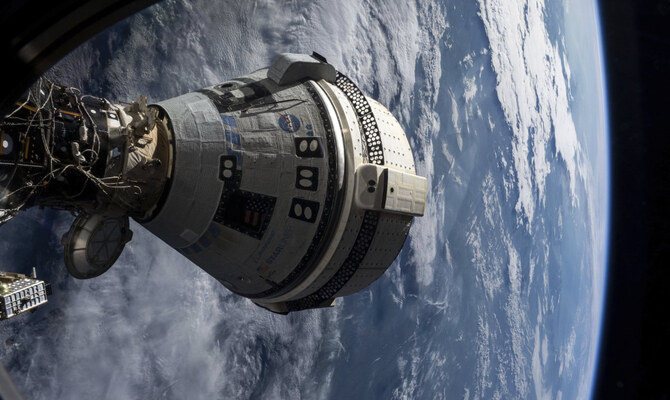

NASA’s announcement Saturday that it won’t use a troubled Boeing capsule to return two stranded astronauts to Earth is a yet another setback for the struggling company, although the financial damage is likely to be less than the reputational harm.
Once a symbol of American engineering and technological prowess, Boeing has seen its reputation battered since two 737 Max airliners crashed in 2018 and 2019, killing 346 people. The safety of its products came under renewed scrutiny after a panel blew out of a Max during a flight this January.
And now NASA has decided that it is safer to keep the astronauts in space until February rather than risk using the Boeing Starliner capsule that delivered them to the international space station. The capsule has been plagued by problems with its propulsion system.
NASA administrator Bill Nelson said the decision to send the Boeing capsule back to Earth empty “is a result of a commitment to safety.” Boeing had insisted Starliner was safe based on recent tests of thrusters both in space and on the ground.
The space capsule program represents a tiny fraction of Boeing’s revenue, but carrying astronauts is a high-profile job — like Boeing’s work building Air Force One presidential jets.
“The whole thing is another black eye” for Boeing, aerospace analyst Richard Aboulafia said. “It’s going to sting a little longer, but nothing they haven’t dealt with before.”
Boeing has lost more than $25 billion since 2018 as its aircraft-manufacturing business cratered after those crashes. For a time, the defense and space side of the company provided a partial cushion, posting strong profits and steady revenue through 2021.
Since 2022, however, Boeing’s defense and space division has stumbled too, losing $6 billion — slightly more than the airplane side of the company in the same period.
The results have been dragged down by several fixed-price contracts for NASA and the Pentagon, including a deal to build new Air Force One presidential jets. Boeing has found itself on the hook as costs for those projects have risen far beyond the company’s estimates.
The company recorded a $1 billion loss from fixed-price government contracts in the second quarter alone, but the problem is not new.
“We have a couple of fixed-price development programs we have to just finish and never do them again,” then-CEO David Calhoun said last year. “Never do them again.”
In 2014, NASA awarded Boeing a $4.2 billion fixed-price contract to build a vehicle to carry astronauts to the International Space Station after the retirement of space shuttles, along with a $2.6 billion contract to SpaceX.
Boeing, with more than a century of building airplane and decades as a NASA contractor, was seen as the favorite. But Starliner suffered technical setbacks that caused it to cancel some test launches, fall behind schedule and go over budget. SpaceX won the race to ferry astronauts to the ISS, which it accomplished in 2020.
Boeing was finally ready to carry astronauts this year, and Butch Wilmore and Suni Williams launched aboard Starliner in early June for what was intended to be an 8-day stay in space. But thruster failures and helium leaks led NASA to park the vehicle at the space station while engineers debated how to return them to Earth.
The company said in a regulatory filing that the latest hitch with Starliner caused a $125 million loss through June 30, which pushed cumulative cost overruns on the program to more than $1.5 billion. “Risk remains that we may record additional losses in future periods,” Boeing said.
Aboulafia said Starliner’s impact on Boeing business and finances will be modest — “not really a needle-mover.” Even the $4.2 billion, multi-year NASA contract is a relatively small chunk of revenue for Boeing, which reported sales of $78 billion last year.
And Aboulafia believes Boeing will enjoy a grace period with customers like the government now that it is under new leadership, reducing the risk it will lose big contracts. NASA administrator Nelson said Saturday he was “100 percent” confident that the Starliner will fly with a crew again.
Robert “Kelly” Ortberg replaced Calhoun as CEO this month. Unlike the company’s recent chief executives, Ortberg is an outsider who previously led aerospace manufacturer Rockwell Collins, where he developed a reputation for walking among workers on factory floors and building ties to airline and government customers.
“They are transitioning from perhaps the worst executive leadership to some of the best,” Aboulafia said. “Given the regime change underway, I think people are going to give them some slack.”
Boeing’s defense division has recently won some huge contracts. It is lined up to provide Apache helicopters to foreign governments, sell 50 F-15 fighter jets to Israel as the bulk of a $20 billion deal, and build prototype surveillance planes for the Air Force under a $2.56 billion contract.
“Those are some strong tailwinds, but it’s going to take a while before they get (Boeing’s defense and space business) back to profitability,” Aboulafia said.


