

What We Are Reading Today: ‘Why We Sleep’

Photo/Supplied
Short Url
Updated 24 August 2024
Follow

What We Are Reading Today: ‘Why We Sleep’

  • He elaborates on the latest research data on sleep functions, revealing how it can enhance memory, strengthen the immune system and improve innovative thinking

Author: Matthew Walker

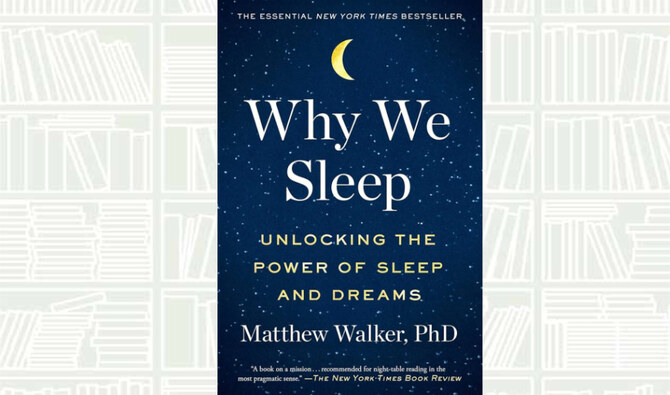
In “Why We Sleep,” Matthew Walker discusses the significant role of sleep in our physical and mental health.

Writing about the results of decades of research, Walker, a professor of neuroscience and psychology at the University of California and director of the San Francisco Center for Human Sleep Science, reflects on common myths about sleep and makes appealing arguments for its importance.

The spread of sleep deprivation in modern life has become alarming. Many people may not be aware of its long-term consequences, which is one of the main ideas that Walker emphasizes in this book.

He presents scientific evidence explaining how chronic sleep loss leaves devastating impacts not only on health but also our on cognitive function and longevity.

From the risk of developing serious health issues such as cancer to the lack of ability to make decisions and emotional regulation, he argues that people should not neglect the need to sleep.

Walker’s ability to translate complex concepts into understandable, compelling stories is impressive; whether explaining the complex neural mechanisms underlying sleep or the fascinating evolutionary history of the sleep-wake cycle, his writing style is clear, effective and engaging.

He also elaborates on the latest research data on sleep functions, revealing how it can enhance memory, strengthen the immune system and improve innovative thinking.

Walker also sheds light on the mysterious world of dreams, suggesting that they might play a major role in emotional processing and problem-solving.  

By emphasizing the vital importance of sleep in our lives, Walker encourages his readers to prioritize this important aspect of their health.

Whether you are a sleep-deprived student, a busy employee, or someone interested in the depth of the human mind, “Why We Sleep” is informative and helpful.


What We Are Reading Today: ‘A Love Story from the End of the World’

Photo/Supplied
Updated 17 January 2026
Follow

What We Are Reading Today: ‘A Love Story from the End of the World’

Author: Juhea Kim

Juhea Kim’s 2024 climate fiction work “A Love Story from the End of the World,” turns the climate catastrophe inward, offering ten stories where environmental collapse is felt in the fragile interiors of the human experience.

The short stories in this book imagine a familiar world where ecological collapse is a lived reality. Global cities are sealed inside domes to survive toxic air. Humans drift across ruined landscapes on mobile arks. Islands become landfills for the waste of richer nations. 

Yet Kim keeps her focus trained on the human scale, writing about how people continue to reach for life and one another even as the ground beneath becomes less stable.

They are all love stories, though not in the traditional sense. Some explore romance and longing, others center on family bonds, friendship, or the connection between humans and the natural world.

The writing is clear and precise, never overwrought, delivering characters’ thoughts and emotions while keeping the bigger concerns in clear view.

“Mountain, Island” follows a boy living on a massive landfill island who gains online fame for his K-pop-inspired dances. The contrast between joy and horror is almost unbearable, and it brings to light the global inequalities that we have grown far too used to accepting. 

In “Biodome,” the opening story, Seoul is sealed beneath a protective dome and follows a civil engineer navigating prospects for an arranged marriage. Intimacy and connection feel constrained, shaped by a reality where even the air is controlled and the possibilities of life have narrowed.

“Bioark,” meanwhile, imagines humanity surviving aboard a massive ark after Earth’s land becomes uninhabitable, using this floating world to examine class and capitalism even at the end of everything. 

Kim has spoken in interviews about conceiving this short story collection as an exhibition, inspired by colors and life changing art experiences around the world. Each story, indeed, feels like a distinct work, yet is enriched by its neighbors. Read together, they form a gallery of love, grief and hope.

“A Love Story from the End of the World” is not a fun and cozy read, despite the title. It is heavy, often heartbreaking, and attentive to the ways we remain human even as the world falls apart. 

Readers who loved “How High We Go in the Dark” by Sequoia Nagamatsu or “What We Fed to the Manticore” by Talia Lakhsmi Kolluri, will find a familiar ache in these stories, and perhaps something to ponder long after the final page is turned.