



RIYADH: In the turquoise waters off Saudi Arabia’s Red Sea coast lies a hidden gem that is quickly gaining recognition as a sanctuary for one of the world’s most charismatic birds: The greater flamingo.
The Farasan Islands, an archipelago off the southwestern coast of Saudi Arabia, boast a biodiverse ecosystem that has attracted these elegant creatures for decades.
While the Kingdom is often associated with desert landscapes, the Farasan Islands present a stark contrast — a lush haven that plays host to thousands of migratory birds each year, including the iconic flamingo.

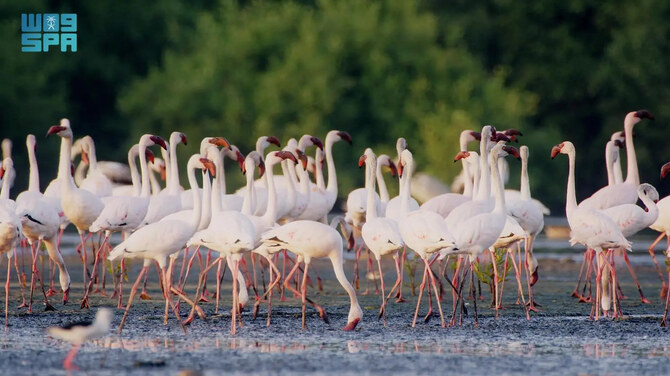
Flamingos are attracted to the shallow, saline lagoons of the Farasan Islands, where they can feed on a diet rich in shrimp, algae and other small organisms. (SPA/File photo)
Saudi Arabia, through its National Center for Wildlife, or NCW, has undertaken efforts to conserve and protect its greater flamingo population as part of a broader commitment to preserve its natural heritage and promote biodiversity in line with Vision 2030.
The NCW, in collaboration with local authorities, has implemented environmental regulations and established protected habitats to ensure the safety and sustainability of these migratory birds.
These include a ban on hunting and the designation of wetland areas as protected zones, and measures to prevent collisions with high-voltage power lines.
DID YOUKNOW?
• Flamingos are social birds that live in large colonies often consisting of thousands of birds.
• They have a lifespan of 20 to 30 years in the wild and even longer in captivity.
• Flamingos have a distinctive courtship display that involves movements and vocalizations to attract potential mates.
These efforts are seen as crucial in maintaining the delicate balance of the Farasan Islands’ ecosystem, which supports not only flamingos but also a variety of other wildlife species.
The Farasan Islands are one of the largest island groups in the Red Sea, situated about 50 km off the coast of Jazan.
The archipelago consists of more than 170 islands, characterized by their coral reefs, mangroves and seagrass beds, which provide essential habitats for a diverse range of marine and terrestrial species.

Aerial view of a boat touring the lush mangroves and waterways of the Farasan Islands. (Saudi Tourism Authority photo)
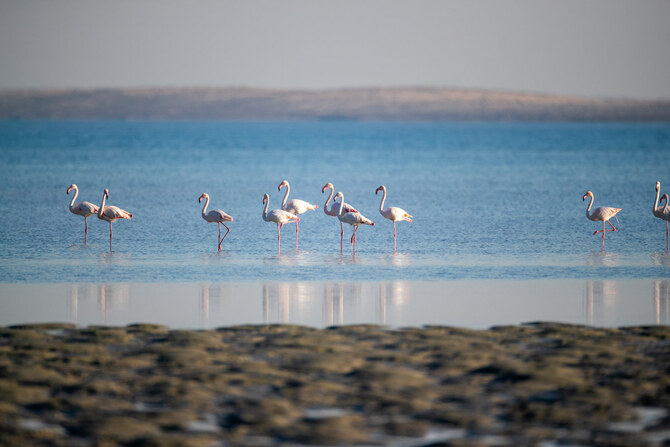
Flamingos are attracted to the shallow, saline lagoons of the Farasan Islands, where they can feed on a diet rich in shrimp, algae and other small organisms. More than 4,000 flamingos have been observed there during the migration season.
“They begin to appear along the coasts of the Kingdom and in the Farasan Islands at the start of winter, by the end of November, and continue until the end of winter,” Mohammed Shobrak, a bird expert and adviser to the NCW, told Arab News.
“Their numbers vary during the migration season in the Farasan Islands. They are more commonly found along the coasts than in the islands.”
The islands offer a relatively safe haven for the flamingos, with minimal human disturbance and ample space for the birds to roost and forage.

Flamingos are more commonly found along the coasts than in the islands. (Supplied)
The greater flamingo is the largest and most widespread species of flamingo, found across Africa, southern Europe and South Asia. These birds are known for their striking pink plumage, which they acquire from their diet.
“The substance responsible for this color is beta-carotene, which is found in algae and crustaceans,” Shobrak said.
“Variations in the levels of this substance in food across different regions may cause color differences, and the physiology of the species may also contribute to these variations among flamingo birds that share the same types of food.
“Additionally, another behavioral study on groups in the Americas indicates that birds with brighter pink-orange colors tend to be more aggressive while feeding.”
Opinion
This section contains relevant reference points, placed in (Opinion field)
While flamingos are not permanent residents of the Farasan Islands, they migrate to the region during the winter months, attracted by the warm climate and rich feeding grounds.
Each year, thousands of greater flamingos make the journey from their breeding grounds in Africa and southern Europe to the coasts of Saudi Arabia.
The Farasan Islands, with their extensive wetlands and shallow lagoons, provide an ideal stopover for these birds during their long migration.
While flamingos do not breed on the islands, they spend several months there, feeding and building up their strength before continuing their journey.
The beauty and ecological significance of the Farasan Islands has not gone unnoticed.
“Horizon,” a new documentary produced by the Konoz Initiative, highlights the rich biodiversity of Saudi Arabia, with a special focus on the Farasan Islands and their flamingo population.
The documentary is part of a broader effort to raise awareness about Saudi Arabia’s natural heritage and the importance of conservation.
“Horizon” provides viewers with a rare glimpse into the lives of flamingos on the Farasan Islands, showcasing their feeding habits, social behaviors and interactions with the environment.

A mesmerizing view of flamingos is shown in this screen grab from the documentary “Horizon,” produced by the Konoz Initiative, and streamed on Netflix.
The film also explores the broader ecosystem of the islands, highlighting the coral reefs, mangroves and other critical habitats that support a wide range of species.
Through stunning visuals and expert commentary, “Horizon” brings the beauty of the Farasan Islands to a global audience, emphasizing the need for continued conservation efforts in the region.
Saudi Arabia’s efforts to protect the greater flamingo and other wildlife on the Farasan Islands are part of a larger commitment to environmental sustainability.
The Kingdom has made significant strides in recent years to enhance its conservation policies, including the establishment of protected areas and the enforcement of strict environmental regulations.

Farasan Islands is also some endangered species, including gazelles and green turtles.
These measures are in line with Saudi Arabia’s Vision 2030 social reform and economic diversification agenda, which seeks to promote sustainable development and preserve the nation’s natural resources for future generations.
In addition to protecting flamingos, Saudi Arabia has taken steps to conserve other endangered species on the Farasan Islands, including gazelles and green turtles.
The islands are home to a variety of marine life, including dolphins, dugongs and a wide range of fish species, all of which benefit from the Kingdom’s conservation initiatives.
Conservation efforts, coupled with increased awareness and education, are helping to ensure that flamingoes and other species will continue to grace the shores of the islands for years to come.


