

Quit the ‘cult’, anti-Trump Republicans plead at DNC

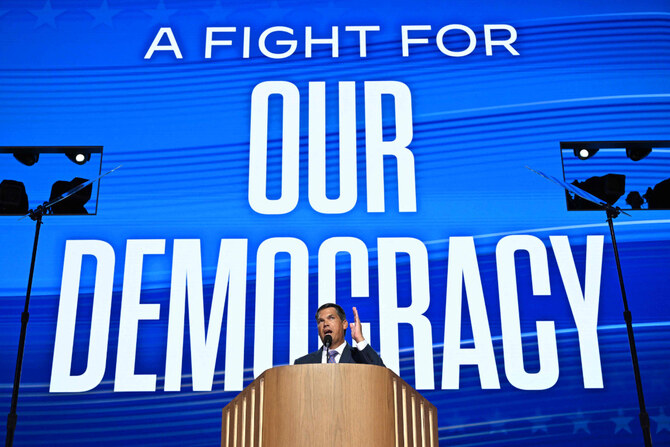
​ Republican Geoff Duncan, former lieutenant governor of Georgia state, speaks on the third day of the Democratic National Convention at the United Center in Chicago, Illinois, on August 21, 2024. (AFP)
Short Url
Updated 23 August 2024
Follow

Quit the ‘cult’, anti-Trump Republicans plead at DNC

  • Geoff Duncan, the former lieutenant governor of Georgia where Trump sought to overturn the results of the 2020 election, slammed Trump as "a direct threat to democracy”
  • Former White House communications director Stephanie Grisham described her ex-boss Trump as a liar with “no empathy, no morals and no fidelity to the truth”
  • John Giles, Republican mayor of Mesa, Arizona, told the convention his party “has been kidnapped by extremists and devolved into a cult: the cult of Donald Trump”

CHICAGO: While Democratic luminaries including the Obamas enthusiastically support Kamala Harris for US president at their party’s convention, an unlikely band of rebels is joining the effort: Republicans urging fellow conservatives to ditch Donald Trump.
The message is nothing new — several Republicans have spoken out against Trump over the years. But their presence at this week’s carefully orchestrated Democratic confab has amplified the call for conservatives and independents to reconsider their election choice in November.
“Let me be clear to my Republican friends at home watching,” Geoff Duncan, the former lieutenant governor of Georgia where Trump sought to overturn the results of the 2020 election, said Wednesday from the convention stage.
“If you vote for Kamala Harris in 2024 you’re not a Democrat, you’re a patriot,” he boomed.
Slamming the recently convicted — and twice-impeached — former president as “a direct threat to democracy,” Duncan said he was aiming his remarks at the millions of Republicans and independents he knows are “sick and tired of making excuses” for Trump.
“These days our party acts more like a cult, a cult worshipping a felonous thug,” said Duncan.

Multiple Republicans have offered similar messages in Chicago, as the Harris campaign seeks to peel off as many Republicans and independent voters as possible in an election that is going down to the wire.
Former White House communications director Stephanie Grisham, who had close access to Trump, took the stage Tuesday slamming her ex-boss as a liar with “no empathy, no morals and no fidelity to the truth.”

“I saw him when the cameras were off. Behind closed doors, Trump mocks his supporters, he calls them basement dwellers,” she said.
Grisham, who was also first lady Melania Trump’s chief of staff, mentioned how she had gone from “a true believer” to a disaffected close adviser who wanted out, and recalled a turning point during the 2021 US Capitol riot by Trump supporters.
“On January 6 I asked Melania if we could at least tweet that while peaceful protest is the right of every American, there’s no place for lawlessness or violence,” Grisham said.
“She replied with one word: ‘No.’“
Grisham resigned that day, “because I love my country more than my party,” she said, to loud applause, adding that Harris “has my vote.”

John Giles, mayor of Mesa, Arizona, and a self-described “lifelong Republican” who claims late senator John McCain as his hero, was equally blunt.
He told the convention his Republican Party “has been kidnapped by extremists and devolved into a cult: the cult of Donald Trump.”
Giles’s message to Americans like him who are in the political middle: “John McCain’s Republican Party is gone, and we don’t owe a damn thing to what’s been left behind.”


Republican Mayor John Giles of Mesa, Arizona, speaks on stage during the second day of the Democratic National Convention at the United Center on August 20, 2024 in Chicago, Illinois.(Getty Images/AFP)

Organizers aired a video Wednesday showing former Trump voters explaining why they were flipping to Harris.
“I made a grave mistake,” Florida voter Rich Logis said via video about how he had jumped headlong into Trump’s MAGA movement. “But it’s never too late to change your mind,” Logis said.
Olivia Troye, a former counter-terrorism adviser for Trump’s vice president Mike Pence, addressed the convention, while high-profile Republican never-Trumper Adam Kinzinger, an ex-congressman, takes the stage Thursday, the closing night.
Trump frequently assails such critics as traitors to the cause, and it remains unclear how persuasive they will be.
David Urban, a Republican adviser to Trump’s 2016 campaign, dismissed any substantial impact.
But he told CNN the appearance by Georgia’s Duncan “may give people permission to vote for Kamala Harris” in the state.


DR Congo’s amputees bear scars of years of conflict

Updated 56 min 59 sec ago
Follow

DR Congo’s amputees bear scars of years of conflict

  • More than 800 people with wounds from weapons, mines or unexploded ordnance have been treated in centers supported by the International Committee of the Red Cross in the eastern DRC this year

GOMA: They survived the bombs and bullets, but many lost an arm or a leg when M23 fighters seized the city of Goma in the eastern Democratic Republic of Congo nearly a year ago.
Lying on a rug, David Muhire arduously lifted his thigh as a carer in a white uniform placed weights on it to increase the effort and work the muscles.
The 25-year-old’s leg was amputated at the knee — he’s one of the many whose bodies bear the scars of the Rwanda-backed M23’s violent offensive.
Muhire was grazing his cows in the village of Bwiza in Rutshuru territory, North Kivu province, when an explosive device went off.
He lost his right arm and right leg in the blast, which killed another farmer who was with him.
Fighting had flared at the time in a dramatic escalation of a decade-long conflict in the mineral-rich region that had seen the M23 seize swathes of land.
The anti-government M23 is one of a string of armed groups in the eastern DRC that has been plagued by internal and cross-border violence for three decades, partly traced back to the 1994 Rwanda genocide.
Early this year, clashes between M23 fighters and Congolese armed forces raged after the M23 launched a lightning offensive to capture two key provincial capitals.
The fighting reached outlying areas of Muhire’s village — within a few weeks, both cities of Goma and Bukavu had fallen to the M23 after a campaign which left thousands dead and wounded.
Despite the signing in Washington of a US-brokered peace deal between the leaders of Rwanda and the DRC on December 4, clashes have continued in the region.
Just days after the signing, the M23 group launched a new offensive, targeting the strategic city of Uvira on the border with the DRC’s military ally Burundi.
More than 800 people with wounds from weapons, mines or unexploded ordnance have been treated in centers supported by the International Committee of the Red Cross (ICRC) in the eastern DRC this year.
More than 400 of them were taken to the Shirika la Umoja center in Goma, which specializes in treating amputees, the ICRC said.
“We will be receiving prosthetics and we hope to resume a normal life soon,” Muhire, who is a patient at the center, told AFP.


- ‘Living with the war’ -


In a next-door room, other victims of the conflict, including children, pedalled bikes or passed around a ball.
Some limped on one foot, while others tried to get used to a new plastic leg.
“An amputation is never easy to accept,” ortho-prosthetist Wivine Mukata said.
The center was set up around 60 years ago by a Belgian Catholic association and has a workshop for producing prostheses, splints and braces.
Feet, hands, metal bars and pins — entire limbs are reconstructed.
Plastic sheets are softened in an oven before being shaped and cooled. But too often the center lacks the materials needed, as well as qualified technicians.
Each new flare-up in fighting sees patients pouring into the center, according to Sylvain Syahana, its administrative official.
“We’ve been living with the war for a long time,” he added.
Some 80 percent of the patients at the center now undergo amputation due to bullet wounds, compared to half around 20 years ago, he said.
“This clearly shows that the longer the war goes on, the more victims there are,” Syahana said.