

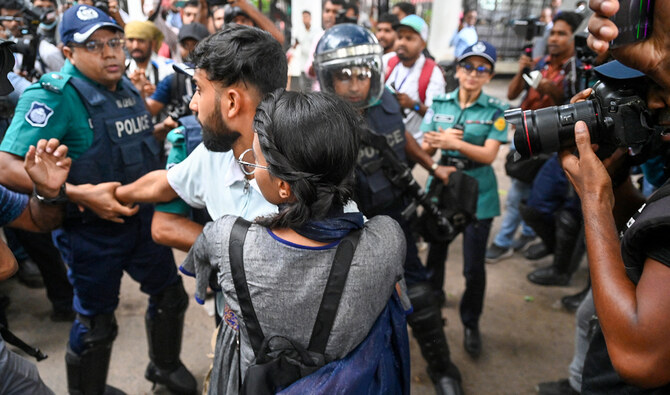

DHAKA: UN investigators arrived in Dhaka on Thursday to discuss the process to investigate alleged human rights violations and hundreds of deaths during Bangladesh’s recent student-led protests which led its longtime prime minister to step down.
Initially peaceful demonstrations in early July, triggered by the reinstatement of a quota system for allocation of civil service positions, turned violent two weeks later following a crackdown by security forces and a communications blackout.
In early August, as protesters defied nationwide curfew rules and stormed government buildings, former prime minister Sheikh Hasina resigned and fled the country, ending 15 years in power.
The new interim administration, led by Nobel-winning economist Muhammad Yunus, has pledged to cooperate with the Office of the UN High Commissioner for Human Rights to deliver justice and accountability for violence committed during the month-long uprising.
“It’s really an exploratory visit to discuss with the interim government, with the advisers, with some of the ministries, with the civil society, with this broad section of Bangladesh society, to hear your priorities, your needs going forward and explore some areas where the office of the high commissioner could assist, including in the area of fact-finding and investigation,” Rory Mungoven, chief of the Asia Pacific region at the OHCHR, who is leading the three-member team to Dhaka, said.
“The high commissioner for human rights, Volker Turk, is really inspired by the courage and commitment to democracy and human rights of the Bangladesh people, particularly the students and particularly the youth. And he sees this as a historic opportunity for the country in restoring democracy, renewing institutions, advancing human rights.”
According to the OHCHR’s preliminary analysis of the recent unrest in Bangladesh and published on Aug. 16, there are “strong indications” that the security forces used “unnecessary and disproportionate force” in their response to the student-led protests.
“Alleged violations included extrajudicial killings, arbitrary arrests and detention, enforced disappearances, torture and ill-treatment, and severe restrictions on the exercise of freedoms of expression and peaceful assembly,” the report reads.
“According to available public reports by media and the protest movement itself, between 16 July and 11 August, more than 600 people were killed ... Thousands of protesters and bystanders have been injured, with hospitals overwhelmed by the influx of patients. The reported death toll is likely an underestimate.”
The majority of deaths and injuries have been attributed to security forces and the student wing affiliated with the then-ruling Awami League party.
The casualties, the report said, resulted from “the use of live ammunition and other force against protesters who while acting violently reportedly were not armed, or only lightly armed,” as well as “from instances of security forces unlawfully using lethal force against protesters posing no apparent threat, unarmed protesters, and bystanders, including at least 4 journalists and at least 32 children.”
Most victims have been student demonstrators, whose colleagues are hoping for justice and accountability.
“We want to believe that we will have a proper investigation,” Umama Fatema, a coordinator of Students Against Discrimination, the main protest organizing group, told Arab News.
“We wanted the International Criminal Court and the UN to intervene in this situation from the very beginning. We just want a proper investigation, and we want to get a proper report. We want to see a proper report on the whole massacre that happened in Bangladesh.”


