UN chief warns Earth in ‘era of global boiling’

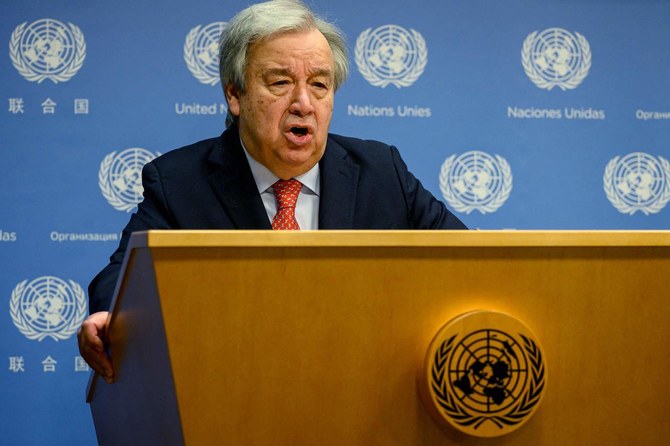
US Secretary-General Antonio Guterres speaks about climate change at UN headquarters in New York City on July 27, 2023. (AFP)
Short Url
Updated 27 July 2023
Follow

UN chief warns Earth in ‘era of global boiling’

  • The secretary-general described the intense heat across the Northern Hemisphere as a “cruel summer“
  • “For the entire planet, it is a disaster,” he said, noting that “short of a mini-Ice Age over the next days, July 2023 will shatter records across the board“

UNITED NATIONS, United States: UN chief Antonio Guterres on Thursday pleaded for immediate radical action on climate change, saying that record-shattering July temperatures show Earth has passed from a warming phase into an “era of global boiling.”
Speaking in New York, the secretary-general described the intense heat across the Northern Hemisphere as a “cruel summer.”
“For the entire planet, it is a disaster,” he said, noting that “short of a mini-Ice Age over the next days, July 2023 will shatter records across the board.”
“Climate change is here. It is terrifying. And it is just the beginning. The era of global warming has ended; the era of global boiling has arrived.”
The extreme impacts of climate change have been in line with scientists’ “predictions and repeated warnings,” Guterres said, adding that the “only surprise is the speed of the change.”
In the face of “tragic” consequences, he repeated his call for swift and far-reaching action, taking aim once again at the fossil fuel sector.
“The air is unbreathable. The heat is unbearable. And the level of fossil fuel profits and climate inaction is unacceptable,” said the former Portuguese prime minister.
“Leaders must lead,” he said. “No more hesitancy. No more excuses. No more waiting for others to move first.”
Ahead of the Climate Ambition Summit he is set to host in September, Guterres called on developed countries to commit to achieving carbon neutrality as close to 2040 as possible, and for emerging economies as close as possible to 2050.
The “destruction” unleashed by humanity “must not inspire despair, but action,” he said, warning that to prevent the worst outcomes humanity “must turn a year of burning heat into a year of burning ambition.”


UK veterans are ‘ticking time bomb’ after Iraq war chemical exposure

Updated 59 min 52 sec ago
Follow

UK veterans are ‘ticking time bomb’ after Iraq war chemical exposure

  • Fifteen former RAF personnel were deployed to the Qarmat Ali water plant in 2003, which was contaminated with sodium dichromate
  • Veterans say they were not screened or protected, and are now living with serious health conditions

LONDON: Fifteen British servicemen who worked on a carcinogen-contaminated water treatment site during the Iraq war say they were not offered biological screening despite official guidance saying they should have been.

The former Royal Air Force members, who have suffered from ailments including cancer, tumors and nosebleeds, told Sky News they were offered no medical assistance or subsequent treatment after having been exposed to toxic sodium dichromate at the Qarmat Ali water treatment plant in 2003.

The channel said it had seen a letter from the RAF’s medical authority stating that senior officers knew of the dangers posed by the substance.

Peter Lewis, 53, was one of 88 personnel deployed to guard the site, which was deemed vital for getting Iraq’s oil industry up and running. He told Sky: “I’ve had eight or nine operations to remove cancer.

“I’ve had so many lumps taken out of my neck, one on my face. This is something I’m literally fighting every year now. It’s constant.”

Qarmat Ali, the former troops say, was covered in ripped bags of bright orange sodium dichromate.

“We were never warned what the bags of chemicals were,” Jon Caunt, another former serviceman, said. “We were breathing this stuff in.”

His former comrade Tony Watters added: “I never thought about what it was. We were told the site is safe.”

Several months after deployment to the site, however, the servicemen were joined by two workers wearing protective gear who placed signs around it reading: “Warning. Chemical hazard. Full protective equipment and chemical respirator required. Sodium dichromate exposure.”

Watters said: “When you left the site, your uniform was contaminated, your webbing was contaminated.

“You went in your sleeping bag, and that was contaminated. And you were contaminating other people with it back at camp.”

Andy Tosh, who has led the group of veterans as they sought answers from the Ministry of Defence, said: “Even with the warning signs going up … they kept us there. They knowingly kept us exposed.”

The RAF gave some of the men a leaflet on their return to the UK, warning of the dangers of the substance, but not all were told.

The letter seen by Sky acknowledging the dangers posed to the veterans made a “strong” link to “increased risk of lung and nose cancer” as well as numerous other issues. It suggested personnel sent to Qarmat Ali should have their medical records altered to mention their exposure to sodium dichromate.

“Offer biological screening. This cannot be detailed until the numbers exposed are confirmed,” the letter also said.

An inquiry into US personnel deployed to Qarmat Ali found that 830 people were “unintentionally exposed” to sodium dichromate, giving them access to support from the US Department of Veterans Affairs. This came after the death of Lt. Col. James Gentry from cancer in 2009, which the US Army determined came “in line of duty for exposure to sodium dichromate.”

There has been no such inquiry by UK authorities despite British personnel being deployed at the site for longer than their American counterparts.

Thirteen of them have suffered from cancer and similar symptoms, including one who developed a brain tumor.

Jim Garth told Sky: “My skin cancer will never go away … It’s treatable, but when the treatment is finished, it comes back, so I’ve got that for life really.”

Lewis added: “I’m actually getting to the point now where I don’t care anymore … sooner or later, it’s going to do me.”

Caunt described his former colleagues’ conditions as a “ticking time bomb.”

He added: “We do not know what’s going to happen in the future."

The MoD insists medical screening was offered to personnel at the time, despite the men stating that it was not. In 2024, several met with Labour MPs about the issue. One, John Healey, who is now the UK defence secretary, said at the time the veterans should have “answers to their important questions.”

In a statement, the MoD said: “We take very seriously the concerns raised by veterans who were deployed to guard the Qarmat Ali Water Treatment Plant in 2003.

“As soon as we were alerted to the possible exposure of Sodium Dichromate, an environmental survey was conducted to evaluate typical exposure at Qarmat Ali. Results showed that the levels at the time were significantly below UK government guidance levels.”

A 2004 letter seen by Sky News suggested, however, that the MoD knew the levels of sodium dichromate were higher.

“Anyone who requires medical treatment can receive it through the Defence Medical Services and other appropriate services,” the MoD said.

“Veterans who believe they have suffered ill health due to service can apply for no-fault compensation under the War Pensions Scheme.”

Watters called on the government to hold an investigation into what happened at Qarmat Ali.

“We are the working class, we are ex-soldiers who have put our lives on the line and you’re turning a blind eye to us,” he said.

Garth added: “We felt let down at Qarmat Ali all those years ago, and we still feel let down now.”