

Heavy rains in Punjab, Khyber Pakhtunkhwa till Aug. 24 as downpours kill 220 since July

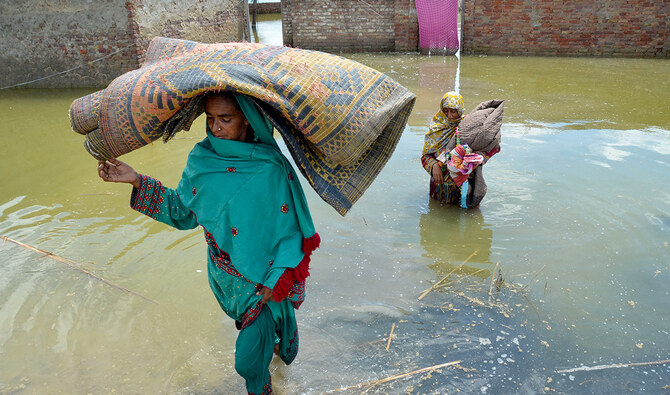
Women displaced by flood, carry their belongings as they wade through floodwaters after heavy monsoon rains at Sohbatpur in Jaffarabad district, Balochistan province on August 19, 2024. (AFP/File)
Short Url
Updated 21 August 2024
Follow

Heavy rains in Punjab, Khyber Pakhtunkhwa till Aug. 24 as downpours kill 220 since July

  • Monsoon rains have killed 89 people in Punjab and 65 in Khyber Pakhtunkhwa province since July 1, says disaster management body 
  • NDMA says heavy monsoon rains can increase flows in local nullahs and tributaries, causing flash floods in many parts of country

ISLAMABAD: Pakistan’s National Disaster Management Authority (NDMA) on Wednesday forecast heavy monsoon rains in the northwestern Khyber Pakhtunkhwa (KP) and Punjab province till Aug. 24, with the downpours killing 220 and injured 416 across the country since July.

Heavy monsoon rains have triggered rains and flash floods in many parts of Pakistan since July, particularly KP and Punjab. As per the latest NDMA report, Punjab has reported the highest number of casualties from rain-related incidents with 89 deaths followed by KP with 65 casualties since July 1. 

The southern provinces of Sindh and Balochistan have reported 39 and 18 deaths from rain-related incidents, respectively, while Azad Kashmir has reported five deaths and the northern Gilgit-Baltistan region four deaths since July. 

“National Emergency Operations Center (NEOC) of NDMA anticipated more rain wind/thunderstorms and heavy downpours in Khyber Pakhtunkhwa and isolated rainfall in Punjab from 21st to 24th August 2024,” the NDMA said in its latest advisory. 

It cautioned that rains may cause increased flows in local nullahs and river tributaries. The disaster management body said Increased flows may cause flash floods in Abbottabad, Parachinar, Charbagh, Charsadda, Chitral, Dir, Haripur, Hazara, Malakand, Mansehra, Mardan, Peshawar, and Swabi districts of KP. 

Meanwhile, it said heavy rainfall is expected in the Potohar region, twin cities of Islamabad and Rawalpindi, Bahawalpur, DG Khan, Faisalabad, Gujranwala, Gujrat, Hafizabad, Jhelum, Lahore, Layyah, Mianwali, Multan, Narowal, Rahimyar Khan, Sialkot and Sargodha districts of Punjab. 

NDMA warned authorities and the public to take all necessary precautions to mitigate the potential impacts of flooding and landslides.

“NDMA issued instructions to all relevant departments to alert Emergency Response Teams and mobilized resources to ensure a swift response to any arising situations,” the advisory said. “Tourists are advised to avoid traveling to these areas during the forecasted period.”

Pakistan is recognized as one of the most vulnerable countries to climate change effects. This year, the South Asian country recorded its “wettest April since 1961,” with 59.3 millimeters of rainfall while some areas of the country faced a severe heat wave in May and June.
In 2022, unusually heavy rains triggered flash floods in many parts of Pakistan, killing over 1,700 people, inflicting losses of around $30 billion, and affecting at least 30 million people. Scientists have attributed Pakistan’s erratic weather patterns to climate change effects and called on countries around the world to take urgent steps to tackle the crisis


Pakistani president arrives in Iraq to deepen trade, energy cooperation

Updated 20 December 2025
Follow

Pakistani president arrives in Iraq to deepen trade, energy cooperation

  • Visit follows recent high-level contacts as Islamabad seeks to expand limited commercial ties with Baghdad
  • Talks are expected to cover investment, manpower and facilitation of Pakistani pilgrims visiting holy sites in Iraq

ISLAMABAD: President Asif Ali Zardari arrived in Iraq on Saturday on an official visit aimed at expanding cooperation in trade, energy and investment, as Pakistan seeks to deepen ties with Baghdad after years of limited engagement.

Pakistan and Iraq established diplomatic relations in 1947 and have traditionally maintained cordial ties, though commercial links remain modest, with officials and business groups identifying scope for cooperation in construction services, pharmaceuticals, manpower and agricultural exports.

“President Asif Ali Zardari arrived in Baghdad on a four-day official visit to Iraq,” his office said in a post on X. “He was received by Culture Minister Dr. Ahmed Fakkak Al-Badrani. During the visit, meetings with senior Iraqi leadership are expected to advance cooperation and further strengthen Pakistan-Iraq relations.”

Zardari’s visit follows a series of recent high-level contacts between the two countries, reflecting efforts to broaden bilateral engagement beyond traditional diplomatic ties and explore collaboration across economic, political and people-to-people domains.

According to Pakistan’s foreign office, the president is expected to hold meetings with Iraq’s senior leadership to discuss cooperation in various areas such as trade and investment, energy, technology, education and manpower.

He is also expected to discuss regional and international issues with Iraqi officials.

Earlier this month, Pakistan’s Interior Minister Mohsin Naqvi met his Iraqi counterpart, Abdul Ameer Al-Shammari, on the sidelines of meetings in Brussels, where both sides agreed to enhance cooperation on security and facilitate travel for Pakistani Shia pilgrims to Najaf and Karbala.

The two officials discussed measures to ensure the smoother movement of these pilgrims and their compliance with visa regulations.
