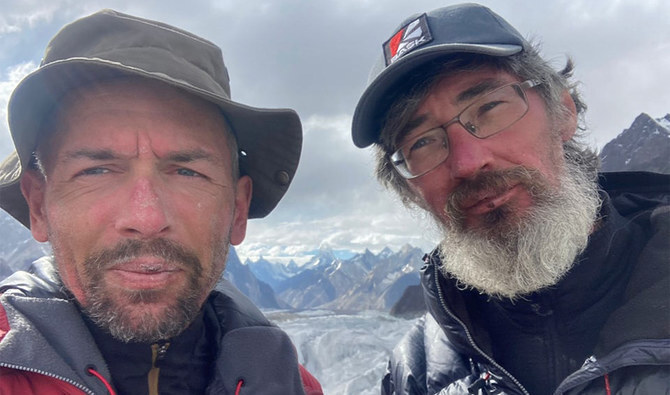
ISLAMABAD: After six days of being stranded on a remote peak in Pakistan’s northeast, two injured Russian climbers were finally rescued, while another remains missing and is presumed dead, a mountaineering official said Wednesday.
The five-member climbing team, which began their expedition on one of Gasherbrum’s peaks to retrieve the body of a fellow climber who died there last year, was hit by a pile of ice on Friday, officials said. Rescuers airlifted two of the mountaineers Monday while more planning was needed to rescue the other two who were unable to move because of their injuries.
An army helicopter, backed by local volunteers, helped rescue the two injured on Tuesday, said Karrar Haidri, the secretary of the Alpine Club of Pakistan, adding that the third climber fell into a crevasse and couldn’t be located
Haidri said Wednesday the two were moved from the peak to the base camp and were in stable condition. “A helicopter was set to transport them to the northern city of Skardu, but it could not fly due to bad weather,” he said, and that they were trying to find another way to get them to a hospital.
The Russian team, which was not accompanied by guides or sherpas, took an unusual route on Gasherbrum.
While Haidri acknowledged that the climbers were hit by the ice formation while “ascending the mountain for a noble cause,” he still warned against such endeavors.
“Climbers are fully aware of the dangers linked to such missions, but they still opt for dangerous and unexplored routes,” he said. “This is how climbers make records but also come across challenges.”
Hundreds of climbers try to scale mountains in northern Pakistan every year, and accidents are common because of avalanches and sudden weather changes. This month, a Pakistani climber Murad Sadpara, 35, known for taking part in high-altitude rescue missions died during a descent from one of the country’s tallest mountains in the north.


![]()

Two injured Russian climbers rescued after 6 days stranded on Pakistan peak
Short Url
https://arab.news/zpnga
Two injured Russian climbers rescued after 6 days stranded on Pakistan peak
- Another Russian climber remains missing and is presumed dead, mountaineering official said
- Five-member climbing team was hit by a pile of ice on Friday on one of Gasherbrum’s peaks
Latest updates


© 2026 SAUDI RESEARCH & PUBLISHING COMPANY, All Rights Reserved And subject to Terms of Use Agreement.