DOHA: Top US diplomat Antony Blinken said Tuesday that “time is of the essence” to secure a Gaza truce as he wrapped up a Middle East tour with a plea for a deal.
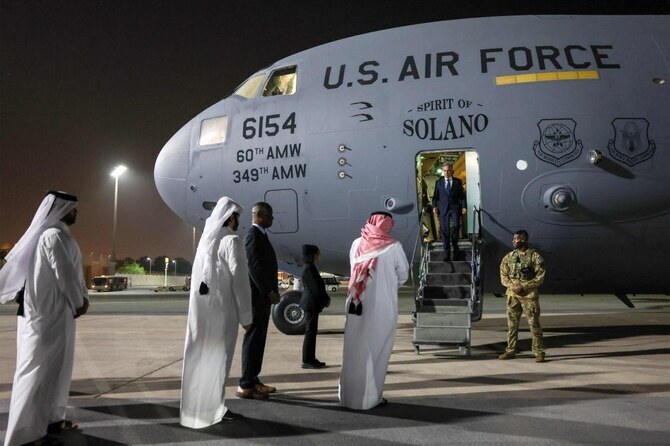
The US secretary of state, on his ninth regional visit since the 10-month-old Israel-Hamas war began, made a brief stop in mediator Qatar but was unable to meet its emir.
Speaking on the tarmac in Doha before heading back to Washington, Blinken reiterated his call for Hamas to accept a “bridging proposal” for a deal, which he said Israel had accepted, and asked both parties to work toward finalizing it.
“This needs to get done, and it needs to get done in the days ahead, and we will do everything possible to get it across the finish line,” he said.
Palestinian militant group Hamas, whose October 7 attack triggered the war, said it was “keen to reach a ceasefire” agreement but protested “new conditions” from Israel in the latest US proposal.
Earlier Tuesday, Blinken flew from Israel to Egypt for talks with President Abdel Fattah El-Sisi, who told him that “the time has come to end the ongoing war,” according to an official Egyptian statement.
El-Sisi warned of the consequences of “the conflict expanding regionally,” it said.
Blinken then traveled to Doha to meet with Emir Sheikh Tamim bin Hamad Al-Thani, though a US official said the Qatari ruler was feeling unwell and the two will instead talk on the phone soon.
Mohammed bin Abdulaziz bin Saleh Al-Khulaifi, minister of state at the Qatari foreign ministry, met with Blinken to discuss “joint mediation efforts to end the war,” Doha said.
Both Egypt and Qatar are working alongside the United States to broker a truce, which diplomats say would help avert a wider conflagration that could draw in Iran and Hezbollah in Lebanon.
Israel and Hamas have blamed each other for delays in reaching an accord that would stop the fighting, free Israeli hostages and allow vital humanitarian aid into the besieged Palestinian territory.
Medics and civil defense rescuers in the Hamas-ruled Gaza Strip said Israeli bombardment on Tuesday killed more than two dozen people, and Israel announced it had recovered the bodies of six hostages.
Mediators met last week with Israeli negotiators in Doha, and more truce talks are expected in Egypt this week.
One of the main sticking points has been Hamas’s long-standing demand for a “complete” withdrawal of Israeli troops from all parts of Gaza, which Israel has rejected.
Israeli media quoted Prime Minister Benjamin Netanyahu as saying Israel would insist on maintaining control of a strategic strip on the Gaza-Egypt border, known as the Philadelphi corridor.
A US official traveling with Blinken, speaking on condition of anonymity to discuss sensitive matters, said that “maximalist statements like this are not constructive to getting a ceasefire deal across the finish line.”
In Doha, Blinken said Washington opposes “any long-term occupation of Gaza by Israel.”
Fears of a regional escalation have mounted since Hezbollah and Iran vowed to respond after an attack last month, blamed on Israel, killed Hamas political leader Ismail Haniyeh in Tehran, shortly after an Israeli strike on Beirut killed a top Hezbollah commander.
Lebanon’s health ministry said four people were killed in Israeli strikes on Tuesday and Hezbollah claimed a string of attacks on Israeli troops, in the latest of the cross-border exchanges which have raged almost daily since the Gaza war began.
Hamas had called on the mediators to implement a framework set out by US President Joe Biden in late May, rather than hold more negotiations.
The Biden plan would freeze fighting for an initial six weeks while Israeli hostages are exchanged for Palestinian prisoners in Israeli jails and humanitarian aid enters Gaza.
Hamas said on Sunday that the current US proposal, which Washington had put forward after two days of meetings in Doha, “responds to Netanyahu’s conditions.”
And on Monday, in response to comments by Biden that it was “backing away” from a deal, the Iran-backed group said the “misleading claims... do not reflect the true position of the movement, which is keen to reach a ceasefire.”
Hamas officials as well as some analysts and critics in Israel have accused Netanyahu of prolonging the war for political gain.
The October 7 attack on southern Israel resulted in the deaths of 1,199 people, mostly civilians, according to an AFP tally of Israeli official figures.
Israel’s retaliatory offensive in Gaza has killed at least 40,173 people, according to the territory’s health ministry, which does not give details of civilian and militant deaths.
Most of the dead are women and children, according to the UN human rights office.
Out of 251 hostages seized during the attack, 105 are still held in Gaza, including 34 the Israeli military says are dead.
Israeli army operations in Gaza have continued throughout the truce talks.
An Israeli strike on Tuesday hit a school in Gaza City where the civil defense agency said at least 12 Palestinians were killed and the military said a Hamas command center was based.
Thousands of displaced Palestinians had sought refuge in the facility, civil defense spokesman Mahmud Bassal said.
AFP photos showed the Mustafa Hafiz school partly reduced to rubble, with Palestinians fleeing.
Elsewhere in Gaza, Bassal and medical sources reported at least 17 killed in four separate strikes.
The Israeli military said forces had retrieved the bodies of six hostages from a tunnel in the southern Gaza district of Khan Yunis.
The United Nations said parts of a north-south Gaza road that is “a crucial passage for humanitarian missions were included in the latest evacuation order” issued by the Israeli military on Saturday.
“This has made it nearly impossible for aid workers to move along this key route,” a UN statement said, preventing “critical supplies and services, such as water trucking” from reaching those in need.


![]()

Blinken wraps up Middle East tour with Gaza truce plea
Short Url
https://arab.news/z6rsw
Blinken wraps up Middle East tour with Gaza truce plea
- Blinken met earlier in the day in Cairo with Egypt’s President Abdel-Fattah El-Sisi
- Top diplomat’s visit to the region also included meetings in Israel on Monday
Latest updates


© 2026 SAUDI RESEARCH & PUBLISHING COMPANY, All Rights Reserved And subject to Terms of Use Agreement.