

‘My wife is my lucky charm,’ says Esports World Cup Street Fighter 6 champion

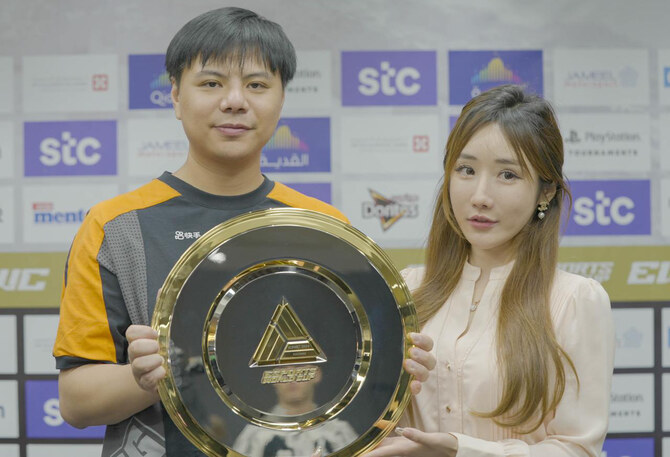
Street Fighter 6 champion Xiao Hai and wife Elena celebrate his win at the Esports World Cup in Riyadh. (Supplied)
Short Url
Updated 21 August 2024
Follow

‘My wife is my lucky charm,’ says Esports World Cup Street Fighter 6 champion

  • Chinese player Xiao Hai dedicates victory in Riyadh to spouse Elena, who ran onto the stage to hug him after his $300,000 triumph

RIYADH: One of the most heartwarming moments during the Esports World Cup in Riyadh so far came just after Zeng Zhuoju unexpectedly, but deservedly, won the Street Fighter 6 tournament.

The player, competing under his nickname Xiao Hai, shed tears of joy as he lifted the coveted trophy. And as if the emotional moment was not perfect enough, his wife Elena then ran onto the stage to embrace him, in a show of love and affection that generated even louder cheers and applause from an already enraptured crowd at the Qiddiya Arena at Boulevard Riyadh City.

“A lot of people said to me, ‘Don’t bring your family, just focus on your tournament,’” said Zeng, who earned $300,000 from the tournament’s $1m prize pool for his success in the final on Aug. 11.

“They said, ‘That’s the only thing you should focus on.’ But I wanted to bring my wife — and I won the tournament because my wife is my lucky charm.”

It was especially fitting that she was there to see his triumph because it was esports that brought 35-year-old Zeng and 29-year-old Elena together. He was competing in a tournament in Changsha, Elena’s home town, which is about two-and-a-half hours by train from where he lived in Guangzhou, when they met at karaoke. They fell in love and married in December 2021.

Elena said that watching her husband win the Street Fighter 6 competition, with a 5-2 victory in the final over Kawano, was a feeling she can still barely describe.

“The way I feel is the way I imagine I will feel when I’m pregnant,” she said. “That’s the kind of feeling I have: I feel so happy. It’s a great feeling.”

Her general sense of pride in her husband is obvious when she speaks.

“He’s very hard working,” Elena added. “Sometimes we’ll go out to eat or watch a movie or something and he’ll have an idea and he’ll stop and write it down. Then he’ll go to his computer on his live stream and start doing the thing he was thinking about.”

They say that behind every great man there stands a great woman and in Zeng’s case it seems the saying could not be more true.

“Sometimes I am playing and streaming so much I don’t even have time to spend with my wife,” he said. “Sometimes I need to write something down in case I forget it.

“Saturday, Aug. 10 (the day before the Street Fighter 6 final) was Chinese Valentine’s Day but I was busy that day. I was focusing. The day after was the great day for me, and for us. It was a great moment for us and we celebrated properly.”

Zeng has spoken since his success about his feeling that people had written him off before the final because of his age. Now, he said, he is aiming for back-to-back Esports World Cup wins in Riyadh.

“I am 35 years old and too many people said I am older and can’t do it anymore,” he said. “But I proved I can do it. I am Xiao Hai, and I am an Esports World Cup champion. And I am really thankful that my wife was there.

“Many people were thinking she was just with me for a holiday or traveling. But she was representing my love. I was very happy to win and give her this moment but it’s not enough. I want more and more. Maybe this could be my future; now I want to win more games and more tournaments and more money. I want to win in Riyadh at the Esports World Cup next year.

“A lot of people would say they are my fans, that they like me, but if I lose they might say, ‘Oh, you need to go back and practice’ or ‘Oh, you shouldn’t have done that.’ My wife is my lucky star. She is with me all the time and has always supported me whether I do good or bad. She is with me. She is my lucky person.”

The Esports World Cup in Riyadh concludes on Aug. 25.


From Jeddah to the world stage: Bader Idrees and Saudi Arabia’s tennis rise

Updated 25 December 2025
Follow

From Jeddah to the world stage: Bader Idrees and Saudi Arabia’s tennis rise

RIYADH: As tennis continues to gain momentum throughout Saudi Arabia, several local players are beginning to emerge on the national and international scene. One of them is Saudi national team player Bader Idrees, whose journey mirrors the Kingdom’s evolving relationship with the sport.

Idrees’ first exposure to tennis came at a time when the local game was still developing. His interest began in early 2010 after watching his older sister train regularly.

“I was five years old when I used to watch my older sister playing tennis every day,” he told Arab News. “One of her coaches recommended that I try it out, and from the first hit, I fell in love with the sport.”

Now 20 years old, Idrees finds himself progressing alongside a country that is investing heavily in tennis. Over the past three months alone, Saudi Arabia has hosted the Six Kings Slam, the WTA Finals, and the Next Gen ATP Finals, an indication of its growing ambitions on the global tennis stage.

A defining moment in Idrees’ development came at the 2025 WTA Finals, where he reached a personal milestone in his role as a hitting partner for some of the world’s best players.

“It was one of the best experiences I’ve had so far,” he said. “To actually see the players and train with them was an eye-opening experience for me.”

The exposure offered by hosting elite tournaments has had a direct impact on aspiring Saudi athletes, providing valuable insight into the professional game.

“Seeing how players prepare for matches — from how they behave off the court to actually practicing on the court — was an amazing experience,” he said.

Beyond individual growth, Idrees believes the broader sporting ecosystem benefits from welcoming international events to the Kingdom.

“Hosting these events motivates every Saudi athlete,” Idrees said. “Foreign players get to know the country and the players who represent it, and it pushes us to perform better knowing that the world is watching.”

That motivation has translated into concrete goals. Idrees is planning a busy start to the year, with four international tournaments scheduled for January.

“I feel very positive about what I’ve accomplished so far, so hopefully I can kick off with a strong start in 2026.”

Despite recent progress, Idrees credits his early development at home as the foundation of his success.

“I don’t think I would be at this level if I weren’t in Saudi Arabia, and if I didn’t meet my coach Wajih there, who played a big role in my journey,” Idrees said.

To further advance his career, he later relocated to Cairo, where increased competition and exposure helped accelerate his development.

“That experience, combined with my coach’s motivation, made me believe I could truly go pro,” he said.

The journey was not without challenges. Idrees reflected on the limitations that once existed in the local tennis landscape.

“Tennis has grown massively in Saudi Arabia over the last few years,” he said. “But before that, we didn’t always have the best facilities or infrastructure. That’s why seeing the progress now makes me happy.”

Today, that transformation is happening at a rapid pace — something Idrees notices each time he returns home from international competition.

“Month by month,” as he puts it.

Whether in Riyadh, Jeddah, or Dammam, the changes are increasingly visible. Looking ahead, Idrees is optimistic about the next generation of Saudi players.

“I wouldn’t be surprised to see the kids playing at the under-10 and under-12 level find themselves in the top 500 or 300 within the next 10 years,” he said. “I see the discipline and motivation in them, and it truly is something special.”

He is also realistic about his own development compared with today’s young talents.

“I wasn’t at this level at 10, 12 years old,” he admitted. “Training with kids at that age now, I’m genuinely impressed. It’s why I’m feeling very positive about their future.”

With growing infrastructure, elite-level exposure, and rising ambition, Idrees’ story represents more than personal achievement. It highlights how Saudi Arabia’s expanding role as a host of global sporting events is reshaping its tennis landscape — and how a new generation of players may be poised to make an impact on the world stage in the years ahead.