Iran shuts down last language institute recognized by German Embassy

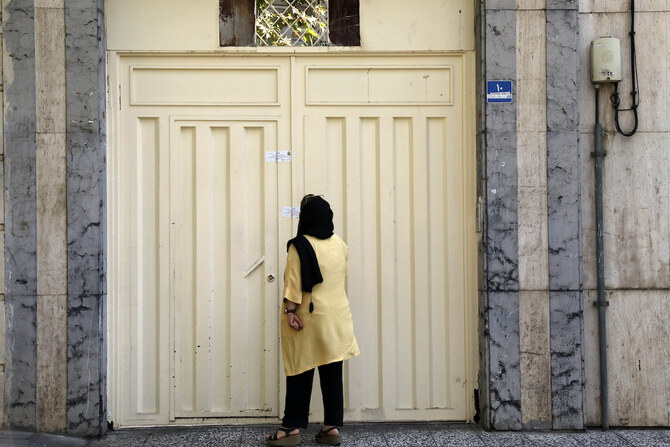
A woman reads the Iranian police closure notice on the gate of a language institute certified by German embassy, in Tehran, Iran, Tuesday, Aug. 20, 2024. (AP)
Short Url
Updated 20 August 2024
Follow

Iran shuts down last language institute recognized by German Embassy

  • Mizanonline.ir said judicial authorities ordered the closure of the institute’s two posts, located in separate Tehran neighborhoods

TEHRAN: Iranian authorities on Tuesday closed down the last language institute certified by the German Embassy, local media said, in retaliation for the shuttering of Islamic centers in the European country.
A report by Nournews.ir, believed to be close to Iran’s security bodies, published a photo of police forces taking down the sign showcasing the establishment’s name. The Institute For Teaching German Language was established in the capital in 1995, according to the embassy.
Mizanonline.ir, a news website affiliated with the country’s judiciary, said judicial authorities ordered the closure of the institute’s two posts, located in separate Tehran neighborhoods, calling them “illegal centers affiliated with the German government” that “breached Iran’s law, committed various illegal actions and extensive financial violations.” The report also said authorities would investigate possible infractions by other German-affiliated centers, without elaborating.
Its closure came after German authorities shut down The Islamic Center Hamburg, and five sub-organizations, in July, accusing it of being an “outpost” of Iran’s theocracy, promoting the ideology of its leadership and supporting Lebanon’s Hezbollah militant group.
German police also raided 53 properties around the country. Imam Ali Mosque in Hamburg, the militant group’s most prominent facility, was among the properties raided.
Hezbollah and Israel have been trading near-daily exchanges of fire across the Lebanon-Israel border since the Israel-Hamas war in Gaza broke out in October. Iran does not recognize Israel and supports anti-Israeli militant groups like Hamas and Hezbollah.
In 1995, Iranian authorities shut down Tehran’s Goethe International Institute, which was part of over 100 sites around the world promoting German culture, language and education.


Halt to MSF work will be ‘catastrophic’ for people of Gaza: MSF chief

Dena Abu Youssef and Mahmoud Abu Youssef, a Palestinian boy who is receiving treatment at Al-Aqsa Martyrs Hospital.
Updated 43 min 30 sec ago
Follow

Halt to MSF work will be ‘catastrophic’ for people of Gaza: MSF chief

  • MSF slammed the move, which takes effect on March 1, as a “pretext” to obstruct aid
  • “Ceasing MSF activities is going to be catastrophic for the people of the Gaza Strip and the West Bank,” he said

GENEVA: Israel’s ban on Doctors Without Borders’ humanitarian operation in Gaza spells deeper catastrophe for the Palestinian territory’s people, the head of the medical charity told AFP on Monday.
Israel announced on Sunday that it was terminating all the activities in Gaza and the West Bank by the organization, known by its French acronym MSF, after it failed to provide a list of its Palestinian staff.
MSF slammed the move, which takes effect on March 1, as a “pretext” to obstruct aid.
“This is a decision that was made by the Israeli government to restrict humanitarian assistance into Gaza and the West Bank at the most critical time for Palestinians,” MSF secretary-general Christopher Lockyear warned in an interview with AFP at the charity’s Geneva headquarters.
“We are at a moment where Palestinian people need more humanitarian assistance, not less,” he said. “Ceasing MSF activities is going to be catastrophic for the people of the Gaza Strip and the West Bank.”
MSF has been a key provider of medical and humanitarian aid in Gaza, particularly since war broke out after Hamas’s October 7, 2023 attack on Israel.
The charity says it currently provides at least 20 percent of hospital beds in the territory and operates around 20 health centers.
In 2025 alone, it carried out more than 800,000 medical consultations, treated more than 100,000 trauma cases and assisted more than 10,000 infant deliveries.
It also provided more than 700 million liters of water, Lockyear pointed out.
‘Impossible choice’
Israel announced in December that it planned to prevent 37 aid organizations, including MSF, from working in Gaza for failing to submit detailed information about their Palestinian employees. The move drew widespread condemnation from NGOs and the United Nations.
It had alleged that two MSF employees had links with Palestinian militant groups Hamas and Islamic Jihad, which the medical charity vehemently denies.
“If Israel has any evidence of such things, then they should share that evidence,” Lockyear said, insisting that “there’s been no proof given to us.”
He decried “an orchestrated campaign to delegitimize us,” calling on other countries to defend efforts to bring desperately-needed humanitarian aid into Gaza.
“They should be speaking to Israel, pressuring Israel to ensure that there is a reverse of any banning of humanitarian organizations.”
Lockyear said MSF, which counts around 1,100 staff inside Gaza, had been trying to engage with Israeli authorities for nearly a year over the requested lists.
But it had been left with “an impossible choice,” he said.
“We’ve been forced to choose between the safety and security of our staff and being able to reach patients.”
‘Can only get worse’
The organization said it decided not to hand over staff names “because Israeli authorities failed to provide the concrete assurances required to guarantee our staff’s safety, protect their personal data, and uphold the independence of our medical operation.”
Lockyear insisted that was a “very rational” decision, pointing out that 15 MSF staff had been killed in Gaza during the war, out of more than 500 humanitarian workers and more than 1,700 medical workers killed in the Strip.
Lockyear highlighted that without independent humanitarian organizations in Gaza, an already “catastrophic” situation “can only get worse.”
“We need to increase massively the humanitarian assistance that’s going into Gaza,” he said, “not restrict it, not block it.”