Saudi Arabia, Uruguay boost bilateral trade with new joint business council

1 / 3
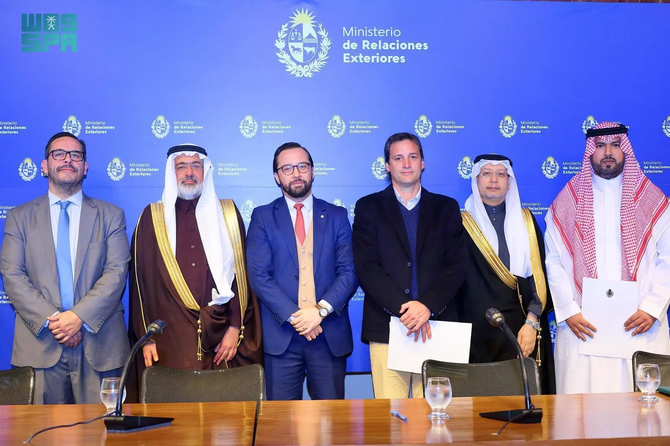
The Saudi Chambers and the Uruguay Exporters Association signed an agreement to establish a joint business council. SPA
2 / 3
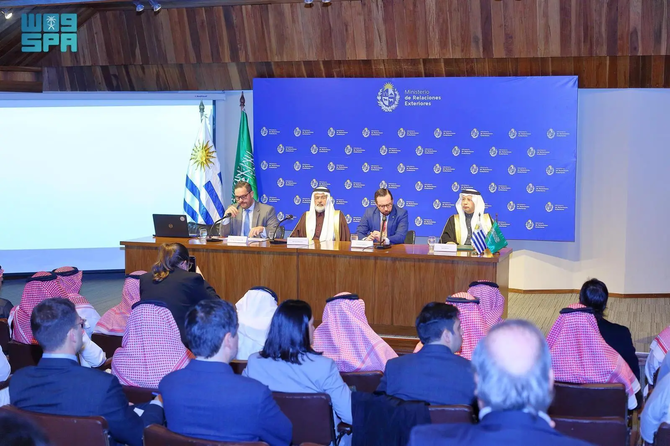
The Saudi Chambers and the Uruguay Exporters Association signed an agreement to establish a joint business council. SPA
3 / 3
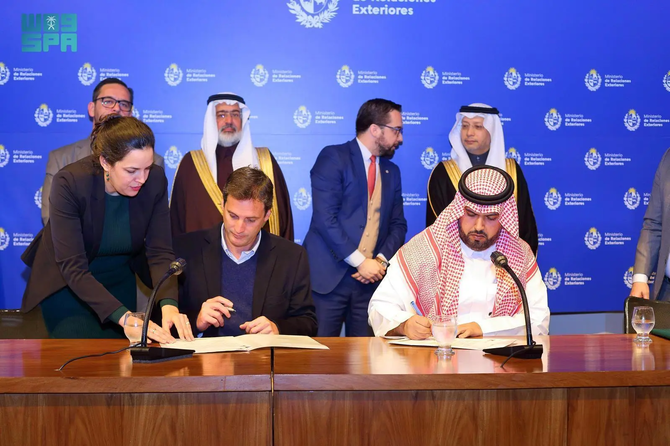
The Saudi Chambers and the Uruguay Exporters Association signed an agreement to establish a joint business council. SPA
Short Url
Updated 20 August 2024
Follow

Saudi Arabia, Uruguay boost bilateral trade with new joint business council

  • The inaugural meeting of the Saudi-Uruguayan joint committee concluded with the deal
  • Uruguay’s economy is expected to grow 3.4% this year and 3% next year

RIYADH: Trade relations between Saudi Arabia and Uruguay are poised to advance following the signing of a memorandum of understanding to establish a joint business council. 

The inaugural meeting of the Saudi-Uruguayan joint committee, held at Uruguay’s Ministry of Foreign Affairs in Montevideo, concluded with the deal, according to the Saudi Press Agency. 

The Saudi delegation was led by Ahmed Al-Khamshi, undersecretary of the Ministry of Environment, Water and Agriculture, while Deputy Foreign Minister Nicolas Albertoni headed the Uruguayan side. 

Uruguay, a country of just 3.5 million people sandwiched between giants Argentina and Brazil, is promoting investment options in a number of areas, with emphasis on agribusiness and renewable energy, and its capacity to be a new breadbasket for the Middle East and North Africa. 

Despite its size, Uruguay is the world’s ninth-largest exporter of rice, according to the US Department of Agriculture. It is the 17th-largest beef-producing country and the fourth-largest dairy exporter. 

While beef is certainly among Uruguay’s list of potential products, dairy could be the game-changer of the country’s trade relations with Saudi Arabia. 

Uruguay’s economy is expected to grow 3.4 percent this year and 3 percent next year, according to the International Monetary Fund. 

The Washington-based lender said the recovery of agricultural exports, increased cellulose production, the easing of financial conditions, robust private consumption, and a recovery in real wages are expected to support economic growth. 

In August 2023, a 60-member delegation from Saudi Arabia, led by Investment Minister Khalid Al-Falih, attended an investment forum in Montevideo.  

The visit underscored Saudi Arabia’s increasing focus on Uruguay as a key investment destination and was the third high-profile delegation visit from the Kingdom to Uruguay in the past 18 months.

The previous visit, which occurred just a month before, was headed by Foreign Affairs Minister Adel Al-Jubeir. This pattern of frequent high-level visits reflects the strengthening ties and growing economic interest between the two nations. 

According to the Observatory of Economic Complexity, Saudi Arabia exported $30.5 million worth of goods to Uruguay in 2022. This marked an increase of $10.5 million from 2017. The key Saudi exports to Uruguay included mixed mineral or chemical fertilizers and ethylene polymers. 

In the same year, Uruguay exported $17.3 million worth of goods to Saudi Arabia. The primary products in these exports were concentrated milk, butter, and frozen bovine meat.

This trade exchange highlights the growing economic relationship between the two countries, with Saudi Arabia focusing on industrial and chemical products, while Uruguay exports dairy and meat products. 


Saudi Arabia merges National Competitiveness Center and Saudi Business Center 

Updated 5 sec ago
Follow

Saudi Arabia merges National Competitiveness Center and Saudi Business Center 

RIYADH: Saudi Arabia has merged the National Competitiveness Center and the Saudi Business Center under a unified entity named the Saudi Competitiveness and Business Center to streamline business reforms. 

The decision was announced during the Cabinet session held in Jeddah on Feb. 24 and chaired by Crown Prince Mohammed bin Salman. 

Majid Al-Kassabi, minister of commerce and chairman of the boards of both centers, praised the leadership’s continued support for the private sector, saying the merger will enhance Saudi Arabia’s competitiveness and elevate its ranking in relevant international indicators and reports. 

He said the decision will enhance the Kingdom’s competitiveness and elevate its ranking in relevant indicators and reports. It will also facilitate procedures for starting and conducting economic businesses and provide all related services and work by adopting the best international methods and practices. 

Al-Kassabi said the Saudi Competitiveness and Business Center will continue delivering more than 6,000 government services to the business sector, in integration with relevant government entities, at the highest levels of quality and innovation. Services will be provided through the unified business platform and 20 branches across 15 cities. 

He said the merger will unify channels for monitoring challenges facing the private sector and implement targeted reforms to facilitate business, adding that it will enhance the Kingdom’s global competitiveness and maximize the benefits of partnerships with local and international entities and organizations, especially in knowledge transfer and the exchange of expertise. 

He said the center will work with the public and private sectors to place the Kingdom among the world’s most competitive countries and make its business environment a global model for the quality, smoothness and efficiency of government services directed to the business sector.