HONG KONG: Hong Kong journalists rated the city’s press freedom lower than ever in an annual survey released on Tuesday, citing fears of sweeping national security laws.
Published every year since 2013 by the Hong Kong Journalists Association (HKJA) and the Hong Kong Public Opinion Research Institute (HKPORI), the Press Freedom Index ranks the city’s media environment on a zero-to-100 scale — 100 being a perfect score.
It is based on a poll of over 250 working journalists and around 1,000 members of the public.
The rating this year among journalists dropped to a record low of 25, down 0.7 points from last year and 17 points from the survey’s launch.
More than 90 percent of the surveyed journalists said the city’s press freedom was “significantly” impacted by a new security law enacted in March which punishes crimes like espionage and foreign interference.
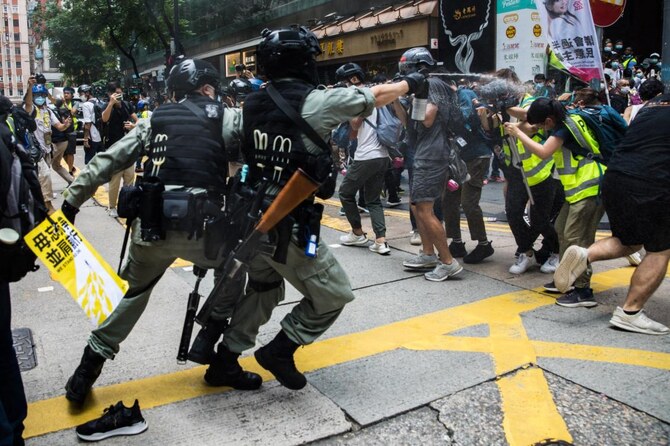
Colloquially known as Article 23, it was the second such law enacted for the financial hub, following one imposed by Beijing in 2020 after Hong Kong saw massive, and at times violent, pro-democracy protests.
Ninety-four percent of journalists also cited the prosecution of media tycoon Jimmy Lai, founder of the now-shuttered Chinese news tabloid Apple Daily, under the first law as being “highly damaging” to press freedom.
Other concerns included the disappearance of South China Morning Post reporter Minnie Chan in Beijing.
HKJA had previously released a statement saying it was “very concerned” about Chan, an award-winning journalist, who has been unreachable since attending a security forum in Beijing last year.
For the public, the overall rating was 42.2 — largely stable after the last major drop from 45 in 2018 to 41.9 in 2019.
“This discrepancy may be explained by the relatively less heated discussion around Article 23 compared to the 2020 National Security Law,” HKJA said in a statement.
However, journalists are “more cognizant of potentially running afoul of the new crimes created by Article 23 when reporting.”
China’s foreign ministry said Tuesday that Hong Kong’s security laws “target a very small number of individuals who severely endanger national security, not law-abiding media reporters.”
Since the laws’ implementation, “press freedom in Hong Kong has been better protected under a safe and stable environment in accordance with the law,” spokeswoman Mao Ning said at a regular press briefing.
The index’s publication came weeks after HKJA’s newly elected chairperson Selina Cheng was fired by the Wall Street Journal after she took up the new role.
The Journal’s parent company Dow Jones declined to comment on Cheng’s case but said at the time that it “continues to be a fierce and vocal advocate for press freedom.”


Hong Kong press freedom sinks to record low: journalist survey
https://arab.news/jfftc
Hong Kong press freedom sinks to record low: journalist survey

- The rating this year among journalists dropped to a record low of 25, down 0.7 points from last year and 17 points from the survey’s launch

Hezbollah says Israeli strike killed Al-Manar TV presenter in southern Lebanon
- The Israeli military said later on Monday that Al-Din was a Hezbollah militant who recently worked to rehabilitate the group’s artillery capabilities in southern Lebanon
The Lebanese armed group Hezbollah said on Monday that an Israeli strike in the country’s south killed TV presenter Ali Nour Al-Din, who worked for the group’s affiliated Al-Manar television station.
The group said the killing portends “the danger of Israel’s extended escalations (in Lebanon) to include the media community.”
The Israeli military said later on Monday that Al-Din was a Hezbollah militant who recently worked to rehabilitate the group’s artillery capabilities in southern Lebanon.
Israel and Lebanon agreed to a US-brokered ceasefire in 2024 to end more than a year of fighting between Israel and Hezbollah, which culminated in Israeli strikes that severely weakened the Iran-backed militant group. Since then, the sides have traded accusations over ceasefire violations.
Lebanon has faced growing pressure from the US and Israel to disarm Hezbollah. The group’s leaders fear that Israel could dramatically escalate strikes across the battered country, aiming to push the Lebanese government for quicker action to confiscate Hezbollah’s arsenal.


