

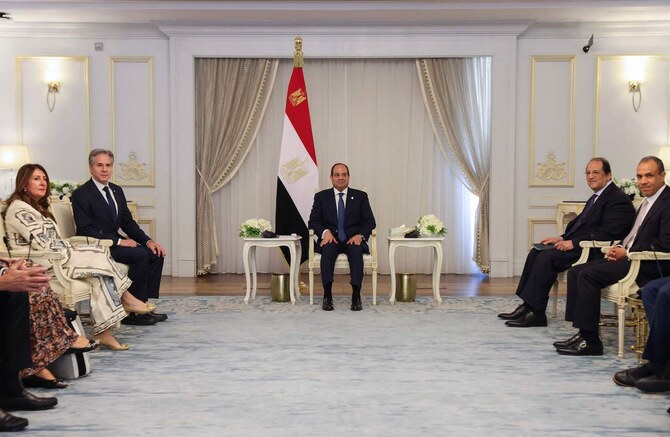
Egypt’s El-Sisi meets with US Secretary of State Blinken

US Secretary of State Antony Blinken meets with Egyptian President Abdel Fattah El-Sisi (C) and Egypt’s Foreign Minister Badr Abdelatty (R) in El-Alamein. (AFP)
Short Url
Updated 20 August 2024
Follow

Egypt’s El-Sisi meets with US Secretary of State Blinken

  • El-Sisi and Blinken exchanged views on the results of the latest negotiations, held last week in the Qatari capital, Doha, and on ways to achieve progress

CAIRO: President of Egypt Abdel Fattah El-Sisi has met with US Secretary of State Antony Blinken, underlining the robust strategic partnership between their two nations.

Their discussions also reaffirmed a commitment to advancing joint efforts to restore security and stability in the region.

The two sides reviewed the Egyptian-American-Qatari mediation efforts to reach a ceasefire in Gaza and bring about an exchange of hostages.

El-Sisi and Blinken exchanged views on the results of the latest negotiations, held last week in the Qatari capital, Doha, and on ways to achieve progress.

Blinken briefed El-Sisi on the outcome of his visit to Israel, stressing the US commitment to calming the situation and reaching an agreement. He expressed huge appreciation for Egypt’s role and constructive efforts.

El-Sisi emphasized that it was time to end the ongoing war, resort to the voice of reason and wisdom, and uphold the language of peace and diplomacy.

He warned of the dangers of the conflict expanding regionally and confirmed that saving lives should be a major driving force for all parties.

A ceasefire in Gaza must be the beginning of broader international recognition of an independent Palestinian state and the enforcement of the two-state solution, he said, adding this would be the fundamental guarantor for stability in the region.

The meeting was also attended by Egyptian Foreign Minister Badr Abdelatty and Director of the General Intelligence Service, Major General Abbas Kamel, as well as US Ambassador Herro Mustafa Garg.

The war in Gaza began on Oct. 7, 2023, when Hamas gunmen stormed into Israeli communities, killing around 1,200 people and abducting about 250 hostages, according to Israeli tallies.

Israel’s retaliatory military campaign in Gaza has killed more than 40,000 people since October according to Palestinian health authorities, and of the remaining hostages being held there.
On Tuesday, Israel’s military said it had recovered the bodies of six hostages from southern Gaza. According to Israeli authorities, 109 hostages now remain in the Palestinian territory, of whom around a third are believed to be dead.
In Gaza, Israeli forces battled Hamas-led militants in central and southern areas, and Palestinian health authorities said at least 21 people had been killed early on Tuesday in Israeli strikes, including on a school housing displaced people.
Israel’s military said it had struck Hamas militants embedded in the school.
Gaza’s Hamas-run health ministry said on Tuesday it was still waiting for polio vaccines to arrive after the disease was discovered in the territory, where most people now live in tents or shelters without proper sanitation. It echoed a call by the UN last week for a ceasefire to allow the vaccination campaign.


Aleppo Citadel is a witness to the city’s great history and legacy

This aerial view shows the Citadel of Aleppo overlooking the northern Syrian city on December 11, 2024. (AFP)
Updated 11 sec ago
Follow

Aleppo Citadel is a witness to the city’s great history and legacy

  • Parts of military fortress date back nearly 2 millennia
  • Historian Abdullah Hajjar provides an extensive study

DAMASCUS: Towering above the old city, the Aleppo Citadel has stood for centuries as both a military stronghold and symbol of the location’s layered history.

After years of closure, neglect, and damage during the war, the Aleppo Citadel reopened to visitors on Sept. 27 following months of restoration.

The site has been listed as a UNESCO World Heritage landmark since 1986.

Rising around 38 meters above its surroundings, the fortress has played a central role in Aleppo’s political, military, and urban development.

Surrounded by a deep defensive moat, the citadel reflects advanced military engineering.

According to historian Abdullah Hajjar in his book “Archaeological Landmarks of Aleppo,” first published in 2010, the moat was excavated and reinforced during the reign of Ayyubid ruler Al-Zahir Ghazi.

At times it was 22 meters deep and about 30 meters wide, and filled with water to strengthen defenses.
Parts of the citadel date back nearly two millennia.

The lower section of its main entrance originates from the third century A.D., while the upper additions were made in the 15th century. Most of the towers and walls were built or expanded between the 13th and 16th centuries.

The citadel has repeatedly been damaged and rebuilt over the centuries. It was destroyed by the Sassanids in 540 A.D., but later restored.

Inside its walls, the citadel contains mosques, military structures, and residential buildings, offering a rare glimpse into daily life within a medieval fortress.

Among its landmarks are the Ibrahim Al-Khalil Mosque, the Great Mosque, defensive towers, barracks, and several historic houses.

Archaeological excavations have uncovered remains from multiple eras. This includes a ninth-century B.C. temple, Roman and Byzantine sarcophagi, and water cisterns dating to the reign of Byzantine Emperor Justinian, who rebuilt Aleppo’s fortifications in the sixth century against Persian invaders.

The citadel flourished during the Mamluk period, when it was restored by Sultan Baybars after the 1260 Battle of Ain Jalut.

Later inscriptions document victories by Mamluk rulers over Crusader and Mongol forces.

Under Ottoman rule, following the Battle of Marj Dabiq in 1516, the fortress gradually lost its military role and became an administrative and residential site.

The book outlines the various stages of restoration of the Aleppo Citadel over the centuries.

It highlights that Al-Zahir Ghazi, son of Saladdine Ayyubi, excavated the moat, reinforced the entrance with three wrought-iron gates, and built a large mosque within the fortress.

Later, Al-Zahir Baybars restored the citadel after the Mongol invasion, and in 1417, Sultan Al-Mu’ayyad Shaykh repaired its walls following their destruction by Timur in 1401.

The Aleppo Citadel has also survived powerful earthquakes, including a devastating quake in 1138 and another in 1822, each followed by major restoration efforts led by regional rulers of the time.

Beyond the citadel itself, Hajjar’s research documents Aleppo’s wider architectural heritage, including historic bathhouses and caravanserais that once supported the city’s role as a major trade center.