Lawyers in UK file claims of Israeli atrocities in arms export ban case

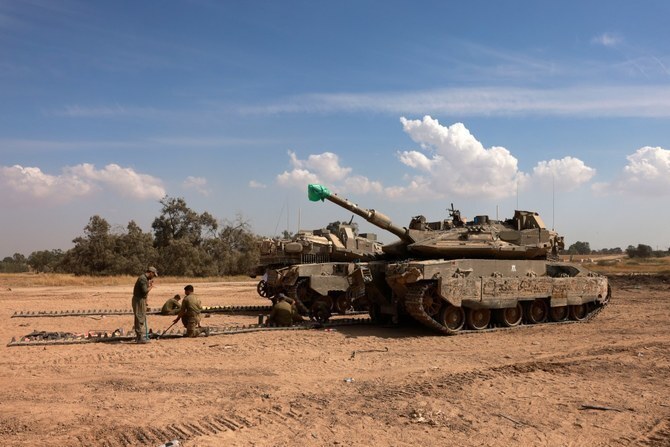
Israeli soldiers work on their tanks in an army camp near Israel's border with the Gaza Strip. (AFP/File Photo)
Short Url
Updated 19 August 2024
Follow

Lawyers in UK file claims of Israeli atrocities in arms export ban case

  • Doctors’ witness statements refer to cases of torture
  • ‘So many people are dying from issues that are completely treatable,’ says doctor who worked in Gaza

LONDON: Lawyers in the UK have filed claims of Israeli atrocities to the high court in London as they seek an order prohibiting British arms exports to Israel, The Guardian reported.

The evidence includes claims of Palestinian civilians being tortured, left untreated in the hospital and being given no escape from bombardment.

It comprises statements from Palestinian and Western medical doctors who worked in Gaza, as well as ambulance drivers and aid workers.

In total, the group of lawyers filed 14 witness statements spanning more than 100 pages.

In order for the ban to be granted, they must prove that the UK government has acted irrationally in refusing to end arms sales to Israel.

Part of the case will center around repeated government claims that the weapons sales would not result in violations of international law.

While the previous Conservative government was firm in continuing weapons exports to Israel, the new Labour government has said that the policy is under review.

The lawyers bringing the case are representing a coalition of nongovernmental organizations that includes Amnesty International, Oxfam, Human Rights Watch and Al-Haq.

All witnesses have been identified by the high court, but The Guardian only named two out of safety fears concerning the Gazan witnesses.

One, Dr. Ben Thompson, a Canadian kidney specialist, told the newspaper about the atrocities he had witnessed while working in Gaza.

He treated one patient who had been forced to stand for two days, and a 60-year-old man who had been stripped naked, and whose wrists were “worn down to the bone” after being bound and dragged across the floor.

Thompson said: “Every part of the healthcare system has been targeted and destroyed and is now completely incapable of providing care.

“So many people are dying from issues that are completely treatable.”

Three children under his care died due to a lack of appropriate medicine, he added.

In the Rafah tent city in March, civilians were forced to ration water to three liters a day per person, and there was one toilet for every 800 people, Thompson said.

On several occasions, he was forced to reset bones on patients who had no pain medication.

In one case at a severely overcrowded hospital, a man Thompson was caring for “died on the floor in a pool of his own blood and brain matter.”

Dr. Khaled Dawas, the second witness named by The Guardian, works as a consultant surgeon at University College Hospital in London.

He traveled to Gaza twice since the outbreak of violence last year to perform surgery.

Conditions in hospitals on both his trips “were what he imagined medieval medicine must have been like,” Dawas said.

Many of his patients were victims of Israeli sniper fire, he added.

“I understand that Israel justifies its attacks on hospitals by reference to its claim that the hospitals are overrun by militants, but in my four weeks in Al-Aqsa Hospital I personally did not see a single one,” Dawas said.

During his work in the enclave, he encountered many patients who had suffered wounds after being beaten in Israeli detention camps.

On Dawas’ second visit, he “found the morale of staff had deteriorated” and by April “there was a sense of fatalism that this would never end,” The Guardian reported.

One UK-based witness not named by The Guardian said that he and a group of doctors were bombed in a “safe zone” on Jan. 18 this year.

“The episode acted as an impetus for NGOs to stop sending humanitarian workers,” he added.

British diplomats in Cairo provided assurances that the bombing would be escalated to the highest level of the UK government.

But the witness said that no government official has contacted the medical team since the attack.


A macabre dispute has kept the body of Zambia’s former president unburied for months

Updated 3 sec ago
Follow

A macabre dispute has kept the body of Zambia’s former president unburied for months

LUSAKA: More than eight months after his death, former Zambian President Edgar Lungu’s remains are still in a South African funeral home, the subject of a macabre fight between his family and the longtime rival who succeeded him.
A graphic symbol of the dispute: an unfilled, coffin-size hole in a cemetery in Zambia’s capital, Lusaka, where the current president, Hakainde Hichilema, had hoped Lungu would be buried in a state funeral. But Lungu, in his last days, told his family members that Hichilema, even as a mourner, should never go near his body.
The matter has gone to the courts, which have repeatedly sided with Zambian authorities over Lungu’s wishes. Lungu’s family persists in seeking a burial that sidelines Hichilema.
So the body lies frozen in South Africa, where Lungu died, while Zambia endures a scandalous saga that offends traditional beliefs and raises many questions in a country where it is taboo to fail to bury the dead promptly and with dignity.
Behind the impasse is a long-running feud between two political rivals. It also reflects a spiritual contest between Hichilema, who is up for reelection in August, and Lungu, who is said to be fighting back from the dead, according to scholars and religious leaders who spoke to The Associated Press.
A spiritual battle
“It has shifted from the physical, it has shifted from politics, and it is now a spiritual battle,” said Bishop Anthony Kaluba of Life of Christ congregation in Lusaka.
Hichilema’s supporters see Lungu’s will as casting a curse, while they say a state funeral attended by Hichilema would be an act of generosity toward Lungu and his family.
The fight over a corpse can seem bizarre to others, but Lungu’s directive resonates with many Zambians.
Some have barred their enemies from attending their funerals, often blaming them for misfortune. Those quarrels are usually more private, not like the public drama of a former president who, facing death, retaliates against his rival in the harsh language of his ancestors.
Across Africa, last words are a “vital force” to enhance life or block it, said Chammah J. Kaunda, a Zambian professor of African Pentecostal theology who serves as academic dean of the Oxford Center for Mission Studies.
Elders facing death can impose curses or give blessings, and Lungu’s case shows that curses “can acquire a life of their own,” he said.
A vibrant democracy with traditional beliefs
Zambia is a vibrant democracy. Its founding president was the genial, handkerchief-waving Kenneth Kaunda, who was voted out of power in 1991, despite his status as an independence hero.
Like Kaunda, subsequent presidents have been civilians lacking the military strength of various authoritarians elsewhere in Africa, giving Zambia’s presidential hopefuls the opportunity to run on their own merits.
Even so, there’s a perception that some political leaders — like many of their compatriots — worry they might be bewitched. The feeling is widespread in a country where traditional religion thrives alongside Christianity, and a spoken curse is dreaded by many as spiritually enforceable if provoked by injustice.
“It is a weapon,” said Herbert Sinyangwe of WayLife Ministries in Lusaka. “We believe in our culture that curses work.”
In the case of three recent presidents — Michael Sata, Lungu and Hichilema — suspicion was rampant. The official presidential residence is now thought by many to be under a deadly spell because all the six former presidents are now dead. Hichilema works there but sleeps elsewhere.
Sata, who was president from 2011 to 2014, worried that Hichilema, then an opposition figure, was victimizing him even as he asserted that charms from his own region were stronger. Zambian authorities last year had two men convicted and jailed for allegedly plotting to kill the president by magic. Lungu’s family doesn’t trust Hichilema.
An empty tomb
The spot in Lusaka that would be Lungu’s tomb was quickly dug and built before it was known that Lungu’s family had objections, said cemetery caretaker Allen Banda. He warned that a tomb without a corpse was akin to digging “your own grave.”
“If nobody goes there, culturally it’s your body that’s going to go there,” he said.
That Hichilema is willing to risk public anger in opposing Lungu’s family has reinforced the views of those who see a spiritual battle between him and Lungu.
“On the one hand, nearly everything done by the Lungu family so far seems to have been designed to deny Hichilema access to Lungu’s body,” said Sishuwa Sishuwa, a Zambian historian who is a visiting scholar at Harvard. “On the other, Hichilema’s conduct so far suggests that he will do whatever it takes to secure access to Lungu’s corpse, perhaps because the president sees the issue as a matter of life and death.”
Lungu died June 5, 2025, after surgery-related complications. He was 68, and was treated for a narrowing of the esophagus.
A fight in court
To organize a state funeral, Zambian authorities would need to take custody of Lungu’s remains until they were interred. But Lungu’s family resisted Hichilema’s plans during negotiations over funeral proceedings.
They preferred to transport the corpse by private charter and had hoped to keep it at Lungu’s residence at night. They picked three people to look after it during the state funeral that never happened.
When Lungu’s family concluded that their wishes were not likely to be followed, they opted for a private funeral in South Africa. They were moving ahead with that ceremony when they found out that Zambian authorities had blocked it.
A South African court ruled in August that Zambian authorities could take Lungu’s body home for burial.
Bertha Lungu, the former president’s sister, was inconsolable in the courtroom after the ruling, wailing and cursing at Mulilo Kabesha, Zambia’s attorney general, who said it was time to take the corpse home. She asserted that Hichilema wanted the corpse for ritual purposes.
Hichilema denies malice toward Lungu, and has said his Christian faith forbids belief in traditional religion.
A bitter rivalry
Lungu rose to power after Sata’s death in 2014. Sata’s vice president, Guy Scott, was ineligible to seek the presidency in a 2015 vote and Lungu was picked to finish Sata’s term.
His main opponent was Hichilema, a wealthy businessman. It was a close race — Lungu won by under 28,000 votes.
After the 2016 election, won again by Lungu, Hichilema faced treason charges and was jailed for four months for allegedly failing to yield to the presidential motorcade.
Five years later, Lungu lost to Hichilema and said he would retire from politics. He changed his mind in 2023, and Zambian authorities withdrew Lungu’s retirement benefits.
Lungu faced more pressure after his wife and daughter were arrested in 2024 over fraud allegations tied to property acquisition.
When he fell sick, Lungu found it hard to leave Zambia. The government restricted his travels. He managed to slip away to South Africa early in 2025, buying a ticket at the airport counter. The incident was reported by the local press as a security lapse over which an airport manager was fired.
Lungu is “still influencing our politics from the grave,” said Emmanuel Mwamba, a Zambian diplomat who speaks for Lungu’s party. “His issues remain. How he was treated in life and how he was treated in death.”