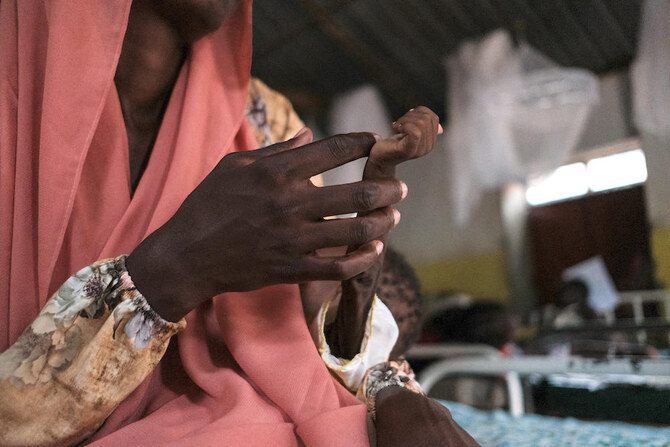
AMMAN: The United Nations warned Monday of a “deepening crisis” of malnutrition in the Middle East and North Africa affecting a third of children.
“At least 77 million — or 1 in 3 — children in the Middle East and North Africa (MENA) have some form of malnutrition,” the UN children’s agency UNICEF said in a statement.
It said 55 million children across the 20 countries assessed are overweight or obese, which UNICEF considers a type of malnutrition.
A further 24 million children suffer from undernutrition, including stunting, wasting and thinness, it said.
“The deepening crisis of malnutrition in the region is being driven by what and how children are fed, poor access to nutritious foods, clean water, medical care and other essential services, and the proliferation of cheap, unhealthy poor foods high in salt, sugar and fat,” it added.
This takes place amid “ongoing conflicts, political instability, climatic shocks, and rising food prices that together, deny children their right to nutritious food and limit humanitarian access to vulnerable communities.”
Only a third of young children are being provided with nutritious foods, said UNICEF regional director Adele Khodr.
“This is a shocking statistic in 2024 and risks becoming even worse as conflicts, crises and other challenges in our region persist,” she said.
UNICEF urged governments to focus on nutrition in their planning and policy.
UN agencies said last month that conflict, economic turmoil and climate change had hampered efforts last year to reduce hunger, affecting about nine percent of the world’s population.
In a report, they estimated that about 733 million people experienced hunger in 2023, a figure that has remained largely the same for three years after a sharp rise following the COVID-19 pandemic.
Moderate and severe food insecurity, which forces people to sometimes skip meals, affected 2.33 billion people last year — about 29 percent of the world’s population, they said.

UN says malnutrition crisis worsening in Middle East, North Africa
Short Url
https://arab.news/8bnzn
UN says malnutrition crisis worsening in Middle East, North Africa
- UNICEF: At least 77 million in the MENA region have some form of malnutrition
- Conflict, economic turmoil and climate change had hampered efforts last year to reduce hunger
Hamas official says Miami talks must end Israel’s Gaza truce ‘violations’
GAZA CITY: A top Hamas official said that talks in Miami on Friday to advance the next phase of the Gaza ceasefire must aim to end Israeli truce “violations” in the Palestinian territory.
US President Donald Trump’s special envoy, Steve Witkoff, is to meet senior officials from Qatar, Egypt and Turkiye in Florida on Friday, amid fears that efforts to reach the second stage of the deal are stalling.
“Our people expect these talks to result in an agreement to put an end to ongoing Israeli lawlessness, halt all violations and compel the occupation to abide by the Sharm El-Sheikh agreement,” Hamas political bureau member, Bassem Naim, told AFP.
Under the second stage, Israel is supposed to withdraw from its positions in Gaza, an interim authority is to govern the Palestinian territory instead of Hamas, and an international stabilization force is to be deployed.
But progress in moving to that phase of October’s agreement between Israel and Hamas, which was brokered by Washington and its regional allies, has so far been slow.
The ceasefire also remains fragile with both sides alleging violations, and mediators fearing that Israel and Hamas alike are stalling.
The health ministry in Hamas-run Gaza said on Thursday that at least 395 Palestinians have been killed by Israeli fire in the territory since the ceasefire came into effect on October 10.
Israel has also repeatedly accused Hamas of violating the ceasefire, with the Israeli military reporting three soldiers killed in the territory since the truce entered into force.
Naim said the new talks should boost entry of humanitarian aid into Gaza.
The talks should also focus on “the entry of aid, the opening of the Rafah crossing in both directions and the delivery of everything necessary for repairs and infrastructure rehabilitation,” Naim said.
He said talks should also address “how to implement the remaining elements of the Trump plan in a way that achieves sustainable stability, launches a comprehensive reconstruction process and paves the way for a political track enabling Palestinians to govern themselves, culminating in a fully sovereign and independent state.”
In the first phase of the Gaza deal, Palestinian militants committed to releasing the remaining 48 living and dead captives held in the territory.
To date, they have released all of the hostages except for one body.
But the Trump administration is now keen to proceed to the difficult second stage, with the provision for Hamas to lay down its weapons being a particular sticking point.
Hamas’s Gaza chief Khalil Al-Hayya said Sunday that the militant group had a “legitimate right” to hold weapons. Israel has repeatedly insisted Hamas “will be disarmed.”
The ceasefire’s third phase includes plans for the reconstruction of the vast areas of Gaza levelled by Israel’s retaliatory military campaign for Hamas’s October 2023 attack on Israel.
US President Donald Trump’s special envoy, Steve Witkoff, is to meet senior officials from Qatar, Egypt and Turkiye in Florida on Friday, amid fears that efforts to reach the second stage of the deal are stalling.
“Our people expect these talks to result in an agreement to put an end to ongoing Israeli lawlessness, halt all violations and compel the occupation to abide by the Sharm El-Sheikh agreement,” Hamas political bureau member, Bassem Naim, told AFP.
Under the second stage, Israel is supposed to withdraw from its positions in Gaza, an interim authority is to govern the Palestinian territory instead of Hamas, and an international stabilization force is to be deployed.
But progress in moving to that phase of October’s agreement between Israel and Hamas, which was brokered by Washington and its regional allies, has so far been slow.
The ceasefire also remains fragile with both sides alleging violations, and mediators fearing that Israel and Hamas alike are stalling.
The health ministry in Hamas-run Gaza said on Thursday that at least 395 Palestinians have been killed by Israeli fire in the territory since the ceasefire came into effect on October 10.
Israel has also repeatedly accused Hamas of violating the ceasefire, with the Israeli military reporting three soldiers killed in the territory since the truce entered into force.
Naim said the new talks should boost entry of humanitarian aid into Gaza.
The talks should also focus on “the entry of aid, the opening of the Rafah crossing in both directions and the delivery of everything necessary for repairs and infrastructure rehabilitation,” Naim said.
He said talks should also address “how to implement the remaining elements of the Trump plan in a way that achieves sustainable stability, launches a comprehensive reconstruction process and paves the way for a political track enabling Palestinians to govern themselves, culminating in a fully sovereign and independent state.”
In the first phase of the Gaza deal, Palestinian militants committed to releasing the remaining 48 living and dead captives held in the territory.
To date, they have released all of the hostages except for one body.
But the Trump administration is now keen to proceed to the difficult second stage, with the provision for Hamas to lay down its weapons being a particular sticking point.
Hamas’s Gaza chief Khalil Al-Hayya said Sunday that the militant group had a “legitimate right” to hold weapons. Israel has repeatedly insisted Hamas “will be disarmed.”
The ceasefire’s third phase includes plans for the reconstruction of the vast areas of Gaza levelled by Israel’s retaliatory military campaign for Hamas’s October 2023 attack on Israel.
© 2025 SAUDI RESEARCH & PUBLISHING COMPANY, All Rights Reserved And subject to Terms of Use Agreement.


