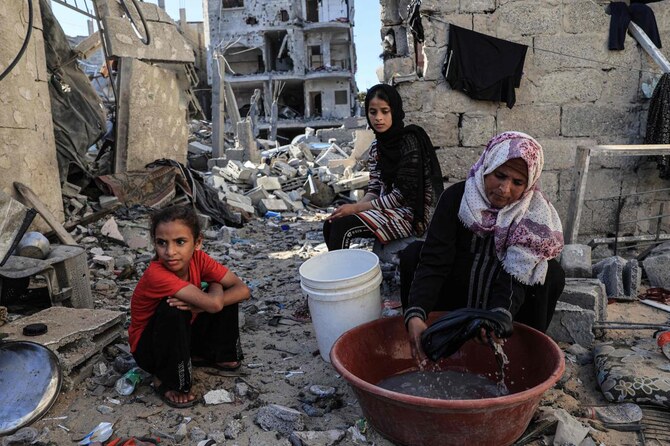


GAZA: For months, Safaa Yassin has dressed her child in the same white bodysuit, an all-too-familiar tale in the Gaza Strip, which has been devastated by 10 months of war.
“When I was pregnant, I dreamed of dressing my daughter in beautiful clothes. Today, I have nothing to put on her,” says Yassin, one of thousands of Palestinians displaced from Gaza City.
“I never thought that one day I wouldn’t be able to dress my children,” says the 38-year-old, now living in Al-Mawasi, a coastal area designated as a humanitarian zone by Israeli forces.
“But the few clothes I found before evacuating to the south were either the wrong size or not suitable for the season,” she adds, as Gaza bakes in summertime temperatures of 30-plus degrees Celsius (86 Fahrenheit) every day.
Finding clothing — any clothing — has become increasingly difficult for the 2.4 million people living in the territory besieged by Israel.
Gaza once had a thriving textiles industry but since the war began on October 7 with Palestinian militant group Hamas’s unprecedented attack on Israel, it has received just a trickle of goods.
Faten Juda also struggles to dress her 15-month-old son, Adam, who is squeezed into ill-fitting pyjamas, his bare arms and legs sticking out from the tight fabric.
“He’s growing every day and his clothes don’t fit him anymore, but I can’t find any others,” the 30-year-old tells AFP.
Children are not the only ones suffering from the lack of clothing in the Gaza Strip, which counted 900 textile factories in the industry’s heyday in the early 1990s.
The sector employed 35,000 people and sent four million items to Israel every month. But those numbers have plummeted since 2007, when Hamas took power and Israel blockaded Gaza.
In recent years, Gaza’s workshops had dwindled to about 100, employing about 4,000 people and shipping about 30,000-40,000 items a month to Israel and the Israeli-occupied West Bank.
By January, three months into the war, the World Bank estimated that 79 percent of Gaza’s private sector establishments had been partially or totally destroyed.
Even the factories that are still standing have ground to a halt, after months without electricity in Gaza. Any fuel that arrives for generators is mainly used for hospitals and United Nations facilities such as warehouses and aid-supply points.
In these conditions, finding new clothes is a rare event.
“Some women have been wearing the same headscarf for the past 10 months,” Philippe Lazzarini, head of UNRWA, the UN agency in charge of Palestinian refugees, posted on X.
Wearing the same clothes all the time is not just unpleasant, it is a health hazard. With limited water to wash them, disease-spreading lice abound.
Ahmed Al-Masri, 29, left his home in the north of Gaza at the start of the war.
Today in Khan Yunis, in the south, he says he does not have any spare shoes or clothes.
“My shoes are extremely damaged. I’ve had them repaired at least 30 times, each time paying 10 times more than before the war,” he says, his gaunt face burnt by the sun.
POVERTY AND DISPLACEMENT
With two-thirds of Gaza’s population living in poverty even before the war, many people were forced to sell their clothes once the conflict broke out and tanked the economy further.
But “there are no more shoes or clothes to sell,” says Omar Abu Hashem, 25, who was displaced from Rafah, on the Egyptian border, to Khan Yunis further north.
Abu Hashem left his home in such a rush that he was unable to take anything with him. He has been wearing the same pair of shoes for five months, but only every other day.
“I share my pair of shoes with my brother-in-law,” he explains.
On the days when he goes barefoot, he fears the worst, tiptoeing around the waste and rubble that carry diseases and contamination of all kinds.
Ahmed Al-Masri, meanwhile, just wants some soap to wash his only T-shirt and pair of trousers.
“I have been wearing the same clothes for nine months. I have nothing else. I quickly wash my T-shirt and then I wait for it to dry,” he says.
“And all this, without soap or detergent.”