Pakistan IT minister says government neither slowed nor shut down Internet 

1 / 2
Pakistan’s State Minister for Information Technology (IT) Shaza Fatima Khawaja is addressing a press conference in August 18, 2024. (PID)
2 / 2
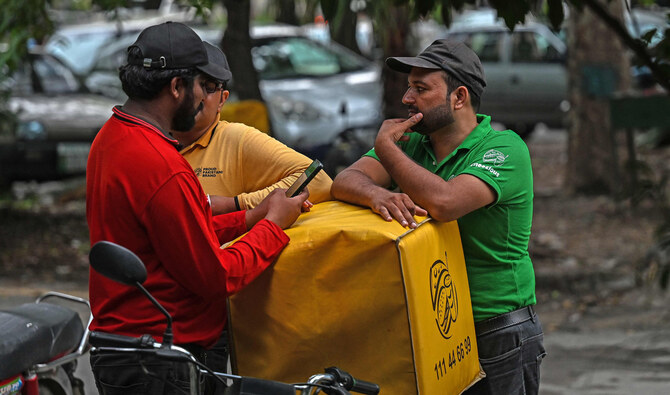
A food delivery man uses his mobile phone near a restaurant in Islamabad on August 17, 2024. (AFP)
Short Url
Updated 19 August 2024
Follow

Pakistan IT minister says government neither slowed nor shut down Internet 

  • Shaza Fatima Khawaja says Internet slowed down because too many people had used virtual private networks 
  • Wireless and Internet Service Providers Association of Pakistan confirmed Internet speed slowed down by 30-40 percent this week 

ISLAMABAD: Pakistan’s State Minister for Information Technology (IT) Shaza Fatima Khawaja on Sunday rejected reports that the government was responsible for slowing or shutting down Internet across the country, saying that the use of virtual private networks (VPNs) by the masses was responsible for the disruption. 

Pakistani freelancers and Internet users this week complained of slow Internet across the country. The Wireless and Internet Service Providers Association of Pakistan (WISPAP) confirmed this week that Internet speed had slowed down by 30-40 percent. 

The development took place as the government moved to implement a nationwide firewall to block malicious content, protect government networks from attacks, and allow the government to identify IP addresses associated with what it calls “anti-state propaganda.”

A firewall is a network security device that monitors and filters incoming and outgoing network traffic based on predetermined security parameters. It acts as a barrier whose main purpose is to allow non-threatening traffic in and to keep dangerous and undesirable traffic out.

“I can tell you under oath that the government did not shut down the Internet nor was it slowed down,” Khawaja told reporters at a news conference. 

The minister explained that when users in Pakistan download a photograph or stream any video content online, they are provided Internet by local content delivery networks (CDNs), adding that they do not access live Internet from abroad. 

She said the country’s majority Internet bandwidth is being run by local CDNs and caches. However, the minister said that once a person uses a VPN, they bypass the CDNs and access Internet directly from the live Internet server from overseas. 

“What happens is that when a lot of people stop using these caches and go to the live Internet, then it puts the pressure on the entire Internet and you see a general slowdown of the Internet,” she explained. 

Khawaja said that the Internet had slowed down for a few days due to the “natural pressure” exerted on it by people who were using VPNs. The minister said she would consult technical experts and Internet service providers next week to figure out a way to ensure such Internet disruptions do not happen again. 

The president of the Pakistan Freelancers Association (PAFLA) said this week that the businesses of over 2.3 million Pakistani freelancers had suffered due to the slow Internet. 

“Not only freelancers but IT companies and e-commerce businesses are also affected by the significant degradation in Internet speed,” PAFLA President Tufail Ahmed told Arab News on Thursday. 

Pakistani freelancers, meanwhile, had also complained that slow Internet was hitting their earnings hard. 

Usman Mehmood, a freelance video animator since 2014, said slow Internet was disrupting timely communication with clients and completion of work.

“In our work time delivery of the project is essential, otherwise the client will move to [freelancers in] other countries, which is happening now,” Mehmood told Arab News on Thursday. 

“It should be fixed at the earliest to save all the freelancer’s work.”


World Bank approves $400 million to expand water, sanitation services in Pakistan’s Punjab

Updated 12 December 2025
Follow

World Bank approves $400 million to expand water, sanitation services in Pakistan’s Punjab

  • Project aims to improve access for 4.5 million people and curb waterborne diseases
  • Program to prioritize women’s participation and climate-resilient urban infrastructure

ISLAMABAD: The World Bank this week approved $400 million for a new project to expand access to safe water, sanitation and hygiene services for around 4.5 million people in Pakistan’s most populous Punjab province, aiming to curb waterborne diseases and reduce long-term public health costs.

The project, known as the Punjab Inclusive Cities Program (PICP), is the second phase of the World Bank-supported Pakistan Urban Water, Sanitation and Hygiene Services Multiphase Programmatic Approach. It will focus on rehabilitating water supply networks, sewerage systems and wastewater treatment plants, while expanding stormwater drainage infrastructure across 16 secondary cities in Punjab.

Punjab faces persistent challenges in providing safe drinking water and adequate sanitation, with many urban households relying on contaminated sources. Weak infrastructure and limited hygiene services contribute to high rates of waterborne diseases such as diarrhea, typhoid and hepatitis, which disproportionately affect children and low-income communities.

“Reducing child stunting is essential for Pakistan’s future. Through the Punjab Inclusive Cities Program, we are investing in safe water, sanitation, and hygiene services to break the cycle of malnutrition and disease that holds back so many children from reaching their full potential,” the World Bank quoted its Country Director for Pakistan, Bolormaa Amgaabazar, as saying in a statement.

“In collaboration with the Punjab Government, the program represents a significant step forward in improving urban infrastructure and strengthening local institutions, thereby laying the foundation for healthier communities and a more prosperous Pakistan.”

Child stunting, a form of chronic malnutrition that leaves children too short for their age, is often linked to repeated infections, poor sanitation and unsafe drinking water, and remains a major public health concern in Pakistan.

Beyond water and sanitation, the project will also support solid waste management systems to improve sanitary waste disposal, extending services to an additional two million people in Punjab’s urban areas. The program will strengthen the capacity of local governments, including efforts to improve revenue generation and long-term service sustainability.

“The program complements infrastructure investments with capacity building and revenue generation, helping to ensure that service delivery is well sustained,” the statement quoted Amena Raja, Senior Urban Specialist at the World Bank, as saying.

“It will also help Punjab’s cities better withstand floods and droughts, ensuring urban development is both environmentally responsible and resilient to climate change.”

The program includes a gender-focused component, prioritizing the hiring of women in decision-making roles, establishing gender-compliant service desks and supporting skills development. It also aims to mobilize private capital to support water and sanitation services in Punjab’s secondary cities.

Pakistan has been a member of the World Bank since 1950 and has received more than $48 billion in assistance since. The Bank’s current portfolio in the country comprises 54 projects with total commitments of $15.7 billion, while its private-sector arm, the International Finance Corporation, has invested about $13 billion since 1956.

Earlier this year, Pakistan and the World Bank signed a first-of-its-kind agreement for a plan to focus $20 billion in lending to the cash-strapped nation over the coming decade on development issues like the impact of climate change as well as boosting private-sector growth.