Ukraine ‘strengthens positions in Russia’s Kursk’

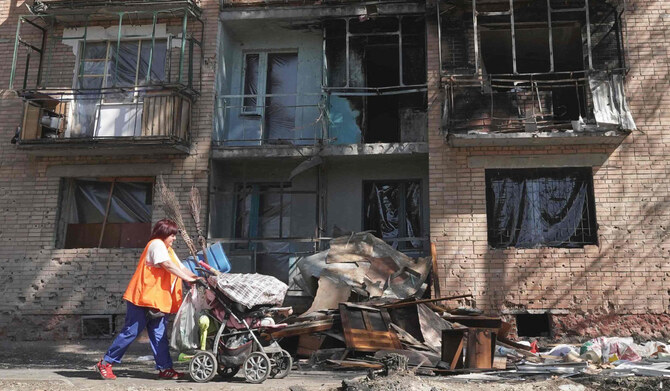
Ukrainian troops ‘continued their advance and also took more Russian servicemen as prisoners.’ (AFP)
Short Url
Updated 17 August 2024
Follow

Ukraine ‘strengthens positions in Russia’s Kursk’

  • Russia has called the incursion a major provocation and vowed to retaliate with a “worthy response,” more than 2-1/2 years since it launched a full-scale invasion of Ukraine

KYIV: Ukrainian President Volodymyr Zelenskyy on Saturday said his troops had strengthened positions and expanded territory in Russia’s Kursk region nearly two weeks into their incursion.
Ukraine says it has seized more than 80 settlements over 1,150 square km (444 square miles) in Kursk since Aug. 6 in the biggest invasion of Russia since WWII.
Zelenskyy said his army chief Oleksander Syrskyi had reported that Ukrainian troops continued their advance and also took more Russian servicemen as prisoners.
“Thank you to all the soldiers and commanders who are taking Russian military prisoners and bringing the release of our soldiers and civilians held by Russia closer,” Zelenskyy said in a statement on the Telegram messaging app.
“General Syrskyi also reported on strengthening our forces’ positions in the Kursk region and expanding the stabilized territory.”
The Ukrainian military said in its daily report that troops were successfully advancing further in Kursk, without offering more details. It had previously reported 35 km of advances.
Russia has called the incursion a major provocation and vowed to retaliate with a “worthy response,” more than 2-1/2 years since it launched a full-scale invasion of Ukraine.
Moscow says Ukraine has been using Western arms, including probably US-made HIMARS rockets to destroy a bridge and kill volunteers trying to evacuate civilians.
Zelenskyy also said that Ukrainian troops had repelled dozens of Russian attacks near Pokrovsk and Toretsk in Ukraine’s Donetsk region. The military said 51 Russian attacks were stopped near Pokrovsk, a major logistics hub in the eastern region, and another 13 near the town of Toretsk in the last 24 hours.
“Our soldiers and units are doing everything to destroy the occupier and repel the assaults. The situation is under control,” Zelenskyy said.


Japan reaffirms no-nukes pledge after senior official suggests acquiring weapons

Updated 58 min 39 sec ago
Follow

Japan reaffirms no-nukes pledge after senior official suggests acquiring weapons

  • The unnamed official said Japan needed nuclear weapons because of a worsening security environment
  • At a regular press briefing in Tokyo, Chief Cabinet Secretary Minoru Kihara said Japan’s nuclear policy had ‌not changed

TOKYO: Japan reaffirmed its decades-old pledge never to possess nuclear weapons on Friday after local media reported that a senior security official suggested the country should ​acquire them to deter potential aggressors.

The unnamed official said Japan needed nuclear weapons because of a worsening security environment but acknowledged that such a move would be politically difficult, public broadcaster NHK and other outlets reported, describing the official as being from Prime Minister Sanae Takaichi’s office.
At a regular press briefing in Tokyo, Chief Cabinet Secretary Minoru Kihara said Japan’s nuclear policy had ‌not changed, but declined ‌to comment on the remarks or ‌to ⁠say whether ​the ‌person would remain in government. There is a growing political and public willingness in Japan to loosen its three non-nuclear principles not to possess, develop or allow nuclear weapons, a Reuters investigation published in August found.
This is driven in part by doubts over the reliability of US security guarantees under President Donald Trump and growing threats from nuclear-armed ⁠China, Russia and North Korea.
Japan hosts the largest overseas concentration of US military forces ‌and has maintained a security alliance with Washington ‍for decades.
Some lawmakers within Takaichi’s ‍ruling Liberal Democratic Party have said the United States should ‍be allowed to bring nuclear weapons into Japan on submarines or other platforms to reinforce deterrence. Takaichi last month stirred debate on her own stance by declining to say whether there would be any changes to the ​three principles when her administration formulates a new defense strategy next year.
“Putting these trial balloons out creates an opportunity ⁠to start to build consensus around the direction to move on changes in security policy,” said Stephen Nagy, professor at the department of politics and international studies at the International Christian University in Tokyo.
Beijing’s assertiveness and growing missile cooperation between Moscow and Pyongyang are “creating the momentum to really change Japan’s thinking about security,” he added.
Discussions about acquiring or hosting nuclear weapons are highly sensitive in the only country to have suffered atomic bombings, and risk unsettling neighboring countries, including China.
Ties between Tokyo and Beijing worsened last month after Takaichi said a ‌Chinese attack on Taiwan that also threatened Japan could constitute a “survival-threatening situation” and trigger a military response.