

Pakistan PM orders strict monitoring after WHO declares mpox public health emergency

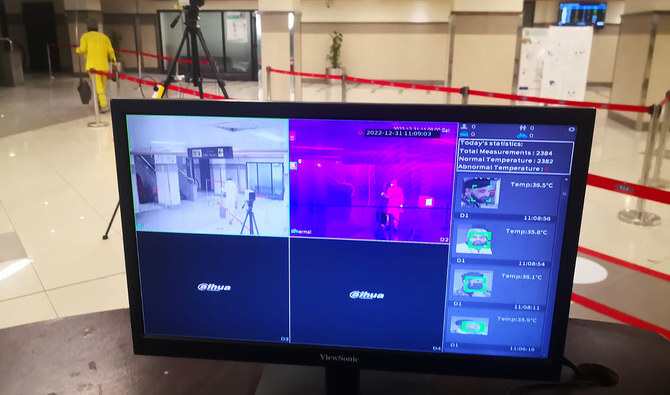
A photograph taken on December 31, 2022, shows a thermal scanner connected to a monitor to detect body temperatures of inbound travelers at the Peshawar airport. (Photo courtesy: CAA)
Short Url
Updated 17 August 2024
Follow

Pakistan PM orders strict monitoring after WHO declares mpox public health emergency

  • PM Sharif asks relevant authorities to ensure provision of necessary equipment and kits for mpox testing
  • He emphasizes effective and comprehensive awareness campaign to prevent the spread of the disease

ISLAMABAD: Prime Minister Shehbaz Sharif on Saturday called for strict monitoring to prevent the spread of mpox after the World Health Organization (WHO) declared it a public health emergency.
Mpox causes flu-like symptoms and pus-filled lesions. The WHO declared the recent outbreak of the disease a public health emergency after a new offshoot of the mpox virus, first identified in the Democratic Republic of Congo, began spreading to other neighboring states.
Pakistan also announced precautionary measures against the disease after mpox was diagnosed in a patient in northwestern Khyber Pakhtunkhwa province who had recently returned to the country after traveling abroad.
Addressing a meeting to evaluate the situation, the prime minister demanded enhanced effectiveness of mpox screening systems at the airports.
“Prime Minister directed border health services to maintain thorough monitoring and strict surveillance of the situation,” said a statement circulated by his office after the meeting.
“He also directed improving coordination with provincial governments, the government of Gilgit-Baltistan and the government of Azad Jammu and Kashmir to prevent the spread of mpox,” it added.
The prime minister also emphasized effective and comprehensive awareness campaign to prevent the spread of the disease.
“Ensure the provision of all necessary equipment and kits for mpox testing,” he was quoted as saying. “I will receive weekly briefings on Mpox.”
The meeting was informed that there was currently no local transmission of the disease in Pakistan.
NO MAJOR EMERGENCY
Earlier, the prime minister’s health coordinator, Dr. Mukhtar Ahmed Bharth, noted that, unlike the COVID-19, the WHO has not declared a major emergency regarding the rising mpox cases in globally, adding that the disease spreads through close contact with infected people and has a low mortality rate.


Dr. Mukhtar Ahmed Bharth, prime minister’s health coordinator, speaks during a press briefing at the Pakistan Television (PTV) Headquarters in Islamabad on August 17, 2024. (APP)

“The World Health Organization has not yet declared [a major] emergency situation regarding mpox, similar to what was done for COVID-19,” he said during a news conference in Islamabad.
“The virus has been found in 99,000 people worldwide,” he continued. “Only 200 patients have died, while all other individuals have recovered.”
Bharth acknowledged it was difficult to diagnose the disease at an early stage since its symptoms appear a bit late in patients.
“The virus can spread if you spend a lot of time with the patient,” he said. “It is better to quarantine the patient.”
He informed the WHO had advised against mass vaccination while dealing with mpox.
“This disease is 99 percent treatable. There is no immediate risk of death, but if the affected person has comorbidities, they need to be more cautious,” he added.
The prime minister’s health coordinator said Pakistan had so far reported 11 mpox cases since last year, with only one death of a patient who suffered from HIV and had a weak immune system.
Pakistan reported its first mpox case on April 11, 2023.
It has initiated a comprehensive passenger screening system at airports and urged people to take necessary precautions.


Pakistan urges concessional finance for developing nations to boost clean energy security

Updated 11 January 2026
Follow

Pakistan urges concessional finance for developing nations to boost clean energy security

  • Pakistan has emerged as one of world’s fastest growing solar markets, with 12GWs of off-grid and 6GWs of net-metered capacity in 2025
  • PM’s aide says Islamabad remains committed to Paris Agreement, looks for continued support in building a resilient and low-carbon future

ISLAMABAD: Pakistan has urged international partners to scale up concessional financing for developing countries, the country’s Press Information Department (PID) said on Sunday, citing an aide to Prime Minister Shehbaz Sharif.

The call was made by Sharif’s coordinator on climate change, Romina Khurshid Alam, while delivering Pakistan’s national statement at the 16th International Renewable Energy Agency (IRENA) Assembly in Abu Dhabi.

Pakistan has emerged as one of the world’s fastest growing solar markets, with 12 gigawatts (GWs) of off-grid and over 6GWs of net-metered solar capacity by the end of 2025. Last fiscal year, renewables accounted for a historic 53 percent of total electricity generation, according to Alam.

The prime minister’s aide stressed that affordable funding for developing nations is critical to accelerating their transition to clean energy and strengthening energy security amid rising climate and economic challenges.

“Alam reaffirmed Pakistan’s target of achieving 60 percent renewables in the power mix by 2030,” the PID said in a statement.

“In her call to action, she urged IRENA and Member States to increase concessional finance for developing nations, treat technologies such as energy storage and green hydrogen as global public goods, and strengthen regional cooperation for shared energy security.”

IRENA is a global intergovernmental agency for energy transformation that serves as the principal platform for international cooperation, supports countries in their energy transition, and provides state of the art data and analyzes on technology, innovation, policy, finance and investment. Its membership comprises 170 countries and the European Union (EU).

The 16th session of the IRENA Assembly is taking place on Jan. 10-12 in Abu Dhabi and focuses on the theme of “Powering Humanity: Renewable Energy for Shared Prosperity.” The session has gathered global leaders and energy decision-makers to discuss strategies and underline necessary actions for the acceleration of renewable energy across countries, regions, and the world, driving economic inclusion, equity, and human well-being.

Alam shared that Pakistan is taking action against energy poverty through initiatives like the Punjab Solar Panel Scheme 2026, which provides free or subsidized systems to low-income households.

She highlighted how distributed solar kits have restored power and livelihoods in flood-affected communities and offer a replicable model for climate-resilient recovery.

“Pakistan remains fully committed to the Paris Agreement and looks to IRENA for continued technical and financial support in building a resilient, inclusive, and low-carbon future,” Alam said.

Adopted in 2015 to combat climate change, the Paris Agreement binds nations to hold “the increase in the global average temperature to well below 2°C above pre-industrial levels” and pursue efforts “to limit the temperature increase to 1.5°C above pre-industrial levels.”