

Hezbollah attacks Israeli settlement in response to Nabatieh massacre 

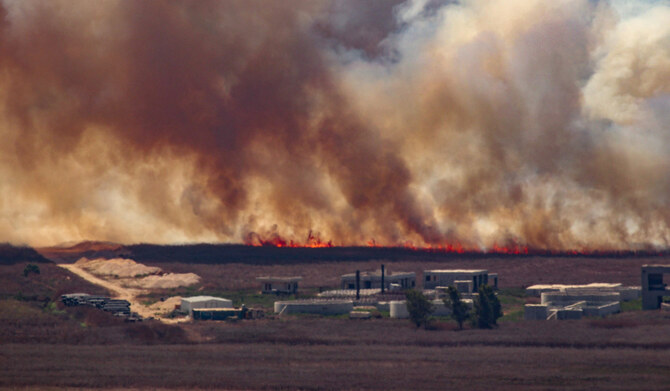
Fire sweep over the Marjayoun plain in southern Lebanon near the border with Israel after being hit by Israeli shelling on August 16, 2024, amid the ongoing cross-border clashes between Israeli troops and Hezbollah fighters. (AFP)
Short Url
Updated 17 August 2024
Follow

Hezbollah attacks Israeli settlement in response to Nabatieh massacre 

  • Southern Lebanon suffers from growing displacement and food shortages amid fighting
  • Woman and two children among those killed

BEIRUT: Hezbollah said on Saturday that it struck the Ayelet Hashahar kibbutz in northern Israel in retaliation for a new massacre in southern Lebanon.

The Israeli military said that two soldiers were wounded in a rocket attack from Lebanon, adding that a total of 55 rockets had been fired in the latest strikes.

Hezbollah said that its attack came in response to “the Israeli army’s assaults on the Kfour village in Nabatieh, north of the Litani Line, earlier on Saturday, killing 10 people, including Syrian children and their mother, and injuring others, including Sudanese workers.”

Hezbollah said that it added Ayelet HaShahar to its firing schedule and struck the settlement with Katyusha rockets for the first time.

According to Hezbollah’s military media, the settlement “is located northeast Safad in the upper Galilee and some 10 km from the Lebanese southern border.”

In another statement, Hezbollah announced “targeting a gathering of Israeli soldiers in the Al-Burj site with two attack drones, hitting it directly.”

Israeli media outlets said that “the barrage of rockets fired from Lebanon toward the north landed in areas that weren’t evacuated, causing fires to erupt.”

They added that “violent explosions were heard in Safad and its surroundings, in addition to heavy shelling with dozens of rockets launched from Lebanon toward the upper Galilee, causing casualties.

“Ambulances headed to the perimeter of the Mahanayim intersection, while the Hatzor HaGlilit area experienced a power outage following the bombing.”

Israeli Army Radio said that “around 40 rockets were launched from Lebanon toward the upper Galilee.”

The Israeli media reported that “a drone exploded in Margaliot, the upper Galilee,” adding that “settlers of areas located in the Hula valley in the upper Galilee were instructed to stay near shelters.”

Tension escalated on the Lebanese southern border on Friday night and Saturday morning, as 10 people died in Kfour, Nabatieh, as a result of an Israeli raid that targeted a building in the village.

The raid hit a cement stone factory in the industrial zone of Toul-Kfour.

It is the second Israeli attack on the village, hundreds of meters from a previous raid that destroyed a house last week.

The raid killed an entire Syrian family, comprised of the factory’s janitor, the mother, and their children, and injured others, including Syrian and Sudanese workers.

Rescuers worked on lifting the rubble until the morning.

The Ministry of Health’s emergency operations center said that the raid killed 10 people, including a woman and her two children, and injured five others, including two critical injuries.”

Israeli army spokesperson Avichay Adraee claimed that the forces “raided a Hezbollah weapons storage.”

Adraee said that several raids targeted “Hezbollah military buildings in Hanine and Maroun Al-Ras” on Friday night and Saturday morning.

The Israeli army immediately responded to the attack that targeted the new settlement, as a military drone struck a motorcycle northeast of Tyre, killing one person, according to the emergency operations center.

According to the center, the Israeli shelling of border villages caused injuries to a citizen in Khiam.

It resulted in the death of one person and the injury of another in an Israeli airstrike in Aitaroun.

Hezbollah’s release of a video on Friday showing tunnels it uses for military purposes in the mountains sparked criticism from Lebanese people on social media, including opposition politicians and activists.

The head of the Lebanese Forces Party, Samir Geagea, said: “Hezbollah has no right, even if it has one or more underground facilities, to single-handedly decide the fate of the Lebanese people.”

Fares Souaid, the head of the “Lady of the Mountain” Gathering, described the tunnel video as “fake.”

Political analyst Khaled Mumtaz stated that the video was an unjustified revelation.

He believes it reflects a desperate attempt to regain prestige against the Israelis.

He said the Israelis struck the party in its stronghold and killed its general commander. So far, Mumtaz said the party had been unable to respond or boost the morale of its community and fighters.

University academic Makram Rabah addressed Hezbollah, saying: “If you can build such tunnels, why didn’t you build shelters in the south? It is an unethical act.”

Also on Saturday, the UN Office for the Coordination of Humanitarian Affairs, or OCHA, reported that the number of displaced people from the southern border area had risen to more than 110,000 as the exchange of fire continued between the Israeli army and Hezbollah.

Lebanese government statistics indicated 97,000 people were displaced from the south as of last month.

In its latest update, OCHA stated that “35 percent of the displaced are children,” adding that estimates suggest that about 150,000 people remained in the border areas of southern Lebanon.

“According to the World Health Organization, 16 attacks on health care have been reported since October last year, and 21 paramedics have been killed in hostilities. Severe damage to water, electricity, telecoms infrastructure, and roads in southern Lebanon have been recorded.”

OCHA said food insecurity had worsened, with 23 percent of the population now affected, up from 19 percent in March.

“The UN and partners continue to scale up relief efforts to support the government-led response. But additional funding is urgently needed. Humanitarian partners need $110 million for ongoing response for conflict-affected people until the end of the year,” OCHA said.


Iran launches missiles at Israel as attacks in Middle East commence for a sixth day

Updated 22 min 18 sec ago
Follow

Iran launches missiles at Israel as attacks in Middle East commence for a sixth day

  • IRGC: Strikes against Iran would result in “the complete destruction of the region’s military and economic infrastructure”
  • Drones and missiles intercepted in different countries, including Turkiye and Saudi Arabia, after IRGC warning

DUBAI: Iran launched missiles at Israel early Thursday as aerial attacks in the Middle East commenced for a sixth day after an American submarine sank an Iranian warship and Iran threatened the destruction of military and economic infrastructure across the region.
Israel announced the incoming attack shortly after its military said it had begun new strikes in Lebanon targeting the Iranian-backed Hezbollah militant group in Beirut’s southern suburbs.
The fighting continued after the US and Israel intensified their bombardment Wednesday of Iran’s security forces and other symbols of power.
The tempo of the strikes on Iran was so intense that state television announced the mourning ceremony for Iranian Supreme Leader Ayatollah Ali Khamenei, who was killed at the start of the conflict, would be postponed. Millions attended the funeral of his predecessor, Ayatollah Ruhollah Khomeini, in 1989.
The US and Israel launched the war Saturday, targeting Iran’s leadership, missile arsenal and nuclear program while suggesting that toppling the government is a goal. But the exact aims and timelines have repeatedly shifted, signaling an open-ended conflict.
President Donald Trump praised the US military Wednesday for “doing very well on the war front, to put it mildly.” Fellow Republicans in the US Senate stood with Trump on Iran as they voted down a resolution seeking to halt the war.
Iran fired on Bahrain, Kuwait and Israel as the conflict spiraled. Turkiye said NATO defenses intercepted a ballistic missile launched from Iran before it entered Turkiye’s airspace.
The war has killed more than 1,000 people in Iran, more than 70 in Lebanon and around a dozen in Israel, according to officials in those countries. It has disrupted the supply of the world’s oil and gas, snarled international shipping and stranded hundreds of thousands of travelers in the Middle East.

Buildings of Iranian military and security forces targeted
US Defense Secretary Pete Hegseth said a torpedo from an American submarine sank an Iranian warship Tuesday night in the Indian Ocean.
Sri Lankan authorities said 32 people were rescued from the ship, while the country’s navy said it recovered 87 bodies.
Israel said it hit buildings associated with Iran’s Basij, the all-volunteer force of the paramilitary Revolutionary Guard whose bloody crackdown on protesters in January left thousands dead.
The Israeli military hit buildings associated with Iran’s internal security command. Israel and the US have said they want to see Iranians overthrow the country’s theocracy, and strikes against Iran’s internal security forces may be aimed at hastening that.
However, Iranian Foreign Minister Abbas Araghchi has said his country’s forces have decentralized leadership, with units acting largely on their own, which could blunt the effect of attacks on top command and control hubs.
Iranian state television showed the ruins of buildings in Tehran and interviews with people saying the attacks damaged their homes. Strikes were also reported in the city of Qom targeting a building associated with a clerical panel set to pick Iran’s next supreme leader. Iranian media said it was empty at the time.
Shifting timelines for US operations
During his Pentagon briefing, Hegseth did not give a definitive timeline for US operations.
“You can say four weeks, but it could be six. It could be eight. It could be three,” he said. “Ultimately, we set the pace and the tempo. The enemy is off balance, and we’re going to keep them off balance.”
Adm. Brad Cooper, the top US military commander in the Middle East, said American forces have damaged Iran’s air defenses and taken out ballistic missiles, launchers and drones.
US and Israeli military officials say launches from Iran have declined as the war has progressed. Israel’s Homefront Command announced it was easing restrictions that closed workplaces nationwide. It said workplaces could reopen Thursday if there’s a shelter nearby. Schools would remain closed.
Still, explosions sounded early Thursday in Israel, which said its defensive systems were moving to intercept Iranian missiles.
At least 1,045 people have been killed in Iran, the country’s Foundation of Martyrs and Veterans Affairs said Wednesday. Eleven people have died in Israel. Six US troops have been killed.
The death toll has exceeded 70 in Lebanon, where the health ministry said Wednesday that three people died when drone strikes hit two vehicles on a Beirut highway. The Israeli military said it was targeting a Hezbollah member.
Israel says its offensive had been planned for midyear
Israeli Defense Minister Israel Katz said the offensive against Iran was originally planned for mid-2026, but “the need arose to bring everything forward to February.”
He listed events inside Iran, Trump’s positions and the possibility of “creating a combined operation” as reasons.
The protests in Iran put unprecedented pressure on its leadership. Trump threatened military action in response to the crackdown before shifting his attention to Iran’s disputed nuclear program.
White House press secretary Karoline Leavitt said Wednesday that the US launched its operation partly out of concern Iran might strike American personnel and assets in the region first. A phone call between Trump and Israeli Prime Minister Benjamin Netanyahu before the airstrikes began was also “important with respect to the timeline,” she said.
Energy supplies in the crosshairs
Iran’s paramilitary Revolutionary Guard issued its most-intense threat yet, saying the strikes against it would result in “the complete destruction of the region’s military and economic infrastructure.”
A Maltese-flagged container ship was attacked Wednesday while passing through the Strait of Hormuz, the narrow mouth of the Arabian Gulf through which about a fifth of the world’s oil is shipped. The ship was hit by two missiles, sparking a fire, according to Malta’s transport minister, Chris Bonett. Its 24 crew members were rescued.
Tanker traffic through the strait has fallen by around 90 percent compared to prewar levels, shipping tracker MarineTraffic.com said Wednesday.
Oil prices have soared as Iranian attacks have disrupted traffic through the strait, and global stock markets have been hammered over worries that the spike in oil prices may grind down the world economy.
Iran’s clerics are choosing a new supreme leader
Iran’s leaders are scrambling to replace Khamenei, who ruled the country for 37 years. It’s only the second time since the 1979 Islamic Revolution that a new supreme leader is being chosen.
Potential candidates range from hard-liners committed to confrontation with the West to reformists who seek diplomatic engagement. Mojtaba Khamenei, Khamenei’s son, has long been considered among them — though he has never been elected or appointed to a government position.
In a sign that Iran’s leadership will only seek to consolidate its power as it faces its biggest crisis in decades, the head of the judiciary warned that “those who cooperate with the enemy in any way will be considered an enemy.”
Israel’s defense minister, Katz, said on X that Iran’s next supreme leader — if he continues to threaten Israel, the US and others — “will be a target for elimination.”