

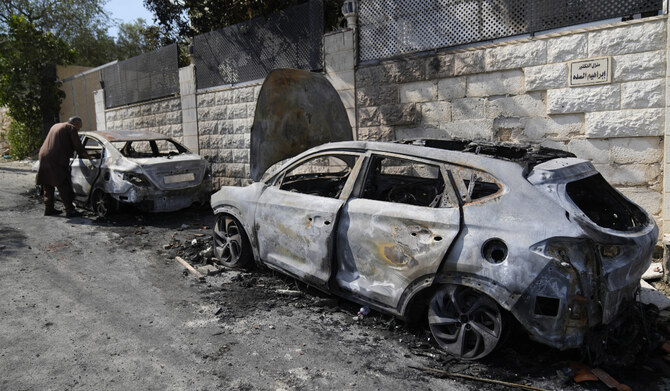

JIT, Palestinian Territories: The Israeli settlers who attacked Hassan Arman’s village of Jit in the occupied West Bank had a simple aim, he says: “To burn, kill, or destroy” — all of which took place that night.
Residents hid in fear while dozens of settlers ransacked their northern village late on Thursday, burning homes and cars, until eventually a young Palestinian man was shot dead.
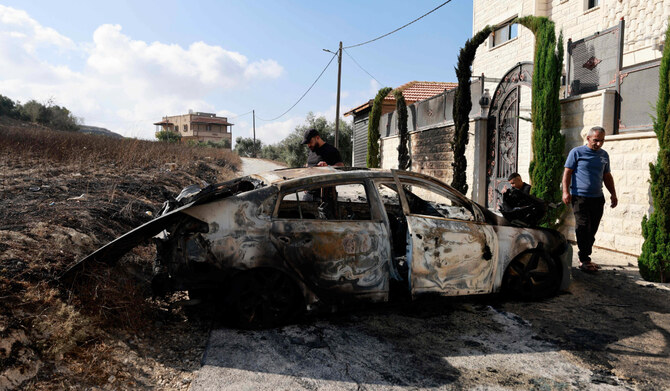
Arman, whose car was destroyed by fire during the attack, said he had “never seen anything like it” in Jit as he opened the charred door of his vehicle.
Inside, everything had melted, leaving just a skeleton of twisted metal.

A young girl comforts the mother of a 23-year-old Palestinian man, a day after he was killed during an attack by Jewish settlers on the village of Jit near Nablus in the occupied West Bank, on August 16, 2024. (AFP)
When the Jewish settlers reached his house, they were “in full uniform, armed with knives, a machine gun, and a silencer,” he said.
A few houses down, Muawiya Al-Sada struggled for words as he stood in the scorched remains of his living room. Only the burnt wooden frame of his sofa remained after the cushions and fabric went up in flames.
“After they burned the house there, they came to this house, broke the windows, and threw firebombs — Molotov cocktails — inside,” he told AFP, while shards of glass from his window panes crunched under the weight of his boots.
Sada and his neighbors then heard gunshots which they later learned caused the death of Rashid Sada, 23, who was said to have been shot in the back.
After that, “there was a brief period of calm, and then the army entered (the village).”
Crowds gathered for the funeral on Friday where the young man’s body, wrapped in a Palestinian flag, was borne aloft by mourners and carried through the streets.
At the funeral, his uncle Muhannad Sada told AFP: “A bullet came from behind him and exited the other side, and he was martyred.”
“It was not the army who fired the bullets, but the settlers,” he added.
CCTV footage released by one resident showed masked men in black hoodies emerging from a field, setting fire to a car and breaking into a home, then setting upon a villager when he tried to chase them away.
The army said it dispersed the settlers from Jit, detaining one Israeli civilian.
The Palestinian Authority, which rules the West Bank from Ramallah, called the attack “organized state terrorism.”
Israel’s president and prime minister both denounced the attack, which drew condemnation from around the globe.
The White House, Germany and France all called the attack “unacceptable,” while Britain’s foreign minister described it as “abhorrent” and the United Nations termed it “horrific.”
EU’s top diplomat Josep Borrell said he would propose sanctions against Israeli government “enablers” of settler violence.
The incident came at a tense time for the region, as negotiators try to hammer out a Gaza war ceasefire that could also douse threats by Iran and its proxies to attack Israel.
“Any action that could jeopardize the negotiation process toward a ceasefire deal is unacceptable,” French Foreign Minister Stephane Sejourne said in Jerusalem.
Violence in the West Bank, a Palestinian territory occupied by Israel since 1967 and separated from the Gaza Strip by Israeli territory, has surged during the Gaza war.
Israeli settlement of the occupied land — considered illegal under international law — has also hit new records since the war began on October 7.
Since then, at least 633 Palestinians have been killed in violence with settlers or Israeli troops, according to the Palestinian authorities.
At least 18 Israelis, including soldiers, have been killed in attacks involving Palestinians, according to official Israeli figures.