LONDON: Immigration tops the list of issues that Britons consider most important for the first time since 2016 — when Britain voted to leave the European Union — following riots this month targeting Muslims and migrants, pollster Ipsos said on Friday.
Just over a third of Britons (34 percent) named immigration as the biggest issue, ahead of health care, on 30 percent, the economy on 29 percent, crime on 25 percent and inflation on 20 percent, the August edition of the monthly Ipsos Issues Index showed.
For 11 percent of those polled race relations was the top issue.
Net migration to Britain — the difference between people moving to the country and those leaving — hit a record high in 2022 of 764,000. It fell slightly to 685,000 the following year.
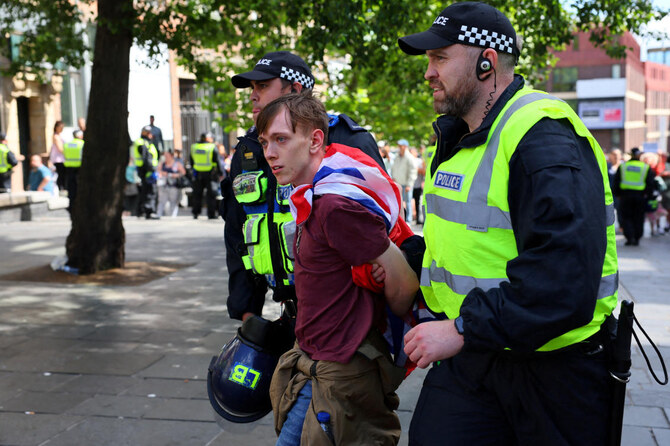
The public’s concerns about immigration have increased in the aftermath of the rioting in many towns and cities this month in which anti-immigration demonstrators targeted hotels housing asylum-seekers and mosques, the pollster said.
“The impact of the recent riots across the UK is clear in this month’s data...the level of concern about crime and race relations has also surged to recent highs,” Ipsos researcher Mike Clemence said.
The unrest abated after a number of those involved were arrested and offenders swiftly jailed. Many people also took part in anti-racism rallies.
The Ipsos poll mirrors another released by YouGov last week, which also showed immigration topping the list of most important national issues for the first time since 2016, when concerns about immigration were a major driver of Britain’s vote to leave the European Union that year.
Ipsos polled 1,010 adults from Aug. 7-13 while YouGov surveyed 2,163 adults from Aug. 5-6.

Immigration biggest issue for Britons for first time since 2016, poll shows
Short Url
https://arab.news/nckhy
Immigration biggest issue for Britons for first time since 2016, poll shows
- Just over a third of Britons (34%) named immigration as the biggest issue
- Public’s concerns about immigration have increased in the aftermath of the rioting this month
‘Not Winston Churchill’: Trump steps up criticism of UK’s Starmer
- Trump criticized Starmer’s decision to cede sovereignty of the Chagos Islands, home to the Diego Garcia air base, saying that they have ‘been very, very uncooperative with with that stupid island’
- Donald Trump: ‘France has been great. They’ve all been great. The UK has been much different from others’
LONDON/WASHINGTON: President Donald Trump intensified his criticism of Prime Minister Keir Starmer on Tuesday, saying his lack of immediate support for US strikes on Iran showed “this is not Winston Churchill we’re dealing with.” Trump has lashed out at Starmer three times this week after he said neither the British military, or its air bases, were involved in the initial US and Israeli strikes on Tehran that killed Iranian Supreme Leader Ayatollah Ali Khamenei. Starmer told parliament that the government had learnt from its mistakes in backing the US in the 2003 Iraq war, and said any military action must have a “viable, thought-through plan.” He also said he did not believe in “regime change from the skies.” But Starmer has since allowed the US to use UK bases to launch what he called limited and defensive strikes to weaken Tehran’s capabilities, after Iran hit US allies in the region with drones and missiles. On Monday, a British base in Cyprus was hit by a drone that Cypriot officials said was likely launched by Iran-backed Lebanese group Hezbollah, prompting London to send a destroyer and more helicopters with counter-drone technology to the region.
Trump told reporters during a meeting in the Oval Office with German Chancellor Friedrich Merz that he was very disappointed with Britain.
“This is not Winston Churchill that we’re dealing with,” he said, comparing Starmer with Britain’s revered wartime leader.
Trump also criticized Starmer’s decision to cede sovereignty of the Chagos Archipelago, home to the US-UK air base of Diego Garcia, saying they have “been very, very uncooperative with that stupid island.”
Starmer has been criticized from all sides at home for his decision, with opponents on the left calling for him to condemn the military action while on the right, opposition leaders Kemi Badenoch and Nigel Farage attacked Starmer for failing to back Britain’s key security and intelligence ally.
Britain has long prided itself on its relationship with the US, aided by British leaders such as Churchill, Margaret Thatcher and Tony Blair cultivating strong relationships with their counterparts, Franklin D. Roosevelt, Ronald Reagan and George W. Bush.
Starmer, a center-left former lawyer, surprised his critics when he too struck up a solid relationship with Trump, but that has been tested in the last year as the US leader became more combative on a number of fronts. Trump earlier told the Sun newspaper he never thought he would see Britain become a reluctant partner, instead heaping praise on France and Germany.
“This was the most solid relationship of all,” he said. “And now we have very strong relationships with other countries in Europe.”
“France has been great. They’ve all been great. The UK has been much different from others.”
Britain, France and Germany released a joint statement in response to Iranian attacks on Saturday, saying they were in close contact with the US, Israel and partners in the region, and were calling for a resumption of negotiations.
Starmer has defended his response, telling parliament on Monday he had to judge what was in Britain’s national interest. “That is what I have done, and I stand by it,” he said.
Polling published by YouGov on Tuesday showed people in Britain were opposed to the US strikes on Iran by 49 percent to 28 percent.
Trump told reporters during a meeting in the Oval Office with German Chancellor Friedrich Merz that he was very disappointed with Britain.
“This is not Winston Churchill that we’re dealing with,” he said, comparing Starmer with Britain’s revered wartime leader.
Trump also criticized Starmer’s decision to cede sovereignty of the Chagos Archipelago, home to the US-UK air base of Diego Garcia, saying they have “been very, very uncooperative with that stupid island.”
Starmer has been criticized from all sides at home for his decision, with opponents on the left calling for him to condemn the military action while on the right, opposition leaders Kemi Badenoch and Nigel Farage attacked Starmer for failing to back Britain’s key security and intelligence ally.
Britain has long prided itself on its relationship with the US, aided by British leaders such as Churchill, Margaret Thatcher and Tony Blair cultivating strong relationships with their counterparts, Franklin D. Roosevelt, Ronald Reagan and George W. Bush.
Starmer, a center-left former lawyer, surprised his critics when he too struck up a solid relationship with Trump, but that has been tested in the last year as the US leader became more combative on a number of fronts. Trump earlier told the Sun newspaper he never thought he would see Britain become a reluctant partner, instead heaping praise on France and Germany.
“This was the most solid relationship of all,” he said. “And now we have very strong relationships with other countries in Europe.”
“France has been great. They’ve all been great. The UK has been much different from others.”
Britain, France and Germany released a joint statement in response to Iranian attacks on Saturday, saying they were in close contact with the US, Israel and partners in the region, and were calling for a resumption of negotiations.
Starmer has defended his response, telling parliament on Monday he had to judge what was in Britain’s national interest. “That is what I have done, and I stand by it,” he said.
Polling published by YouGov on Tuesday showed people in Britain were opposed to the US strikes on Iran by 49 percent to 28 percent.
© 2026 SAUDI RESEARCH & PUBLISHING COMPANY, All Rights Reserved And subject to Terms of Use Agreement.


