

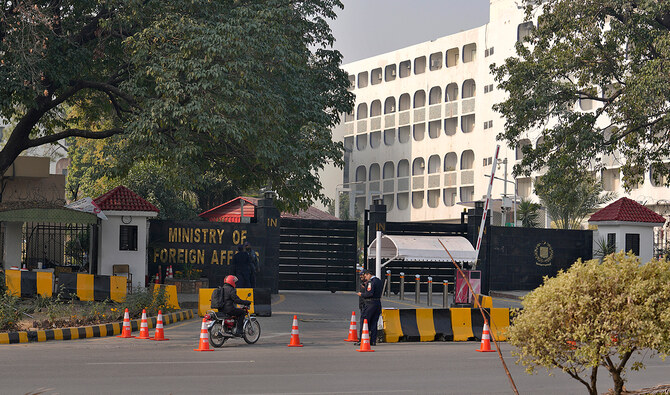

ISLAMABAD: Pakistan’s foreign office on Friday rejected accusations made by members of Bangladesh’s former premier Sheikh Hasina’s party regarding Islamabad’s involvement in her ouster, saying there was “absolutely no truth to such allegations.”
Hasina, 76, stepped down as prime minister amidst a student-led uprising and fled by helicopter to her close ally New Delhi on August 5, marking the end of her 15-year rule.
Her son, Sajeeb Wazed Joy, claimed in a recent interview that the protests in Bangladesh were likely influenced by a foreign intelligence agency, pointing specifically to Pakistan’s Inter-Services Intelligence (ISI).
This notion has also been echoed by several members of Hasina’s political party, the Awami League, since her ouster.
“There is absolutely no truth to such allegations,” Mumtaz Zahra Baloch, a Pakistani foreign office spokesperson, told reporters at a weekly media briefing in Islamabad.
“Pakistan believes that the people of Bangladesh have the capacity to settle their own affairs and determine their future without the support of the international community or unsolicited advice from outsiders.”
She said Pakistan would continue to support and extend its “best wishes” to the people of Bangladesh.
Pakistan welcomes Doha talks for Gaza ceasefire
To a question about ongoing talks in Doha for a ceasefire in Gaza, the spokesperson said Pakistan had always welcomed any initiative that promoted peace, calling on the international community to bring an end to the “massacre and genocide” of the Palestinian people by Israel.
“We have always welcomed any initiative that may lead to peace and dialogue and resolution of the current situation where we live to be under attack by the Israeli occupation authorities,” she said.
The truce talks resumed in Qatar’s capital on Thursday without Hamas, which blamed Israel for blocking a deal and demanded the enforcement of earlier agreements. Months of negotiations have failed to secure the release of hostages in Gaza or stop the rising death toll from Israel’s war, which has surpassed 40,000 since Oct 2023.
Pakistan does not recognize the state of Israel and calls for an independent Palestinian state based on “internationally agreed parameters” and the pre-1967 borders with Al-Quds Al-Sharif as its capital.
Since the beginning of Israel’s war on Gaza in October last year, the South Asian country has repeatedly raised the issue at the United Nations and demanded international powers and multilateral bodies stop Israeli military actions. Pakistan has also dispatched several aid consignments for the Palestinians.
‘Timely return’ of Pakistani pilgrims from Iraq
Asked about the deportation of Pakistani pilgrims from Iraq, Baloch said the Pakistani government was focused on enhancing the management of religious tourism to ensure well-being and “timely return” of all pilgrims.
“As part of its commitment, Pakistan is implementing measures including signing a memorandum of understanding on Zaireen (pilgrims) management with the government of Iraq,” Baloch said.
Iraqi shrine cities of Najaf and Karbala are home to some of the holiest sites, particularly for Shi’ite Muslims, where thousands of devotees arrive daily from around the world, including Pakistan.
Last month, Pakistan’s Religious Affairs Minister Chaudhry Salik Hussain made national headlines after reportedly telling a Senate committee that 50,000 Pakistani pilgrims to Iraq had gone “missing.”
In an interview with Arab News last week, Hussain clarified he had never used the term “missing” and that the number of unauthorized pilgrims who overstay in Iraq is between 20,000 to 30,000.
The foreign office spokeswoman emphasized that various figures were circulating in this regard, many of which were based on speculative reporting.
“We believe that the two sides, both Pakistan and Iraq, can work together to ensure that the Pakistani nationals who visit Iraq for pilgrimage return in a timely manner,” Baloch added.


