DOHA: Negotiators seeking a Gaza ceasefire were set to meet for a second day in Qatar on Friday, while top European diplomats were expected in Israel to stress the urgency of averting a wider war.
The on-and-off truce talks reconvened in Qatar’s capital on Thursday without Hamas, which has accused Israel of obstructing a deal and insists on the implementation of previously agreed terms.
Months of talks have yet to secure the return of hostages held by militants in Gaza or staunch the spiralling death toll, which authorities in Hamas-ruled Gaza on Thursday said had topped 40,000 in the Palestinian territory after more than 10 months of war.
US National Security Council spokesman John Kirby said the talks had “a promising start” but acknowledged “there remains a lot of work to do.”
Israel’s main military supplier the United States has been mediating the talks with Qatar and Egypt.
The United States and its allies see the proposed Gaza truce as key to de-escalating soaring regional tensions, particularly with Iran.
“This is a dangerous moment for the Middle East. The risk of the situation spiralling out of control is rising,” British Foreign Secretary David Lamy said ahead of his visit with French Foreign Minister Stephane Sejourne.
During meetings with Israel’s Foreign Minister Israel Katz and Minister of Strategic Affairs Ron Dermer, they would “stress there is no time for delays or excuses from all parties on a ceasefire deal” in Gaza, according to Britain’s foreign ministry.
Sejourne said “any miscalculation in the current situation could provoke a generalized conflagration.”
While talks take place in the Gulf emirate, bombs have continued to fall in Gaza.
As they struggled to recover bodies from the ruins of yet another air strike on Thursday, Palestinians in north Gaza questioned why, when Israeli Prime Minister Benjamin Netanyahu’s team was in Qatar.
“Why did Netanyahu send a delegation to the talks while we are being killed here?” in Jabalia, Mohammed Al-Balwi said as rescuers around him pulled bodies from the concrete wreckage.
They had found “limbs on the ground,” he said.
Fears of a wider Middle East war have soared since the July 31 killing of Hamas political leader and truce negotiator Ismail Haniyeh in Tehran. Iran and its allied groups in the region blamed Israel and vowed revenge.
Haniyeh’s death came hours after an Israeli strike killed Fuad Shukr, the military commander of Lebanon’s Iran-backed Hezbollah movement, which has exchanged near-daily cross border fire with Israeli forces.
The Gaza war has also drawn in Tehran-aligned groups in Iraq, Syria and Yemen.
The US military said its forces had destroyed a “ground control station” operated by Yemen’s Iran-backed Houthi rebels. The Houthis have for months fired missiles and drones at shipping in waterways vital to world trade off Yemen.
The Houthis, like Hezbollah, say they are acting in support of the Palestinians.
Violence has also surged in the Israeli-occupied West Bank.
Israeli President Isaac Herzog on Thursday condemned a Jewish settler attack on a West Bank village that the Palestinian Authority said killed one Palestinian and wounded another.
The Israeli military said dozens of Israeli civilians, some masked, entered Jit on Thursday evening and “set fire to vehicles and structures in the area, hurled rocks and Molotov cocktails.”
It added that it had opened an investigation and was looking into reports of a fatality.
Since the war in Gaza began, hundreds of Palestinians have been killed in the West Bank by the Israeli army or settlers, according to an AFP count based on official Palestinian data.
During the same period in the West Bank, at least 18 Israelis, including soldiers, have been killed in Palestinian attacks, according to official Israeli data.
The Qatari foreign ministry said Gaza truce negotiations would continue on Friday.
Mediators remain committed “in their endeavours to reach a ceasefire in the strip that would facilitate the release of hostages and enable the entry of the largest possible amount of humanitarian aid into Gaza,” a ministry spokesperson said.
They are seeking to finalize details of a three-phase proposal initially outlined by US President Joe Biden in May.
While Hamas is not directly taking part, an official of the Islamist movement, Osama Hamdan, told AFP the group would join if the meeting set a timetable for implementing the agreed terms.
He added that Hamas would not engage in negotiations that “give Netanyahu more time to kill our Palestinian people.”
Netanyahu has called Hamas leader Yahya Sinwar “the only obstacle to a hostage deal.”
Hamas’s unprecedented October 7 attack on Israel that triggered the war resulted in the deaths of 1,198 people, mostly civilians, according to an AFP tally of Israeli official figures.
Militants also seized 251 hostages, 111 of whom are still held in Gaza, including 39 the military says are dead.
Some were freed during a one-week truce in November.
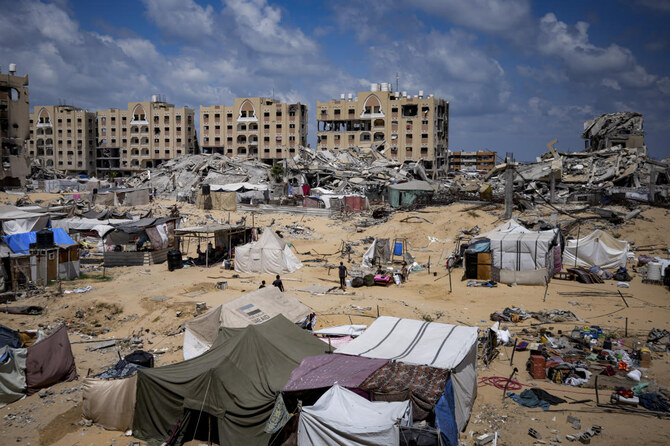
The war has displaced almost the entire population of Gaza and destroyed much of its housing and other infrastructure, leaving widespread shortages of food.
Gaza’s health ministry, which does not provide a breakdown of civilian and militant casualties, on Thursday said the war has killed at least 40,005 people.
The United Nations human rights chief, Volker Turk, called it a “grim milestone for the world.”

Gaza ceasefire talks to resume for 2nd day in Qatar
Short Url
https://arab.news/zyzb2
Gaza ceasefire talks to resume for 2nd day in Qatar
- The on-and-off truce talks reconvened in Qatar’s capital on Thursday without Hamas
- United States and its allies see the proposed Gaza truce as key to de-escalating soaring regional tensions, particularly with Iran
Prosecutors plan to charge Israeli settler with killing Palestinian activist in West Bank
RAMALLAH: Israeli prosecutors said Monday that they plan to charge a settler in the killing of a Palestinian activist during a confrontation that was caught on video, opening a rare prosecution of violence by Jewish settlers in the occupied West Bank.
Attacks from settlers and home demolitions by authorities have spiked dramatically over the past two years, but the death in July of Awdah Hathaleen has drawn particular attention due to his involvement in the 2025 Oscar-winning film “No Other Land,” which chronicled Palestinian villagers’ fight to stay on their land.
The case also stands out because the confrontation between Palestinians and Yinon Levi, an internationally sanctioned settler, was captured on video from multiple vantage points.
In a video that family members say was taken by Hathaleen himself, Levi could be seen firing toward the person holding the camera. Another showed Levi firing two shots without showing where the bullets struck.
An Israeli judge released Levi from custody six months ago, citing a lack of evidence that he fired the shots that killed Hathaleen.
Israel’s State Attorney General’s office confirmed in a statement Monday that it had initiated proceedings to indict Levi. It did not specify the charges.
Eitan Peleg, an attorney for Hathaleen’s family, said the office had informed them it planned to indict Levi for reckless homicide, triggering a process that allows Levi to contest charges before they’re formally filed.
“Enforcement of the law in cases like this involving Palestinians in the West Bank is very rare, so this is unique,” Peleg told The Associated Press on Monday.
Israel’s military referred questions on the indictment to police, who have not yet responded. Both bodies enforce laws in the area.
More than 3.4 million Palestinians and 700,000 Israelis live in the occupied West Bank and east Jerusalem, territories captured by Israel in 1967 and sought by Palestinians for a future state. The international community overwhelmingly considers Israeli settlement construction in these areas to be illegal and an obstacle to peace.
Palestinians and rights groups say authorities routinely fail to prosecute settlers or hold them accountable for violence. Under National Security Minister Itamar Ben Gvir, investigations into settler attacks have plummeted, according to the Israeli rights group Yesh Din.
Khalil Hathaleen, Awdah’s brother, said the family was glad some measure of justice was being pursued but felt the charge of “reckless homicide” was insufficient.
“It was an intentional killing in broad daylight, with prior intent and premeditation,” he said.
Levi’s attorney, Avichai Hajjbi, declined Monday to comment on the coming indictment, which he said he hadn’t received. After the shooting, he told The Associated Press that Levi acted in self-defense, without elaborating. Levi did not answer phone calls Monday.
Parts of the confrontation were filmed
Video released last year by B’Tselem, an Israeli human rights group showed Levi firing a gun toward the person filming. At the moment that B’Tselem says Hathaleen collapsed, the visuals are jostled but moans of pain can be heard. The group said it obtained the video from the family of Hathaleen, who said he filmed it.
Additional footage obtained by the AP last year showed Levi waving a pistol during the standoff in Umm Al-Khair that was with a group of Palestinians over an excavator that had rolled down from a nearby settlement and damaged Palestinian property earlier in the day.
Alaa Hathaleen, a cousin who filmed the encounter, told AP at the time that he had approached Levi to tell him the group was unarmed and to stop the bulldozing.
In the video, one Palestinian insults Levi and another challenges him to shoot. Levi shoves someone just out of the frame, demands to know who threw stones, and later fires a shot, seemingly away from the crowd. He then fires again and yells toward the crowd to get away from the excavator.
The footage did not show where bullets struck, though other relatives said they saw Awdah Hathaleen fall immediately after shots were fired.
Levi was detained before being released to house arrest. That condition was eventually lifted, too.
Levi was among the Israeli settlers sanctioned by the United States and other Western countries over allegations of violence toward Palestinians in 2024. President Donald Trump lifted the US sanctions after taking office the following year.
Attacks spike as spotlight grows
Activists and crew members on the film “No Other Land” have said settler attacks have intensified on the village portrayed since the movie won the Oscar.
Hamdan Ballal, one of the film’s directors, said his family home in Umm Al-Khair was subject to another attack on Sunday. Four relatives were arrested during the confrontation, he said.
Ballal said a soldier, who came to their home accompanied by another soldier and a settler-herder, grabbed his brother by the neck and tried to choke him. Neither the army nor the police responded to requests for comment on the incident.
“The year after I won the Oscar, the assaults increased significantly. On a daily basis, settlers come and destroy the fields, destroy the trees, destroy the crops around the house,” he said.
Israeli proof-of-ownership rules spark anger
As prosecutors move to indict Levi and violence persists across the West Bank, Israel is moving ahead with measures to deepen its control over land in the occupied territory.
On Sunday, it announced it would resume a land registration process across the West Bank to require anyone with a claim to land to submit documents proving ownership. Rights groups say the process could strip Palestinians of land they’ve lived on and farmed for generations and transfer vast swaths of land to Israeli state control.
Israel’s Foreign Ministry said the steps countered Palestinian Authority land registration efforts in areas where Israel maintains civil and military control.
The measures follow years of accusations by Palestinians that actions by settlers and the military — campaigns of violence, harassment and demolitions — have pushed them from their land.
The decisions have drawn widespread condemnation as violations of international law, including from countries involved in the ceasefire process in the Gaza Strip and Trump’s Board of Peace.
Saudi Arabia’s Foreign Ministry in a statement on Monday said the measures were part of Israel’s effort to impose a “new legal and administrative reality” that undermines prospects for peace and stability. Egypt’s Foreign Ministry called the move a “flagrant violation” of international law, warning it would escalate tensions in the Palestinian territories and across the region.
Attacks from settlers and home demolitions by authorities have spiked dramatically over the past two years, but the death in July of Awdah Hathaleen has drawn particular attention due to his involvement in the 2025 Oscar-winning film “No Other Land,” which chronicled Palestinian villagers’ fight to stay on their land.
The case also stands out because the confrontation between Palestinians and Yinon Levi, an internationally sanctioned settler, was captured on video from multiple vantage points.
In a video that family members say was taken by Hathaleen himself, Levi could be seen firing toward the person holding the camera. Another showed Levi firing two shots without showing where the bullets struck.
An Israeli judge released Levi from custody six months ago, citing a lack of evidence that he fired the shots that killed Hathaleen.
Israel’s State Attorney General’s office confirmed in a statement Monday that it had initiated proceedings to indict Levi. It did not specify the charges.
Eitan Peleg, an attorney for Hathaleen’s family, said the office had informed them it planned to indict Levi for reckless homicide, triggering a process that allows Levi to contest charges before they’re formally filed.
“Enforcement of the law in cases like this involving Palestinians in the West Bank is very rare, so this is unique,” Peleg told The Associated Press on Monday.
Israel’s military referred questions on the indictment to police, who have not yet responded. Both bodies enforce laws in the area.
More than 3.4 million Palestinians and 700,000 Israelis live in the occupied West Bank and east Jerusalem, territories captured by Israel in 1967 and sought by Palestinians for a future state. The international community overwhelmingly considers Israeli settlement construction in these areas to be illegal and an obstacle to peace.
Palestinians and rights groups say authorities routinely fail to prosecute settlers or hold them accountable for violence. Under National Security Minister Itamar Ben Gvir, investigations into settler attacks have plummeted, according to the Israeli rights group Yesh Din.
Khalil Hathaleen, Awdah’s brother, said the family was glad some measure of justice was being pursued but felt the charge of “reckless homicide” was insufficient.
“It was an intentional killing in broad daylight, with prior intent and premeditation,” he said.
Levi’s attorney, Avichai Hajjbi, declined Monday to comment on the coming indictment, which he said he hadn’t received. After the shooting, he told The Associated Press that Levi acted in self-defense, without elaborating. Levi did not answer phone calls Monday.
Parts of the confrontation were filmed
Video released last year by B’Tselem, an Israeli human rights group showed Levi firing a gun toward the person filming. At the moment that B’Tselem says Hathaleen collapsed, the visuals are jostled but moans of pain can be heard. The group said it obtained the video from the family of Hathaleen, who said he filmed it.
Additional footage obtained by the AP last year showed Levi waving a pistol during the standoff in Umm Al-Khair that was with a group of Palestinians over an excavator that had rolled down from a nearby settlement and damaged Palestinian property earlier in the day.
Alaa Hathaleen, a cousin who filmed the encounter, told AP at the time that he had approached Levi to tell him the group was unarmed and to stop the bulldozing.
In the video, one Palestinian insults Levi and another challenges him to shoot. Levi shoves someone just out of the frame, demands to know who threw stones, and later fires a shot, seemingly away from the crowd. He then fires again and yells toward the crowd to get away from the excavator.
The footage did not show where bullets struck, though other relatives said they saw Awdah Hathaleen fall immediately after shots were fired.
Levi was detained before being released to house arrest. That condition was eventually lifted, too.
Levi was among the Israeli settlers sanctioned by the United States and other Western countries over allegations of violence toward Palestinians in 2024. President Donald Trump lifted the US sanctions after taking office the following year.
Attacks spike as spotlight grows
Activists and crew members on the film “No Other Land” have said settler attacks have intensified on the village portrayed since the movie won the Oscar.
Hamdan Ballal, one of the film’s directors, said his family home in Umm Al-Khair was subject to another attack on Sunday. Four relatives were arrested during the confrontation, he said.
Ballal said a soldier, who came to their home accompanied by another soldier and a settler-herder, grabbed his brother by the neck and tried to choke him. Neither the army nor the police responded to requests for comment on the incident.
“The year after I won the Oscar, the assaults increased significantly. On a daily basis, settlers come and destroy the fields, destroy the trees, destroy the crops around the house,” he said.
Israeli proof-of-ownership rules spark anger
As prosecutors move to indict Levi and violence persists across the West Bank, Israel is moving ahead with measures to deepen its control over land in the occupied territory.
On Sunday, it announced it would resume a land registration process across the West Bank to require anyone with a claim to land to submit documents proving ownership. Rights groups say the process could strip Palestinians of land they’ve lived on and farmed for generations and transfer vast swaths of land to Israeli state control.
Israel’s Foreign Ministry said the steps countered Palestinian Authority land registration efforts in areas where Israel maintains civil and military control.
The measures follow years of accusations by Palestinians that actions by settlers and the military — campaigns of violence, harassment and demolitions — have pushed them from their land.
The decisions have drawn widespread condemnation as violations of international law, including from countries involved in the ceasefire process in the Gaza Strip and Trump’s Board of Peace.
Saudi Arabia’s Foreign Ministry in a statement on Monday said the measures were part of Israel’s effort to impose a “new legal and administrative reality” that undermines prospects for peace and stability. Egypt’s Foreign Ministry called the move a “flagrant violation” of international law, warning it would escalate tensions in the Palestinian territories and across the region.
© 2026 SAUDI RESEARCH & PUBLISHING COMPANY, All Rights Reserved And subject to Terms of Use Agreement.