

Trump says he’s ‘entitled to personal attacks’ on VP Harris as his Democratic rival’s poll numbers surge

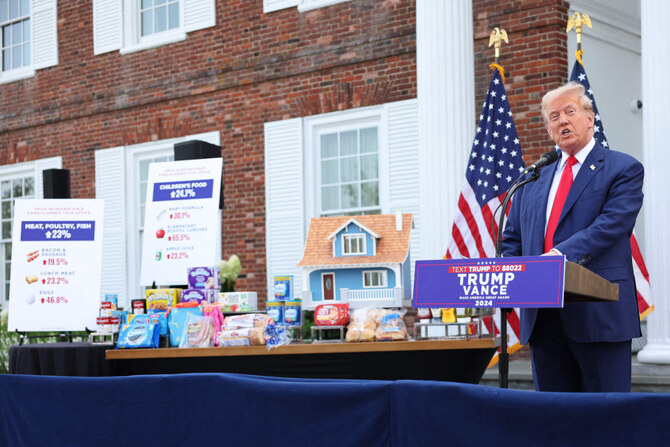
With groceries as props, Republican presidential candidate Donald Trump attacks the economic record of his Democratic rival, Vice President Kamala Harris, during a news conference at Trump National Bedminster Clubhouse on August 15, 2024 in Bedminster, New Jersey. (Getty Images/AFP)
Short Url
Updated 16 August 2024
Follow

Trump says he’s ‘entitled to personal attacks’ on VP Harris as his Democratic rival’s poll numbers surge

  • "I’m very angry at her that she would weaponize the justice system against me and other people,“ he said
  • He labelled Harris as a “radical“ who ”broke the economy, broke the border and broke the world”

BEDMINSTER, New Jersey: Former President Donald Trump said Thursday he thinks he’s “entitled to personal attacks” on his Democratic rival, adding he’s “very angry” at Vice President Kamala Harris and questioning her intelligence.

Trump was asked during a news conference whether his campaign needs more discipline as he faces a Democratic ticket newly energized since Harris replaced President Joe Biden as the party’s presidential candidate.

“As far as the personal attacks, I’m very angry at her because of what she’s done to the country. I’m very angry at her that she would weaponize the justice system against me and other people, very angry at her. I think I’m entitled to personal attacks,” Trump said at his New Jersey golf club, where he invited reporters in his quest to saddle Harris with Biden’s unpopular economic record.

“I don’t have a lot of respect for her intelligence and I think she’ll be a terrible president,” he added.

There is no evidence that Biden or Harris weaponized the criminal justice system to target Trump, who has pledged to retaliate with criminal investigations of Biden and his relatives if he wins.

Trump also took issue with Democrats branding him and his running mate, Ohio Sen. JD Vance, as “weird.” Harris is “weird in her policy,” he said.

Trump stuck close to his scripted economic message for more than half an hour, reading from a binder in front of him in a news conference at his New Jersey golf club.

Later, he veered into familiar stories he enjoys telling at his rallies.

A day earlier, he had struggled to make a sustained case for his economic policies during a meandering speech that his campaign had billed as a major policy address.

“Kamala Harris is a radical California liberal who broke the economy, broke the border and broke the world, frankly,” Trump told reporters.

Trump was flanked by popular grocery store items, including instant coffee, sugary breakfast cereals and pastries, laid out on tables as he highlighted the cost of everything from food to car insurance to housing. Posters showed the increase of prices for grocery staples.

At one point, as Trump talked about the 2020 election he lost, he noticed a box of cereal. “I haven’t seen Cheerios in a long time,” Trump said. “I’m going to take them back to my cottage.”

As he turned to walk back inside, Trump did not respond to shouted questions about when he last went grocery shopping. The event came one day after the Labor Department announced year-over-year inflation had reached its lowest level in more than three years in July — the latest sign that the worst price spike in four decades is fading.

But consumers are still feeling the impact of higher prices — something Trump’s campaign is banking on to motivate voters this fall. A new poll from The Associated Press-NORC Center for Public Affairs Research finds that Americans are more likely to trust Trump over Harris when it comes to handling the economy and immigration, issues he has put at the center of his case for returning to the White House.

Harris is planning her own economic policy speech Friday in North Carolina, promising to push for a federal ban on price gouging on groceries.

Trump predicted he would beat Harris by more that he would have beaten Biden by “once she’s exposed.” “People don’t know who she is,” Trump said.

A small crowd of Trump supporters watched his news conference from the periphery, occasionally cheering him on. But without a crowd of thousands to please with red meat attacks on his enemies, Trump stuck closer to his prepared remarks.

Trump continued lobbing insults at Harris and Biden at an evening event dedicated to Jewish voters, where he was introduced by GOP megadonor Miriam Adelson to an audience that included a Holocaust survivor.

Hours before the news conference, Trump’s campaign leaders announced they were expanding his staff, bringing a number of former aides and outside advisers formally into the fold.

Corey Lewandowski, Taylor Budowich, Alex Pfeiffer, Alex Bruesewitz and Tim Murtaugh will advise the campaign’s senior leadership.

Lewandowski was Trump’s first campaign manager during his 2016 campaign. Budowich and Pfeiffer are moving over from MAGA Inc., a pro-Trump super PAC. Bruesewitz produces pro-Trump content for a large social media following. And Murtaugh was the communications director for Trump’s 2020 campaign.

Summer has been the time for shakeups in Trump’s two prior campaigns. This year’s change comes weeks after the campaign itself was transformed by Biden’s decision to end his reelection campaign and endorse Harris.

Trump gave his top advisers a vote of confidence Thursday, writing on his social media platform that his management team headed by Chris LaCivita and Susie Wiles is “THE BEST.”

Trump spoke to the press as he has stepped up his criticism of Harris for not holding a news conference or sitting down for interviews since Biden made way for her.

“I think I’m doing a very calm campaign,” Trump said after being asked about criticism from Republicans who want him to focus less on personal attacks.

“Some of you will say, ‘He ranted and raved,’” Trump said to journalists. “I’m a very calm person, believe it or not.”


Obamacare health subsidy to end as US Senate rejects dueling remedies

Updated 11 sec ago
Follow

Obamacare health subsidy to end as US Senate rejects dueling remedies

  • Senate rejects Republican and Democratic health care proposals
  • Democratic plan sought subsidy extension; Republicans offered to boost health savings accounts

WASHINGTON: The US Senate on Thursday rejected competing proposals by Republicans and Democrats to address a looming health care crisis, leaving some 24 million Americans vulnerable to significantly higher insurance premiums beginning on January 1 when a federal subsidy expires.
Barring any late breakthroughs, Congress will begin an end-of-year holiday recess sometime next week and not return until January 5, after new premiums are locked in for those who had relied on the Affordable Care Act enhanced subsidy.
In back-to-back votes largely along party lines, Democrats and Republicans blocked each other’s bill.
The House of Representatives might attempt to pass some sort of legislation next week, which has not yet been unveiled. Even if it were to pass, Senate Democrats, and possibly some Republicans, would oppose it and they could use their votes to kill that effort.
“After today’s vote, the American health care crisis is 100 percent on their shoulders,” Senate Democratic leader Chuck Schumer said of Republicans.
Senate Republican leader John Thune dismissed the Democratic bill as “a political messaging exercise” and said “Republicans are ready to get to work. I’m not sure yet that Democrats are interested.”
The bitter battle in Congress has left some Americans uncertain over renewing their health insurance under the federal health care program.
The percentage of returning customers in the Obamacare exchanges is slightly down from a year ago, with the government reporting 19.9 percent of people enrolled this year opting to renew their plans so far, down from 20.5 percent this time last year.
The Republican bill by US Senators Bill Cassidy of Louisiana and Mike Crapo of Idaho would have sent up to $1,500 to individuals earning less than 700 percent of the federal poverty level — about $110,000 for an individual or $225,000 for a family of four in 2025. Those funds could not be used for abortion or gender transition procedures and would require verification of beneficiaries’ immigration or citizenship status — provisions Democrats reject.
The Democratic proposal on the subsidies under the Affordable Care Act, popularly known as Obamacare, would have extended COVID-era subsidies for three years to keep insurance premiums from soaring for many. Without action by Congress, those premiums could more than double in cost on average, according to KFF, a health policy organization.
Sixty votes were needed to pass either measure in a Senate that Republicans control 53-47. Four Republicans voted for the Democratic proposal. No Democrats backed the Republicans’ bill.
President Donald Trump has largely sat out the brawl over health care, although he ultimately embraced the Cassidy-Crapo approach.
At Thursday’s bipartisan Congressional Ball, Trump predicted Republicans and Democrats would work together on health care. But he advocated for the Republican bill.
“We have an idea that rather than making these massive payments... insurance companies, we make beautiful big payments directly to the people, and they buy their own,” Trump said in remarks at the black-tie event at the White House.
The $1,500 payments in the Republican bill were meant to cover some of the out-of-pocket costs that people in the “Bronze” or “Catastrophic” categories — the lower-cost Obamacare plans — need to pay before their insurance kicks in.
However, it is far below the plans’ deductibles, meaning that even after that payment, a patient would be on the hook for up to $7,500 in out-of-pocket medical expenses before their insurance would start to pay for part of their care.
Those costs can rack up quickly for people with lower-cost plans, with a visit to a US emergency room costing between $1,000 and $3,000, while an ambulance ride can cost anywhere from $500 to over $3,500.
With 2026 congressional elections coming into focus, many Republicans are nervous about the prospect of stiff premium increases hitting every state, including many that backed Trump’s 2024 re-election. Polling indicates voters could mostly punish Republicans, who control Congress and the White House.
Republican US Senator Josh Hawley of Missouri, a state that Trump carried by 18 points in his 2024 re-election, said his constituents have been telling him, “We can’t afford our premiums now, let alone if they would go up by 50 or 100 percent.”
Insurance companies warned customers of the rising premiums in the new year, and Democrats argued there was not enough time to do anything but a clean extension of the tax credits they sought.
A new Reuters/Ipsos poll found Americans back a health care subsidy continuation. Some 51 percent of respondents — including three-quarters of Democrats and a third of Republicans — said they support extending the subsidies. Only 21 percent said they were opposed.
Moderate Republican Representative Brian Fitzpatrick of Pennsylvania is spearheading a bipartisan bill to extend the subsidy through 2027. He is hoping to garner enough support to circumvent leadership and force votes on the measure by the full House.
