ROME: The UN refugee agency, which has expressed serious concerns about Italy’s deal to process some migrants’ asylum requests at holding centers in Albania, has agreed to monitor the first three months of the agreement.
UNHCR recalled that it wasn’t a party to the Italy-Albania deal, had maintained reservations about it and requested clarification about how it would be implemented. But the agency said in a statement on Wednesday that it had agreed to monitor its execution to help “safeguard the rights and dignity of those subject to it.”
The agency said that it would counsel migrants about their right to seek asylum and ensure that the procedures used are “consistent with relevant international and regional human rights standards, are fair, and promote protection and solutions for those in need of international protection.”
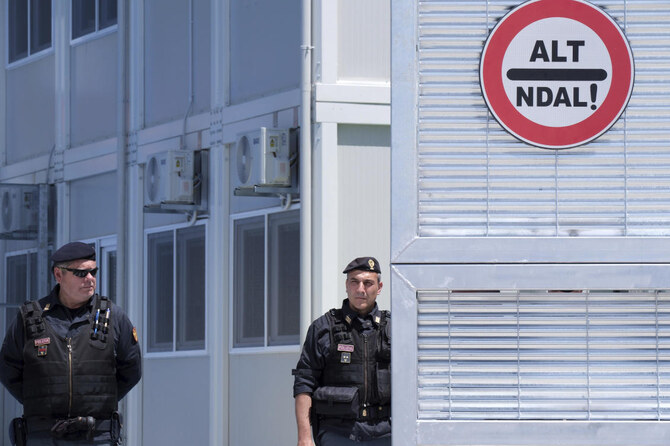
The contentious five-year deal, inked last year, calls for Albania to house up to 3,000 male migrants at a time who have been rescued in international waters while Italy fast-tracks their asylum claims. It was supposed to have become operational this month, but construction delays at the two new detention centers in Albania put off the start date.
Italy’s right-wing government has held up the agreement as an important example of burden-sharing of Europe’s migrant responsibilities, while also serving as a deterrent to would-be refugees. The European Commission, which has long struggled with Europe’s migrant debate, has endorsed it.
But human rights groups have denounced what they call Italy’s outsourcing of its responsibilities under international law to process the asylum requests of Italy-bound migrants rescued at sea. The center-left opposition in Italy has called the centers Italy’s “Guantanamo.”
UNHCR said that its monitoring mission would be funded by sources other than Italy and Albania to ensure that it remains independent and said it would report back after three months with recommendations.
According to the agreement, migrants will be screened initially on board the ships that have rescued them, with vulnerable migrants taken to Italy while others are sent to Albania for additional screening.
UNHCR and other agencies have expressed concern both about the onboard screenings, and whether they will truly be able to identify vulnerable migrants, as well as migrants’ access to adequate legal counsel once in Albania.
In a January appearance at Italy’s lower chamber of parliament, UNHCR’s Italy director, Chiara Cardoletti, said that the issue of legal representation would be complicated by housing the migrants in Albania, especially establishing a relationship of trust and confidentiality.
She noted that none of the protocols to date had established how migrants who aren’t eligible for asylum would be sent home. And she also questioned the costs, and recommended regardless that more resources be spent reinforcing the migrant processing centers in Italy.
The two centers in Albania will cost Italy 670 million euros ($730 million) over five years. The facilities will be fully run by Italy, and both centers are under Italian jurisdiction, while Albanian guards will provide external security.
UNHCR’s announcement of a monitoring mission came on the eve of an annual update by Italy’s interior minister about a host of security issues, including migration. Interior Minister Matteo Piantedosi noted that Italy had registered a 20 percent increase in the number of repatriations of migrants this year who aren’t eligible for asylum.
At the same time, the number of new migrants arriving in Italy is sharply down this year: As of Wednesday, 37,644 people had arrived by boat this year, compared to 100,419 over the same period last year, according to interior ministry statistics.

UNHCR to monitor implementation of Italy-Albania accord to ensure migrants’ asylum rights respected
https://arab.news/6528j
UNHCR to monitor implementation of Italy-Albania accord to ensure migrants’ asylum rights respected
- The center-left opposition in Italy has called the centers Italy’s “Guantanamo”
- UNHCR said that its monitoring mission would be funded by sources other than Italy and Albania to ensure that it remains independent
Proposals on immigration enforcement flood into state legislatures, heightened by Minnesota action
- Oregon Democrats plan to introduce a bill to allow residents to sue federal officers for violating their Fourth Amendment rights against unlawful search and seizure
NASHVILLE, Tennessee: As Democrats across the country propose state law changes to restrict federal immigration officers after the shooting death of a protester in Minneapolis, Tennessee Republicans introduced a package of bills Thursday backed by the White House that would enlist the full force of the state to support President Donald Trump’s immigration crackdown.
Momentum in Democratic-led states for the measures, some of them proposed for years, is growing as legislatures return to work following the killing of Renee Good by an Immigration and Customs Enforcement officer. But Republicans are pushing back, blaming protesters for impeding the enforcement of immigration laws.
Democratic bills seek to limit ICE
Democratic Gov. Kathy Hochul wants New York to allow people to sue federal officers alleging violations of their constitutional rights. Another measure aims to keep immigration officers lacking judicial warrants out of schools, hospitals and houses of worship.
Oregon Democrats plan to introduce a bill to allow residents to sue federal officers for violating their Fourth Amendment rights against unlawful search and seizure.
New Jersey’s Democrat-led Legislature passed three bills Monday that immigrant rights groups have long pushed for, including a measure prohibiting state law enforcement officers from cooperating with federal immigration enforcement. Democratic Gov. Phil Murphy has until his last day in office Tuesday to sign or veto them.
California lawmakers are proposing to ban local and state law enforcement from taking second jobs with the Department of Homeland Security and make it a violation of state law when ICE officers make “indiscriminate” arrests around court appearances. Other measures are pending.
“Where you have government actions with no accountability, that is not true democracy,” Democratic state Sen. Scott Wiener of San Francisco said at a news conference.
Democrats also push bills in red states
Democrats in Georgia introduced four Senate bills designed to limit immigration enforcement — a package unlikely to become law because Georgia’s conservative upper chamber is led by Lt. Gov. Burt Jones, a close Trump ally. Democrats said it is still important to take a stand.
“Donald Trump has unleashed brutal aggression on our families and our communities across our country,” said state Sen. Sheikh Rahman, an immigrant from Bangladesh whose district in suburban Atlanta’s Gwinnett County is home to many immigrants.
Democrats in New Hampshire have proposed numerous measures seeking to limit federal immigration enforcement, but the state’s Republican majorities passed a new law taking effect this month that bans “sanctuary cities.”
Tennessee GOP works with White House on a response
The bills Tennessee Republicans are introducing appear to require government agencies to check the legal status of all residents before they can obtain public benefits; secure licenses for teaching, nursing and other professions; and get driver’s licenses or register their cars.
They also would include verifying K-12 students’ legal status, which appears to conflict with a US Supreme Court precedent. And they propose criminalizing illegal entry as a misdemeanor, a measure similar to several other states’ requirements, some of which are blocked in court.
“We’re going to do what we can to make sure that if you’re here illegally, we will have the data, we’ll have the transparency, and we’re not spending taxpayer dollars on you unless you’re in jail,” House Speaker Cameron Sexton said at a news conference Thursday.
Trump administration sues to stop laws
The Trump administration has opposed any effort to blunt ICE, including suing local governments whose “sanctuary” policies limit police interactions with federal officers.
States have broad power to regulate within their borders unless the US Constitution bars it, but many of these laws raise novel issues that courts will have to sort out, said Harrison Stark, senior counsel with the State Democracy Research Initiative at the University of Wisconsin Law School.
“There’s not a super clear, concrete legal answer to a lot of these questions,” he said. “It’s almost guaranteed there will be federal litigation over a lot of these policies.”
That is already happening.
California in September was the first to ban most law enforcement officers, including federal immigration officers, from covering their faces on duty. The Justice Department said its officers won’t comply and sued California, arguing that the laws threaten the safety of officers who are facing “unprecedented” harassment, doxing and violence.
The Justice Department also sued Illinois last month, challenging a law that bars federal civil arrests near courthouses, protects medical records and regulates how universities and day care centers manage information about immigration status. The Justice Department claims the law is unconstitutional and threatens federal officers’ safety.
Targeted states push back
Minnesota and Illinois, joined by their largest cities, sued the Trump administration this week. Minneapolis and Minnesota accuse the Republican administration of violating free speech rights by punishing a progressive state that favors Democrats and welcomes immigrants. Illinois and Chicago claim “Operation Midway Blitz” made residents afraid to leave their homes.
Homeland Security spokesperson Tricia McLaughlin accused Minnesota officials of ignoring public safety and called the Illinois lawsuit “baseless.”


