


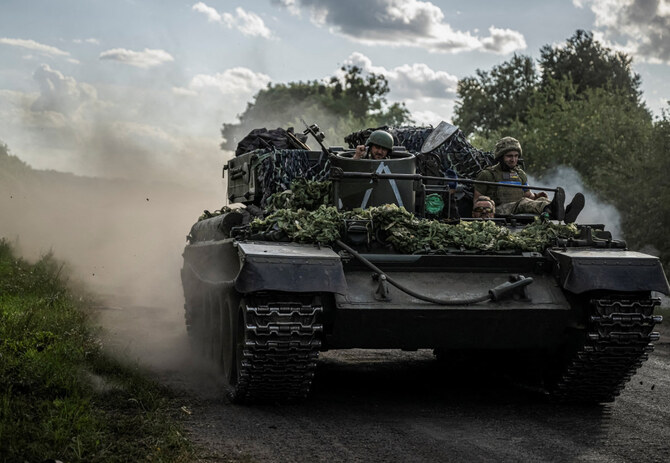

KYIV: Ukraine’s forces advanced further into Russia’s Kursk region on Wednesday as Kyiv said its gains would provide a strategic buffer zone to protect its border areas from Russian attacks.
Kyiv’s surge into Russian territory last week caught Moscow by surprise. Russian forces that began a full-scale invasion of Ukraine in 2022 had been grinding out steady gains all year.
President Volodymyr Zelensky said he met top officials to discuss the humanitarian situation and establishing a military commandant’s offices “if needed” in an occupied area that Kyiv says exceeds 1,000 sq km (390 sq miles).
“We continue to advance further in Kursk,” Zelensky wrote on Telegram, “from one to two km in various areas since the start of the day.”
Later, in his nightly address, Zelensky referred to the growing number of Russian prisoners of war taken in Kursk who could be exchanged for Ukrainian fighters.
“Our advance in Kursk is going well today – we are reaching our strategic goal. The ‘exchange fund’ for our state has also been significantly replenished.”
Interior Minister Ihor Klymenko said creation of a “buffer zone” was “designed to protect our border communities from daily enemy attacks.”
Russia has been pummelling Ukraine with strikes launched from adjacent border territories, including Kursk.
Ukraine complains its defense against such attacks has been hamstrung by the need to respect Western countries’ compunction about using their weapons against Russia’s hinterland rather than against its forces in occupied Ukraine. Zelensky once more urged Western allies to permit long-range missile strikes into Russia.

Russia claims downing 117 drones and 4 missiles
Russian President Vladimir Putin has vowed to expel the Ukrainian troops. He says they aim, with Western backing, to give Kyiv a stronger hand in possible future ceasefire talks. But more than a week of intense battles have so far failed to oust them.
“The situation remains difficult,” said Yuri Podolyaka, an influential Ukrainian-born, pro-Russian military blogger.
Ukraine’s General Staff said Kyiv hit four Russian military airfields overnight in the Russian regions of Voronezh, Kursk and Nizhniy Novgorod, targeting fuel stores and aerial weapons. Zelensky called the attack “timely” and “accurate.”
The aim of the long-range drone strike was to undermine Russia’s ability to attack Ukraine with glide bombs, a Ukrainian security source told Reuters on condition of anonymity. Ukraine’s military said it had destroyed a Russian Su-34.
Opinion
This section contains relevant reference points, placed in (Opinion field)
Moscow said it shot down 117 of the Ukrainian drones as well as four missiles. The Russian Defense Ministry posted a video on Telegram that it said showed Sukhoi Su-34 bombers striking Ukrainian positions in Kursk region.
Later, Russia’s defense ministry said its forces had repelled a series of Ukrainian attacks inside Kursk, including at Russkoye Porechnoye, 18 km (11 miles) from the border. Some pro-Russian war bloggers said the front had been stabilized, while state television said Moscow’s forces were turning the tide.
Russia’s National Guard said it was beefing up security at the Kursk nuclear power plant, just 35 km (22 miles) from the fighting.
In the Russian border region of Belgorod, governor Vyacheslav Gladkov declared a state of emergency.
Russia says it has already evacuated around 200,000 people from the border zone. The acting governor of the Kursk region late on Wednesday said on Telegram that residents of the border settlement of Glushkovo were ordered to evacuate.
Ukraine plans civilian evacuation corridors
Ukrainian Deputy Prime Minister Iryna Vereshchuk said Kyiv would open humanitarian corridors for evacuating civilians toward both Russia and Ukraine.
Ukrainian officials said Kyiv would also arrange access for international humanitarian organizations, likely to include the International Committee of the Red Cross and the United Nations.
The unprecedented incursion carries major risks for Russia, Ukraine and the West, which is keen to avoid a direct confrontation between Russia and the US-led NATO military alliance that has helped arm Ukraine.
US President Joe Biden said US officials were in constant touch with Kyiv over the incursion, although the White House said Washington had not received advance notice and had no involvement.
Russian officials say Ukraine’s Western backers must have known of the attack. “Of course they are involved,” lawmaker Maria Butina told Reuters.
The offensive could leave Ukrainian forces more exposed on other parts of the front, where Russia has been slowly adding to the 18 percent of Ukrainian territory it now controls.
The heaviest fighting is still in the Donetsk region, and Zelensky said his forces there would receive more weapons than planned from the next Western support package.
Ukraine’s top commander, Oleksandr Syrskyi, said the Russian town of Sudzha, a transhipment hub for Russian natural gas flowing to Europe via Ukraine, was fully under Ukrainian control. Natural gas was still flowing on Wednesday. “Sudzha is under Ukrainian control. However, Ukraine has no intention of claiming someone else’s land,” the Kyiv foreign ministry said on X.
The Russian rouble fell further against the dollar on Wednesday, for a loss of over 8 percent since the incursion began.


