KHAN YOUNIS, Palestinian Territories: Mohammed Abu Al-Qumsan had just collected the birth certificates of his three-day-old twins when he received the news: his Gaza apartment had been bombed, killing the babies and their mother.
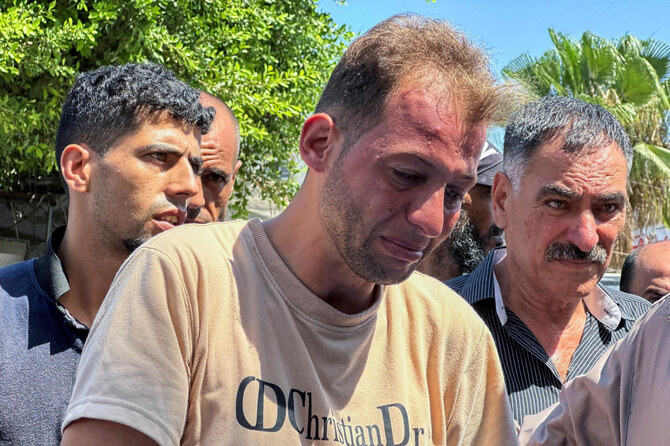
Footage of a distraught Abu Al-Qumsan, weeping and falling as he still holds the birth certificates, has been widely circulated on social media, becoming the latest emblem of the devastating toll of the war in the Palestinian territory.
“I was in the hospital at the time when the house was targeted,” he says, tears streaming down his face.
“There was a call, after the birth certificates were printed.
“The caller asked, ‘Are you okay and where are you?’ I told them I was at Al-Aqsa Martyrs Hospital, and I was told that my house had been bombed.”
Abu Al-Qumsan had left his wife, the infants and his mother-in-law in the fifth-floor flat they shared in Deir Al-Balah, in the central Gaza Strip, which has been relentlessly bombed by Israeli forces.
“I was informed that they are in Al-Aqsa Martyrs Hospital and I told them I am at the entrance to the hospital,” he says.
“I went inside the hospital with the birth certificates in my hands... and they told me they are in the morgue.”
On Wednesday, with his home obliterated and his family gone, Abu Al-Qumsan folded unused pink and yellow baby clothes outside a blue tent in Al-Mawasi, a coastal area that Israel has declared a humanitarian zone.
He never got the chance to show his wife that their babies had been legally named: Aser, the boy, and Aysal, the girl.
“On the same day I obtained their birth certificates, I also had to submit their death certificates, for my children, and also for their mother.”
“I did not get the chance to celebrate their arrival. Their clothes are new, they did not wear them,” he says, also showing a half-full pack of nappies.
“These nappies, we had a hard time finding them. For three months, we have been trying to buy some” in the Gaza Strip, where there has been a dire shortage of basic supplies since the start of the war.
The Gaza war began with Hamas’s October 7 attack on southern Israel which resulted in the deaths of 1,198 people, mostly civilians, according to an AFP tally of Israeli official figures.
Militants also seized 251 people, 111 of whom are still held captive in Gaza, including 39 the military says are dead.
Israel’s retaliatory military offensive in Gaza has killed at least 39,965 people, according to a toll from the territory’s health ministry, which does not provide a breakdown of civilian and militant deaths.
Abu Al-Qumsan married his wife Jumana, a pharmacist, in July last year, before the war plunged their lives into chaos.
She endured a traumatic pregnancy as they fled from place to place to escape the bombardments. Despite carrying twins, she insisted on volunteering in hospitals until the seventh month.
“Since the beginning of the war, I have been afraid every day, living in terror, and I was afraid that she would miscarry,” Abu Al-Qumsan says.
“We lost friends, family, and people who were very dear to us,” he adds.
“We were in a lot of pain, we were very scared. We ran a lot.”
“I want to know why she was killed in this way. I want to know why she was targeted. In the house, in a safe area,” he says.
“There was no prior warning of the bombing of the house. I have nothing to do with military action. We are civilians.”


![]()
![]()

Newborn twins killed in Gaza strike while father registered birth

Short Url
https://arab.news/pg4u4
Newborn twins killed in Gaza strike while father registered birth
- Footage of a distraught Abu Al-Qumsan, weeping and falling as he still holds the birth certificates, has been widely circulated on social media
- “I was in the hospital at the time when the house was targeted,” he says, tears streaming down his face


Latest updates




© 2026 SAUDI RESEARCH & PUBLISHING COMPANY, All Rights Reserved And subject to Terms of Use Agreement.