PESHAWAR: A prominent tribal leader was killed and another sustained injuries on Tuesday when their car was targeted in a blast triggered by an Improvised Explosive Device (IED) in Pakistan’s restive northwestern Bajaur district bordering Afghanistan, police and a tribal chief said.
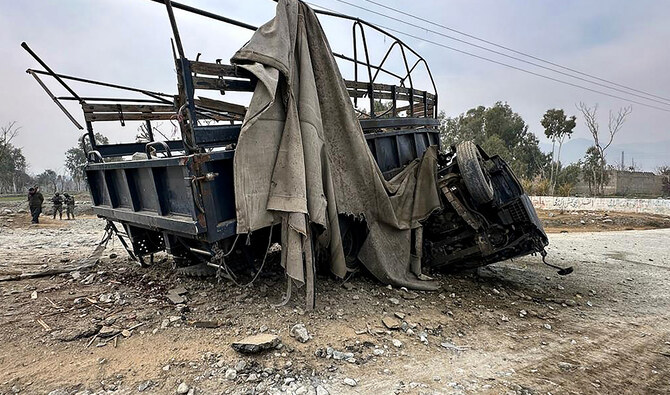
Police official Aziz-ur-Rehman said tribal leader Malik Yar Khan and his companion were heading to a function in Barang, a remote settlement in the Bajaur district when their vehicle was targeted in an IED blast.
“The blast tore through their vehicle, leaving Malik Yar Khan dead on the spot while his colleague Malik Rozi Khan sustained injuries, who was rushed to a local medical facility for treatment,” Rehman told Arab News.
A police party was dispatched to the area to collect evidence, the police official said, adding that suspected militants in the past used remote-controlled devices to target elders, security officials and politicians in the area.
No group has so far claimed responsibility for the attack but suspicion is likely to fall on the Tehreek-e-Taliban Pakistan (TTP), a separate but allied group of the Afghan Taliban who have carried out some of the deadliest attacks against Pakistani civilians and armed forces since 2007 to impose their strict brand of Islamic law.
A month earlier, former Pakistani senator Hidayatullah Khan was among five persons who were killed in an explosion in Bajaur district while campaigning for a local by-election.
Mansur Khan Mahsud, executive director at the Islamabad-based think-tank Fata Research Center, told Arab News that attacks on several tribal chiefs in Pakistan’s erstwhile tribal districts had almost paralyzed the leadership of Pashtun tribes of these areas.
Mahsud said that since 2004, a rough estimate shows that around 2,500 to 3,000 tribal elders have been killed in Pakistan.
“For years now, tribal elders remain a soft target for militants who are decimating them systematically because tribal chiefs play the role of a bridge between the government and people,” Mahsud told Arab News.
“And anti-peace elements are out to sabotage that bridge to create a vacuum in which they (anti-peace elements) have succeeded to a great extent.”
Tribal elders are very influential in the patriarchal society prevalent in the areas bordering Afghanistan, Mahsud said.
Here, these tribal leaders adjudicate disputes in jirgas or tribal councils, he explained.
In Bajaur and adjacent tribal districts including other parts of the northwestern Khyber Pakhtunkhwa province, militants allied with Daesh and the TTP regularly target politicians, tribal elders and security personnel.
Attacks in these areas have surged since a fragile truce between the TTP and the state broke down in Nov. 2022.
Malik Farmanullah Khan, a tribal leader from Bajaur, told Arab News Khan’s killing “clearly demonstrated the failure” of the concerned institutions. He described Khan as a “strong voice” against lawlessness and violence.
“These target killings continued unabated since 2007 in Bajaur but unfortunately, the perpetrators cannot be traced or identified,” Farmanullah said. “It is the state’s responsibility to tell us who is killing innocent people.”


![]()

Pakistani tribal leader killed in IED blast in northwestern district bordering Afghanistan
Short Url
https://arab.news/b4x5j
Pakistani tribal leader killed in IED blast in northwestern district bordering Afghanistan
- Malik Yar Khan was heading to a function in remote settlement in northwestern Pakistan when blast targeted his vehicle
- Tribal elders are targeted by militants because they play role of a bridge between state and people, says think tank official
Latest updates


© 2026 SAUDI RESEARCH & PUBLISHING COMPANY, All Rights Reserved And subject to Terms of Use Agreement.