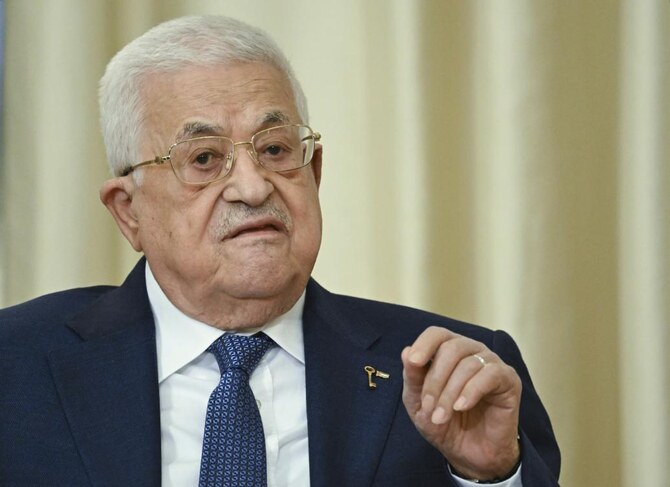
ANKARA: Palestinian Authority President Mahmud Abbas is set to meet with Turkiye’s Recep Tayyip Erdogan on Wednesday in Ankara, a day after a visit to Moscow.
The visit comes at a tense time during the 10-month Israel-Hamas war, with faltering efforts for a ceasefire and Israel braced for threatened attacks from Iran and its proxies following killings of senior Hamas officials in Iran and Lebanon.
Abbas is due to meet with Erdogan at 1530 GMT at the presidential palace, according to the Turkish leader’s itinerary.
Erdogan has been a fierce critic of Israel’s conduct in the war sparked by Hamas’s October 7 attacks, dubbing Israeli Prime Minister Benjamin Netanyahu “the butcher of Gaza.”
He also criticized the Western world for failure to pressure Israel to stop the war.
While Hamas is viewed by the United States, the European Union and Israel as a terrorist organization, Erdogan has described it as “a liberation movement.”
In July, Erdogan chastised Abbas for not responding to his invitation to visit Turkiye.
Abbas added a trip to Ankara after meeting with Russian President Vladimir Putin in Moscow on Tuesday.
He will address the Turkish parliament in a special session dedicated to the Palestinian issue on Thursday.
Abbas, who heads the Fatah Palestinian movement, a rival to Hamas, had already visited Turkiye at Erdogan’s invitation in early March.
Palestinian Authority President Abbas to meet Turkiye’s Erdogan
https://arab.news/we9u2
Palestinian Authority President Abbas to meet Turkiye’s Erdogan
- The visit comes at a tense time during the 10-month Israel-Hamas war
- Erdogan has been a fierce critic of Israel’s conduct in the war
Turkiye blocks aid convoy to Syria’s Kobani: NGOs
- They said the aid was blocked before it reached the Turkiye-Syria border
- “Blocking humanitarian aid trucks carrying basic necessities is unacceptable,” said the platform
ANKARA: Turkish authorities have blocked a convoy carrying aid to Kobani, a predominantly Kurdish town in northern Syria encircled by the Syrian army, NGOs and a Turkish MP said on Saturday.
They said the aid was blocked before it reached the Turkiye-Syria border, despite an agreement announced on Friday between the Syrian government and the country’s Kurdish minority to gradually integrate the Kurds’ military and civilian institutions into the state.
Twenty-five lorries containing water, milk, baby formula and blankets collected in Diyarbakir, the main city in Turkiye’s predominantly Kurdish southeast, “were prevented from crossing the border,” said the Diyarbakir Solidarity and Protection Platform, which organized the aid campaign.
“Blocking humanitarian aid trucks carrying basic necessities is unacceptable, both from the point of view of humanitarian law and from the point of view of moral responsibility,” said the platform, which brings together several NGOs.
Earlier this week, residents of Kobani told AFP they were running out of food, water and electricity because the city was overwhelmed with people fleeing the advance of the Syrian army.
Kurdish forces accused the Syrian army of imposing a siege on Kobani, also known as Ain Al-Arab in Arabic.
“The trucks are still waiting in a depot on the highway,” said Adalet Kaya, an MP from Turkiye’s pro-Kurdish DEM party who was accompanying the convoy.
“We will continue negotiations today. We hope they will be able to cross at the Mursitpinar border post,” he told AFP.
Mursitpinar is located on the Turkish side of the border, across from Kobani.
Turkish authorities have kept the border crossing closed since 2016, while occasionally opening it briefly to allow humanitarian aid to pass through.
DEM and Turkiye’s main opposition CHP called this week for Mursitpinar to be opened “to avoid a humanitarian tragedy.”
Turkish authorities said aid convoys should use the Oncupinar border crossing, 180 kilometers (110 miles) away.
“It’s not just a question of distance. We want to be sure the aid reaches Kobani and is not redirected elsewhere by Damascus, which has imposed a siege,” said Kaya.
After months of deadlock and fighting, Damascus and the Syrian Kurds announced an agreement on Friday that would see the forces and administration of Syria’s Kurdish autonomous region gradually integrated into the Syrian state.
Kobani is around 200 kilometers from the Kurds’ stronghold in Syria’s far northeast.
Kurdish forces liberated the city from a lengthy siege by the Daesh group in 2015 and it took on symbolic value as their first major victory against the militants.
Kobani is hemmed in by the Turkish border to the north and government forces on all sides, pending the entry into the force of Friday’s agreement.