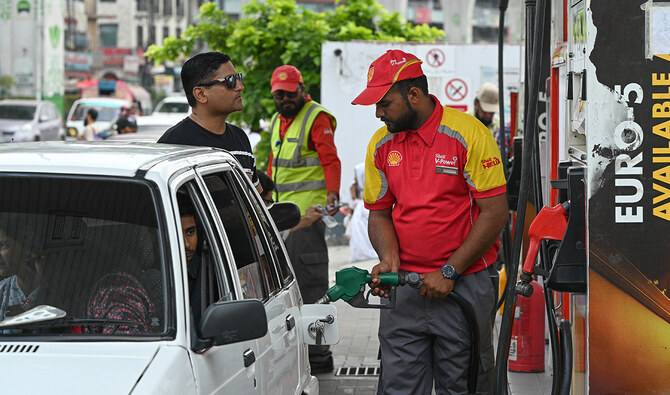
On Independence Day eve, Pakistan cuts petrol price by Rs8 per liter

A worker pumps petrol in a car at a fuel station in Rawalpindi on July 16, 2023. (AFP/File)
Short Url
Updated 14 August 2024
Follow

On Independence Day eve, Pakistan cuts petrol price by Rs8 per liter

  • The South Asian country revises petroleum prices every fortnight
  • Prices reduced due to ‘price variations in international market

ISLAMABAD: The Pakistani government has decreased the prices of petrol and high-speed diesel by as much as Rs8 per liter, its Finance Division said late Tuesday, as celebrations began in country for the 78th Independence Day.
The price of petrol was reduced by Rs8.47 to Rs260.96 per liter, while high-speed diesel went down by Rs6.70 to Rs266.07 per liter.
“The Oil and Gas Regulatory Authority (OGRA) has worked out the consumer prices of petroleum products, based on price variations in the international market,” the Finance Division said in a notification.
Pakistan revises petroleum prices every fortnight, however, the reduction came a day before to coincide with the 78th Independence Day of Pakistan on August 14.
The latest decrease will be a slight relief for the masses in a country where petroleum and electricity prices have been the key drivers of high inflation.
Petrol is mostly used in private transport, small vehicles, rickshaws and two-wheelers while any increase in the price of diesel is considered highly inflationary as it is mostly used to power heavy transport vehicles and particularly adds to the prices of vegetables and other eatables.


Pakistan top military commander urges ‘multi-domain preparedness’ amid evolving security threats

Updated 9 sec ago
Follow

Pakistan top military commander urges ‘multi-domain preparedness’ amid evolving security threats

  • Asim Munir says Pakistan faces layered challenges spanning conventional, cyber, economic and information domains
  • His comments come against the backdrop of tensions with India, ongoing militant violence in western border regions

ISLAMABAD: Pakistan’s top military commander Field Marshal Asim Munir on Tuesday stressed the need for “multi-domain preparedness” to counter a broad spectrum of security challenges facing the country, saying they ranged from conventional military threats to cyber, economic and information warfare.

Pakistan’s security environment has remained volatile following a brief but intense conflict with India earlier this year, when the two nuclear-armed neighbors exchanged missile and artillery fire while deploying drones and fighter jets over four days before a ceasefire was brokered by the United States.

Pakistan has also been battling militant violence in its western provinces of Khyber Pakhtunkhwa and Balochistan, where authorities say armed groups operate from across the border in Afghanistan and receive backing from India. Both Kabul and New Delhi have rejected claims.

The military has also warned that disinformation constitutes a new form of security threat, prompting tighter regulations that critics say risk suppressing dissent. Munir also pointed to a “complex and evolving” global, regional and internal security landscape while addressing participants in the National Security and War Course at the National Defense University (NDU).

“These challenges span conventional, sub-conventional, intelligence, cyber, information, military, economic and other domains, requiring comprehensive multi-domain preparedness, continuous adaptation and synergy among all elements of national power,” he said, according to a military statement.

“Hostile elements increasingly employ indirect and ambiguous approaches, including the use of proxies to exploit internal fault lines, rather than overt confrontation,” he continued, adding that future leaders must be trained and remain alert to recognize, anticipate and counter these multi-layered challenges.

Munir also lauded the NDU for producing strategic thinkers who he said were capable of translating rigorous training and academic insight into effective policy formulation and operational outcomes.