

Turkiye works to bring together rivals Somalia, Ethiopia

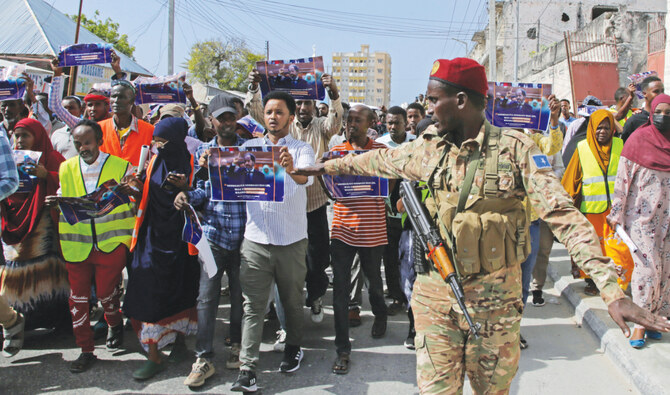
Mogadishu residents protest at a rally an agreement signed between Ethiopia and the breakaway region of Somaliland to give landlocked Ethiopia access to its shoreline, in this Jan. 3 file photo. (AP)
Short Url
Updated 13 August 2024
Follow

Turkiye works to bring together rivals Somalia, Ethiopia

ISTANBUL: Turkiye is seeking to bring together Horn of Africa rivals Somalia and Ethiopia for the second round of talks in Ankara aiming to ease tensions between them, a Turkish diplomatic source said.

Turkish Foreign Minister Hakan Fidan separately met with his counterparts from Somalia and Ethiopia on Monday.

“The parties are not meeting with one another,” the Turkish diplomatic source said.

“The Turkish delegation is conducting shuttle diplomacy under the coordination of our minister,” the same source added.

The two neighbors have a history of stormy relations and territorial feuds. They fought two wars in the late 20th century.

These tensions were exacerbated earlier this year when Addis Ababa signed a memorandum of understanding with Somaliland that gives Ethiopia — one of the largest landlocked countries in the world — long-sought-after sea access.

In return, Somaliland — which unilaterally declared independence from Somalia in 1991, a move not recognized by Mogadishu — has said Ethiopia would give it formal recognition, although these assertions have not been confirmed by Addis Ababa.

Under the January 1 pact, Somaliland agreed to lease 20 kilometers (12 miles) of its coast for 50 years to Ethiopia, which wants to set up a naval base and a commercial port.

Fidan announced “good progress” during July talks and said he remained hopeful for the future, during press conference alongside the two neighbors’ foreign ministers.

President Recep Tayyip Erdogan is also involved in the diplomatic efforts for reconciliation between the two sides as he held separate phone calls with Somalian President Hassan Sheikh Mohamud and Ethiopian Prime Minister Abiy Ahmed at the weekend.

Turkiye is pushing for diplomatic and economic influence in Africa, at a time when many countries in the continent are turning away from their former colonial rulers.

Over Erdogan’s two decades in power, Ankara has consolidated its foothold on the continent, quadrupling its number of embassies there.

Turkiye has already announced plans to launch an oil and gas exploration mission off the coast of Somalia, similar to the one it is carrying out in Libyan waters.

Ankara has signed defense agreements with a number of states spanning the breadth of the continent, including Somalia, Libya, Kenya, Rwanda, Ethiopia, Nigeria and Ghana.


Hegseth says US ‘can’t stop everything’ that Iran fires even as he asserts air dominance

Updated 11 sec ago
Follow

Hegseth says US ‘can’t stop everything’ that Iran fires even as he asserts air dominance

WASHINGTON (AP): Defense Secretary Pete Hegseth acknowledged Wednesday that some Iranian air attacks may still hit their targets even as he asserted that US military superiority is quickly giving it control of the Islamic Republic’s airspace.
The US has spared “no expense or capability” to enhance air defense systems to protect American forces and allies in the Middle East, Hegseth told reporters at the Pentagon days after the US and Israel attacked Iran in a war that has widened throughout the region.
“This does not mean we can stop everything, but we ensured that the maximum possible defense and maximum possible force protection was set up before we went on offense,” he said.
The acknowledgement that additional drone or missile strikes in the region could cause damage and harm to troops comes as President Donald Trump and top defense leaders have warned that additional American casualties were expected in a conflict that could last months.
US service members “remain in harm’s way, and we must be clear-eyed that the risk is still high,” Gen. Dan Caine, chairman of the Joint Chiefs of Staff, said at the same press conference.
Six soldiers were killed when an Iranian drone strike hit an operations center Sunday in the heart of a civilian port in Kuwait, miles away from the main Army base. The husband of one of the slain soldiers, who was part of a supply and logistics unit based in Iowa, says the center was a shipping container-style building and had no defenses.
Hegseth also signaled a possible longer time frame for the conflict than has previously been floated by the Trump administration, saying it could last eight weeks but that the US has the munitions and the equipment to beat Iran in a war of attrition. He declined to set a specific time range, saying the specific duration of the war would depend on how it unfolds.
“You can say four weeks, but it could be six, it could be eight, it could be three,” he said. “Ultimately, we set the pace and the tempo. The enemy is off balance, and we’re going to keep them off balance.”
More forces continue to arrive in the region, including jet fighters and bombers, Hegseth said, and the US “will take all the time we need to make sure that we succeed.”
Tehran has vowed to completely destroy the Middle East’s military and economic infrastructure — signaling the war was nowhere near over and could expand further.
President Donald Trump said this week the campaign are likely to last four to five weeks but that he was prepared “to go far longer than that.”