

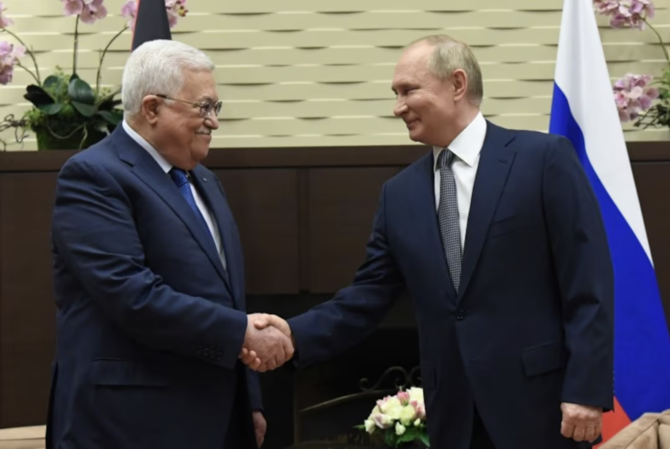
Putin to hold talks with Palestinian president Abbas on Tuesday: TASS

Russian President Vladimir Putin shakes hands with Palestinian President Mahmoud Abbas during their meeting in Sochi, Russia November 23, 2021. (File/Reuters)
Short Url
Updated 12 August 2024
Follow

Putin to hold talks with Palestinian president Abbas on Tuesday: TASS

  • Abbas arrived in Russia on Monday to discuss Gaza war

MOSCOW: Russian President Vladimir Putin will hold talks on Tuesday with Palestinian President Mahmoud Abbas, who is visiting Russia, state news agency TASS reported.

Abbas arrived in Russia on Monday to discuss the Gaza war with Russian President Vladimir Putin, a Palestinian envoy said.

Russia's state-run TASS news agency cited the Palestinian ambassador in Moscow as saying Abbas will arrive on Monday and meet Putin on Tuesday.

Abbas heads the Fatah Palestinian movement, a rival to Hamas.

Ambassador Abdel Hafiz Nofal said the two leaders would discuss events in Gaza since the October 7 attacks on Israel. "They will talk about Russia's role, what can be done."

He added: "We have a very difficult situation, and Russia is a country that is close to us. We need to consult each other."

Moscow for years tried to balance relations with all major players in the Middle East, including Israel and the Palestinians.

But since the Israel-Hamas war and Russia's own offensive on Ukraine, Putin has moved closer to Israel's foes, Hamas and Iran.

The Kremlin has repeatedly criticized Israel's response to the October 7 attacks and called for restraint.

(With AFP and Reuters)

The Yazidi nightmare
Ten years after the genocide, their torment continues

Enter


keywords

France demands EU-Mercosur trade pact signing be put off

Updated 6 sec ago
Follow

France demands EU-Mercosur trade pact signing be put off

  • “France asks that the deadlines be pushed back to continue work on getting the legitimate measures of protection for our European agriculture,” said the statement

PARIS, France: France on Sunday urged the European Union to postpone the deadlines set for signing a free trade agreement with South American bloc Mercosur, rejecting the deal in its current form.
In a statement from Prime Minister Sebastien Lecornu’s office, Paris said the conditions were not in place for EU member states to vote on the agreement.
“France asks that the deadlines be pushed back to continue work on getting the legitimate measures of protection for our European agriculture,” said the statement.
European Commission President Ursula von der Leyen is due in Brazil on Monday for talks to finalize the landmark pact with the Mercosur bloc, which includes Brazil, Argentina, Uruguay, and Paraguay.
But Brussels first has to get the approval of the EU member states over the coming week.
“Given a Mercosur summit is announced for December 20 (Saturday), it is clear in this context that the conditions have not been met for any vote (by states) on authorizing the signing of the agreement,” said the statement from Paris.
Earlier Sunday, in an interview published in the Germany financial daily Handelsblatt, France’s Finance Minister Roland Lescure made France’s objections clear.
“As it stands, the treaty is simply not acceptable,” he said.
Securing robust and effective safeguard clauses was one of the three key conditions France set before giving its blessing to the agreement, he added.
The other key points were requiring the same production standards faced by EU farmers and establishing “import controls.”
“Until we have obtained assurances on these three points, France will not accept the agreement,” said Lescure.
European nations are poised to vote on the trade agreement between Tuesday and Friday, according to EU sources.
The European Parliament votes Tuesday on safeguards to reassure farmers — particularly those in France — who are fiercely opposed to the treaty.
If approved, the EU-Mercosur agreement would create a common market of 722 million people.
It is intended to allow the EU to export more cars, machinery, wine, and other goods, and will also facilitate the entry into the European Union of beef, poultry, sugar, honey, and other products.
Farmers in France and some other European countries say it will create unfair competition due to less stringent standards, which they fear could destabilize already fragile European food sectors.