

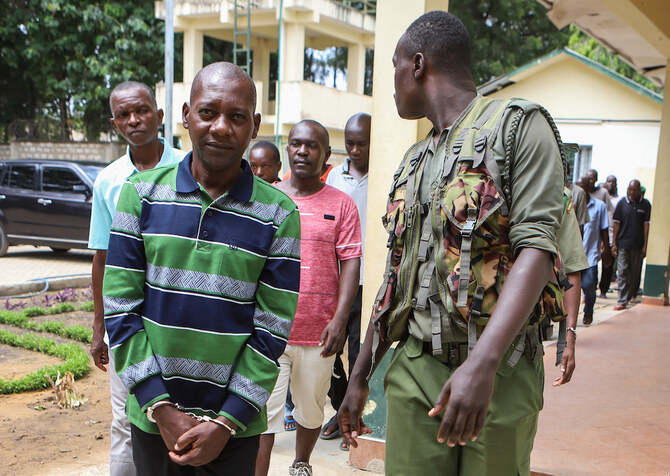

NAIROBI: The leader of a Kenyan starvation sect went on trial on Monday for manslaughter over the deaths of more than 400 of his followers in one of the world’s worst cult-related tragedies.
Self-proclaimed pastor Paul Nthenge Mackenzie and dozens of other suspects pleaded not guilty in January to multiple counts of manslaughter, one of several cases against them over what is known as the “Shakahola Forest Massacre.”
Mackenzie appeared in a magistrate’s court in the Indian Ocean port city of Mombasa along with more than 90 other suspects, prosecutors and court officials said.
“There has never been a manslaughter case like this in Kenya,” prosecutor Alexander Jami Yamina said, adding that they will be charged under a Kenyan law dealing with suicide pacts.
“This is going to be a very unique manslaughter case.”
Mackenzie is alleged to have incited his followers to starve to death in order to “meet Jesus” in a case that provoked horror in Kenya and across the world.
He was arrested in April last year after several bodies were first discovered in the remote Shakahola forest that lies inland from the Indian Ocean town of Malindi.
Rescuers spent many months searching the scrubland and have now unearthed around 448 bodies from mass graves.
Autopsies revealed that the majority of victims had died of hunger. But others, including children, appeared to have been strangled, beaten or suffocated.
Previous court documents also said that some of the bodies had their organs removed.
At least 420 witnesses have been prepared by the prosecutors, with the hearing scheduled to run for four days until Thursday.
“Due to the gravity of the case, we have prepared well,” Yamina said.
Some of the witnesses will present testimonies in camera.
The suspects, 55 men and 40 women, went on trial last month on charges of terrorism over the Shakahola massacre, and also face separate cases of murder and child torture and cruelty relating to the deaths, which prosecutors say occurred over the years 2020 to 2023.
In March this year, the authorities began releasing some victims’ bodies to distraught relatives after months of painstaking work to identify them using DNA. So far 34 have been returned.
Mackenzie had set up his Good News International Church in 2003, but said he closed it in 2019 and moved to Shakahola to prepare for what he had predicted would be the end of the world in August last year.
The grisly case led the government to flag the need for tighter control of fringe denominations, while questions have been raised about how Mackenzie managed to evade law enforcement despite a history of extremism and previous legal cases.
A commission set up by President William Ruto to investigate the deaths and review regulations governing religious bodies presented its report last month, urging for a hybrid model of self-regulation and government oversight.
Separate reports by the Kenyan senate and a state-funded human rights watchdog have said the authorities could have prevented the deaths.
Efforts to regulate religion in the majority-Christian country have often been fiercely opposed in the past as attempts to undermine constitutional guarantees for the division of church and state.


