Egypt and Japan eye enhanced economic cooperation on 70th anniversary of ties

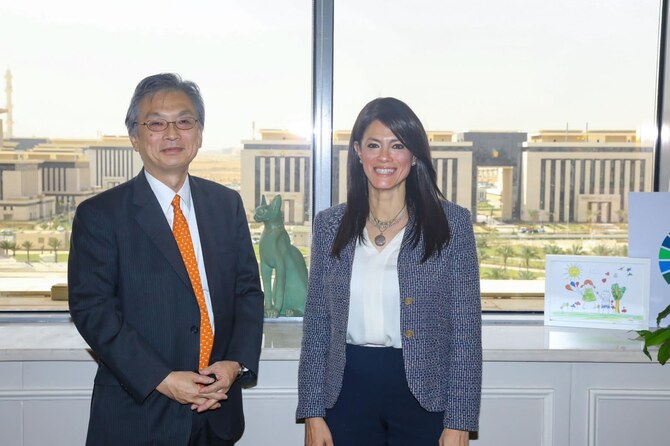
Egypt’s Minister of Planning, Economic Development and International Cooperation Rania Al-Mashat met Japan’s ambassador to Egypt Oka Hiroshi. Facebook/Egyptian Cabinet
Short Url
Updated 12 August 2024
Follow

Egypt and Japan eye enhanced economic cooperation on 70th anniversary of ties

  • Talks discussed ways to deepen bilateral ties and expand collaborative efforts
  • Egyptian minister stressed importance of deepening partnerships with Japan, particularly in industrial development, localization and human capacity enhancement

RIYADH: Egypt and Japan are poised to bolster their economic relations following a virtual meeting between key officials from both countries. 

Rania Al-Mashat, Egypt’s minister of planning, economic development and international cooperation, held talks with Oka Hiroshi, Japan’s ambassador to Egypt, to explore avenues for enhanced economic cooperation to deepen bilateral ties and expand collaborative efforts. 

The meeting marks the first interaction between Al-Mashat and Hiroshi since the recent merger of Egypt’s Ministry of Planning and Economic Development with the Ministry of International Cooperation. 

It also aligns with the 70th anniversary of diplomatic relations between the two nations, according to a statement by the Egyptian Cabinet. 

Al-Mashat highlighted the importance of strengthening international partnerships in industrial localization and human development as the milestone anniversary approaches. 

The minister emphasized the strong ties between Egypt and Japan and highlighted their significant partnerships across key areas. These include investments in human capital, infrastructure projects and support for renewable energy transitions, all contributing to inclusive and sustainable growth. 

Hiroshi expressed Japan’s pride in its partnership with Egypt and its dedication to furthering cooperation in various areas. Both sides also agreed to organize a high-level policy dialogue by the end of August, which is expected to strengthen bilateral collaboration, the statement added. 

The policy dialogue will focus on development cooperation, exploring future proposals and technical assistance aligned with Egypt’s 2030 Vision — the government’s three-year program — and various ministry priorities. 

Al-Mashat stressed the importance of deepening partnerships with Japan, particularly in industrial development, localization and human capacity enhancement to support the Egyptian government’s strategic goals. 

She highlighted the importance of these two areas and their role in achieving comprehensive and sustainable economic development, underscoring the need to utilize Japanese expertise in these fields. 

The discussions also covered Al-Mashat’s upcoming visit to Japan, which is set to commemorate the 70th anniversary of bilateral relations. The visit is expected to include extensive meetings with Japanese officials and development institutions, according to the official statement. 

Al-Mashat highlighted that the Egyptian-Japanese partnership has significantly advanced under President Abdel Fattah El-Sisi, evolving into a strategic alliance. This progress has driven notable achievements in development projects, politics, economics, trade, investment and health care. 

She added that the partnership has also achieved progress in culture, education, science and technology, both bilaterally and multilaterally. 

The meeting also addressed key joint priorities, including the World Bank-approved Development Policy Financing loan program to support Egypt’s post-pandemic recovery, and several grants nearing completion in culture and agriculture. 

The minister stressed the importance of coordinating with partners to advance Egypt’s development plans and bolster economic and social progress. 

She highlighted ongoing collaboration with the Japan International Cooperation Agency and other financial institutions to drive private sector investment in key sectors, reflecting the government’s focus on enhancing economic policies and expanding the role of the private sector in development. 

She also spoke about the pivotal role of Japanese institutions in financing private sector energy projects under Egypt’s Nexus of Water, Food, and Energy program, which seeks to advance the country’s climate goals. 

Japan remains a key development partner for Egypt, with a portfolio of over 18 projects valued at approximately $3.9 billion. 


Rafal to develop 4 hotels in Riyadh, Tilal Khuzam units accessible from $1,867 monthly, CEO says

Updated 11 sec ago
Follow

Rafal to develop 4 hotels in Riyadh, Tilal Khuzam units accessible from $1,867 monthly, CEO says

RIYADH: Rafal Real Estate Development Co, a Saudi developer, plans to advance its expansion strategy, with investments in Riyadh reaching about SR6.5 billion ($1.73 billion) by 2025.

The company aims to strengthen its presence outside the capital starting next year, Elias Abuo Samra, CEO of Rafal, told Al Eqtisadiah in an exclusive interview.

Abuo Samra said the firm has begun investing in the hospitality sector through a partnership with the hotel brand Rove to develop four new hotel projects ready to serve Expo Riyadh 2030.

He added that the company is also presenting a $1 billion initiative to “tokenize” a real estate portfolio, aimed at bringing small investors into the sector, underscoring that the undeveloped land fee decision has had a significant positive impact by increasing development opportunities and reducing market monopolies.

How much has Rafal invested in Saudi Arabia to date?

The company has been operating in the market for 18 years. Our investments in Riyadh in 2025 total about SR6.5 billion, divided across three main areas: revenue-generating projects; the Tilal Khuzam project in northern Riyadh, in partnership with the National Housing Co.; and a newly established urban services division that includes surface parking, storage projects, and others.

Are your investments limited to Riyadh?

Currently, our focus is on Riyadh. Starting next year, we plan to expand through exclusive brands we work with to develop four premium hotels in the city, and from there we will extend to other regions in Saudi Arabia.

What monthly income does an individual need to own property in Rafal projects?

An individual can start ownership with support from the Ministry of Housing with a monthly income of SR7,000. This allows ownership in Tilal Khuzam, where units start from SR500,000, with an area of 60 to 70 sq. meters, overlooking Khuzam Park, the second-largest park in Riyadh.

Tell us about your key upcoming projects.

Our flagship initiative is an exclusive partnership with Rove Hotels, which owns around 14,000 rooms in Dubai. Through this partnership, we have launched four hotel projects with more than 1,000 rooms across central, northern, and eastern Riyadh.

Two of these projects began in the fourth quarter of 2025, while the other two will start in the first quarter of 2026. All four are scheduled to open in 2027 in time for the Saudi Expo.

Are there plans to list Rafal on the Saudi market?

We are focused on achieving sustainable returns from our projects, especially as the real estate market experiences fluctuations.

Our plan is to achieve this sustainability within two to three years, whether through returns from the Rove project or our five residential developments near Riyadh metro stations. Once these projects reach operational sustainability, we will be ready for a local market listing.

You said you focus on innovation and urban living in your projects, what does that mean?

Innovation and urban living mean addressing Riyadh’s urban challenges. We monitor the city’s social, demographic, and economic evolution to launch projects that meet the expectations of youth and visitors.

For example, we have projects designed to support public transportation, with 1,200 hotel rooms located within five minutes of metro stations. This provides functional housing solutions for young people, helps address traffic issues, and creates a high-quality urban lifestyle. 

We also focus on hotels in strategic locations to ensure visitors can stay at an average rate of no more than SR500 per night throughout the year, in prime locations close to services and the metro.

You launched a tokenization initiative for your portfolio in Riyadh. What is your objective?

Yes, we launched a $1 billion tokenization initiative. This approach, common globally, converts real estate into units that can be traded and owned by small investors, under the supervision of regulatory bodies like the Capital Market Authority.

The main aim is to involve Saudi youth in real estate investment, limit speculation, distribute wealth more broadly, and enable foreign investors to participate, starting from $1,000 to $ 50,000.

Tell us about your financing collaborations with banks.

We rely on smart financing closely linked to our projects. We work with strategic financiers focused on areas such as green finance, housing finance, or technology-driven funding. This approach gives us better terms and incentives to complete projects efficiently.

How has the Tilal Khuzam project performed?

Tilal Khuzam was our first collaboration with NHC. It includes 385,000 residential units, some of which will become revenue-generating rental apartments.

The project has more than 50 six-story buildings, targeting annual returns of 8 percent. Unit prices range from SR500,000 to SR1.5 million.

The project is divided into four phases, originally planned to be sold over four years. By the end of last November, around 1,500 apartments had been sold, representing approximately 45 percent of the first phase.

You have announced projects worth SR4bn. Can you tell us about them?

Yes, these investments are distributed across key areas: SR1.5 billion is allocated to hospitality projects, around SR2 billion for the new phase of the Tilal Khuzam project, and in the coming weeks, we will announce a new logistics project in the heart of Riyadh.

How did the fee decision on undeveloped lands affect your projects in Riyadh?

We do not engage in land hoarding or resale; instead, we acquire land and develop it immediately to improve and accelerate returns.

Two-thirds of our revenues come from development services, not land trading. Therefore, the decision had a very positive impact on us, increasing our development opportunities fivefold compared with before.

This demonstrates that the decision stimulated the market, reduced monopolies, and we expect a significant increase in supply over the next two years, which will benefit both Saudi families and foreign investors.

What are your market expectations for the next phase?

The real estate market cannot be assessed in isolation from the flow of life; it is not like gold, iron, rice, or other commodities. It is an integral part of every person’s life, and location, price, and product are influenced by various supply and demand factors.

Speaking of the residential sector, the numbers are clear: Riyadh will need 300,000 housing units annually over the next five years due to the significant migration from other cities and provinces to the capital.

The economic reality is that the more job opportunities there are in Riyadh, the stronger the demand. The market cannot be evaluated without considering the successful attraction of global company headquarters. Today, Riyadh hosts more than 500 international companies, and we see their impact on demand for office spaces and educational services.

We have also noticed changes in our projects: we have sold four residential units to executives from four global Chinese companies that relocated their offices to Riyadh, and we are increasingly seeing purchases by residents of various nationalities living in Saudi Arabia.