

In Iraq’s summer, residents of Kurdistan’s Irbil ache for water

1 / 4
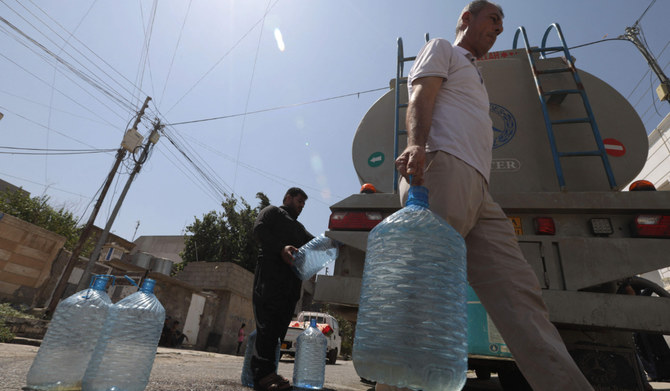
Iraqi Kurds fill container with portable water distributed by a mobile tanker as summer temperatures soar in Arbil, the capital of Iraq's northern autonomous Kurdish region, on July 25, 2024. (AFP)
2 / 4
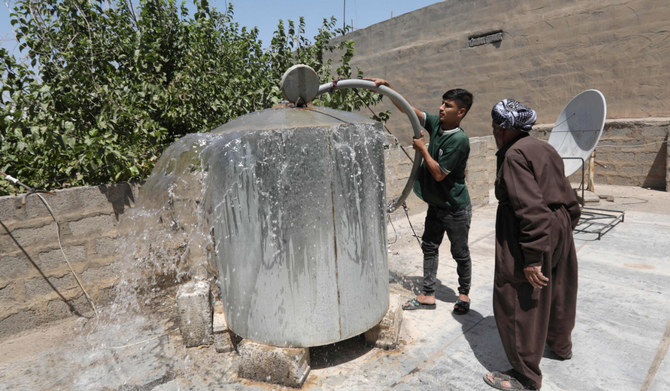
An Iraqi Kurd youth fills a water tank with portable water distributed by a mobile tanker (unseen), as summer temperatures soar in Arbil, the capital of Iraq's northern autonomous Kurdish region, on July 25, 2024. (AFP)
3 / 4
Iraqi Kurds fill container with portable water distributed by a mobile tanker as summer temperatures soar in Arbil, the capital of Iraq's northern autonomous Kurdish region, on July 25, 2024. (AFP)
4 / 4
An Iraqi Kurd fill an water tank and a large container with portable water distributed by a mobile tanker (unseen), as summer temperatures soar in Arbil, the capital of Iraq's northern autonomous Kurdish region, on July 25, 2024. (AFP)
Short Url
Updated 12 August 2024
Follow

In Iraq’s summer, residents of Kurdistan’s Irbil ache for water

  • Iraq is known in Arabic as the Land of the Two Rivers, referring to the once mighty Tigris and Euphrates

IRBIL, Iraq: The taps have run dry, and the wells are almost empty. In the capital of Iraq’s autonomous Kurdistan region, 80-year-old Babir hasn’t bathed in weeks and impatiently waits for trucked-in water deliveries.
“There is nothing worse than not having water,” said Babir, who gave only his first name, in his modest house in Irbil’s Darto suburb.
As in several other densely populated areas of Irbil and its suburbs, Babir and his neighbors rely on groundwater as their primary water source.
But for years, they have dreaded summer, when relentless drought, a lack of wells and power outages that bring pumps to a halt leave them cut off the supply of water.
For everything from bathing to watering plants, cooking and washing, they have been forced to depend on trucked-in water.
Usually “we bathe once every fortnight,” said Babir, dressed in traditional Kurdish sarwal trousers.
From the roof of his house, he shouted for a water truck as it drove up into the street, then hurried downstairs to request a refill for his home.
This time, the truck belonged to a local aid group. When such assistance is unavailable, the retiree has to pay from his meagre pension or rely on family for water and other essentials.
Over the years, residents of several districts have taken to the streets many times to demand solutions, but Babir said appeals to officials had fallen on deaf ears. He said he was considering moving “to a place with water.”

Iraq is known in Arabic as the Land of the Two Rivers, referring to the once mighty Tigris and Euphrates. But the rivers’ water levels have plummeted and the UN classifies the country as one of the most impacted by some effects of climate change.
Authorities blame the drought as well as dams built upstream in neighboring Turkiye and Iran.
Irbil relies on 1,240 wells dotted across the city alongside the Ifraz water station that draws from the upper Zab River, which has its source in Turkiye and joins the Tigris in Iraq.
Its governor, Omed Khoshnaw, told reporters earlier this month that “more than 25 percent of wells have dried up this year,” adding that Irbil should rely less on groundwater.
Amid the crisis, the city’s local authorities say they have allocated 1.5 billion Iraqi dinars ($1.1 million) to help solve it, including by digging new wells and providing power via generators and the electricity grid.
Local official Nabz Abdul Hamid said that power outages have heavily impacted pumps for wells in residential areas.
“We have now provided an uninterrupted electricity supply to most of the wells,” he told AFP, adding that officials were working to fix the broader problem including by improving the Ifraz plant supply.

In the Darto district, one person skillfully maneuvered the aid truck’s hose as a torrent of water gushed into a tank.
A young girl waited to fill plastic bottles while other children joyfully splashed water on their faces, finding relief from the relentless heat.
But when it comes to washing, Surur Mohamad, 49, said that for anything more than basic clothes he goes to a nearby village where they have a steady water supply.
Trucked-in water from aid organizations “is not a solution,” he said, adding that overcrowding has put further pressure on the water system while poor pipe infrastructure has exacerbated the problem.
“The government must find radical solutions as relying solely on wells” is no longer viable, especially considering the drought, he said.
His neighbor, Mahya Najm, said the lack of water had stopped her children and young families from visiting her.
“We cannot wash, cook or even receive guests,” she said.
“We are in dire need of water. This is not a life,” she added.

The Yazidi nightmare
Ten years after the genocide, their torment continues

Enter


keywords

US transfers thousands of Daesh detainees from Syria to Iraq

Updated 8 sec ago
Follow

US transfers thousands of Daesh detainees from Syria to Iraq

BAGHDAD: The United States Central Command said it has completed the transfer of more than 5,700 detained Daesh group suspects from Syria to Iraq.
The detainees from some 60 countries had for years been held in Syrian prisons run by Kurdish-led forces before the recapture of surrounding territory by Damascus prompted Washington to step in.
CENTCOM said it “completed a transfer mission following a nighttime flight from northeastern Syria to Iraq on Feb 12 to help ensure Daesh detainees remain secure in detention facilities.”
“The 23-day transfer mission began on Jan 21 and resulted in US forces successfully transporting more than 5,700 adult male Daesh fighters from detention facilities in Syria to Iraqi custody,” it added in a statement.
The US had previously announced it would transfer around 7,000 detainees.
Daesh swept across Syria and Iraq in 2014, committing massacres and forcing women and girls into sexual slavery.
Backed by US-led forces, Iraq proclaimed the defeat of Daesh in the country in 2017, and the Kurdish-led Syrian Democratic Forces (SDF) ultimately beat back the group in Syria two years later.
The SDF went on to jail thousands of suspected jihadists and detain tens of thousands of their relatives in camps.

- 61 countries -

Last month, Syrian troops drove Kurdish forces from swathes of northern Syria, sparking questions over the fate of the Daesh prisoners.
Lingering doubts about security pushed Washington to announce it would transfer them to Iraq to prevent “a breakout” that could threaten the region.
“We appreciate Iraq’s leadership and recognition that transferring the detainees is essential to regional security,” said head of CENTCOM Admiral Brad Cooper.
“Job well done to the entire Joint Force team who executed this exceptionally challenging mission on the ground and in the air,” he added.
Iraq’s National Center for International Judicial Cooperation (NCIJC) said 5,704 Daesh detainees of 61 nationalities have arrived in Iraq.
They include 3,543 Syrians, 467 Iraqis, and another 710 detainees from other Arab countries.
There are also more than 980 foreigners including those from Europe, Asia, Australia and the United States.
The NCIJC said Iraq’s judiciary will interrogate the detainees before taking legal action against them.
Many prisons in Iraq are already packed with Daesh suspects.
Iraqi courts have handed down hundreds of death sentences and life terms to those convicted of terrorism offenses, including foreign fighters.
Under Iraqi law, terrorism and murder offenses are punishable by death, and execution decrees must be signed by the president.
The detainees in Syria were transferred to Baghdad’s Al-Karkh prison, once a US Army detention center known as Camp Cropper, where former ruler Saddam Hussein was held before his execution.
To make space for the newcomers, authorities moved thousands of prisoners from the Karkh prison to other facilities, a lawyer and an inmate told AFP on condition of anonymity.

- Repatriation -

Iraq has issued calls for countries to repatriate their nationals among the Daesh detainees, though this appears unlikely.
For years, Syria’s Kurdish forces also called on foreign governments to take back their citizens, but this was done on a small scale limited to women and children held in detention camps.
Most foreign families have left northeast Syria’s Al-Hol camp, which holds relatives of Daesh fighters, since the departure of Kurdish forces who previously guarded it, humanitarian sources told AFP on Thursday.
Last month, the Syrian government took over the camp from Kurdish forces who ceded territory as Damascus extended its control across swathes of Syria’s northeast.