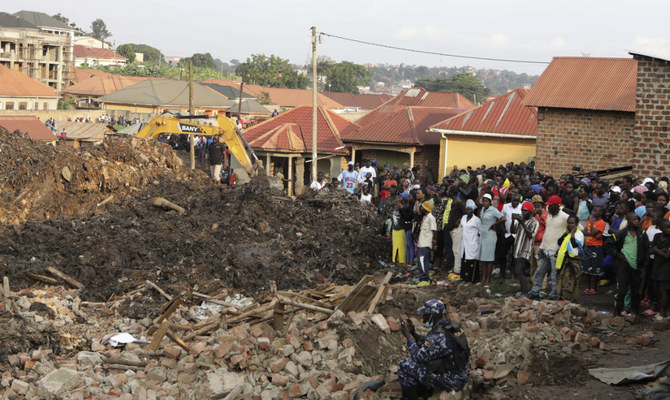
KAMPALA, Uganda: A vast landfill site in the Ugandan capital has collapsed, killing at least 18 people, the Red Cross said.
Fourteen other people were injured when the Kiteezi landfill, which serves as a waste disposal site for much of Kampala, collapsed late Friday. At least two of the dead were children, Kampala Capital City Authority said in a statement.
The collapse is believed to have been triggered by heavy rainfall. The precise details of what happened were unclear, but the city authority said there was a “structural failure in waste mass.”
Irene Nakasiita, a spokeswoman for the Uganda Red Cross, said the toll reached 18 after more bodies were retrieved from the scene Sunday.
“The assessment is not yet completed,” she said, adding that rainfall was slowing the efforts of rescue teams digging through heaps of trash.
The Kiteezi landfill is on a steep slope in an impoverished part of the city. Women and children who scavenge plastic waste for income frequently gather there, and some homes have been built close to the landfill.
Kampala authorities for years have considered closing the site and commissioning a larger area outside the city as a waste disposal site. It was not clear why the plan has failed to take off since 2016.
Ugandan President Yoweri Museveni ordered an investigation into the incident, asking in a series of posts on the social platform X why people were living in close proximity to an unstable heap of garbage.
“Who allowed people to live near such a potentially hazardous and dangerous heap?” Museveni said, adding that effluent from the site is hazardous enough that people should not be living there.

At least 18 dead after landfill site collapses in Uganda’s capital
Short Url
https://arab.news/5vvmm
At least 18 dead after landfill site collapses in Uganda’s capital
- The collapse is believed to have been triggered by heavy rainfall
Bangladesh criticizes India over fugitive leader Hasina’s speech
DHAKA: Bangladesh said on Sunday it was “surprised” and “shocked” that India had allowed fugitive former prime minister Sheikh Hasina to make a public address in New Delhi.
Hasina, 78, fled to neighboring India in August 2024 after a student-led uprising ended her iron-fisted 15-year rule. She made her first public speech since then in an audio address to a packed press club in Delhi on Friday.
She was found guilty in absentia by a Dhaka court in November of incitement, issuing an order to kill and inaction to prevent atrocities and was sentenced to be hanged.
“The government and the people of Bangladesh are surprised and shocked,” Dhaka’s foreign ministry said in a statement.
“Allowing the event to take place in the Indian capital and letting mass murderer Hasina openly deliver her hate speech... constitute a clear affront to the people and the Government of Bangladesh.”
It said allowing Hasina to make the speech set “a dangerous precedent” that could “seriously impair bilateral relations.”
Bangladesh voters go to the polls on February 12 to choose new leaders after a period of turmoil that followed the overthrow of Hasina’s autocratic government.
Hasina said in her audio address that “Bangladesh will never experience free and fair elections” under interim leader Muhammad Yunus.
More than 100,000 people watched the address, which was broadcast online.
Bangladesh has asked India to extradite Hasina, but New Delhi has yet to comment on the request.
India’s past support for Hasina has frayed relations between the South Asian neighbors since her overthrow.
Hasina, 78, fled to neighboring India in August 2024 after a student-led uprising ended her iron-fisted 15-year rule. She made her first public speech since then in an audio address to a packed press club in Delhi on Friday.
She was found guilty in absentia by a Dhaka court in November of incitement, issuing an order to kill and inaction to prevent atrocities and was sentenced to be hanged.
“The government and the people of Bangladesh are surprised and shocked,” Dhaka’s foreign ministry said in a statement.
“Allowing the event to take place in the Indian capital and letting mass murderer Hasina openly deliver her hate speech... constitute a clear affront to the people and the Government of Bangladesh.”
It said allowing Hasina to make the speech set “a dangerous precedent” that could “seriously impair bilateral relations.”
Bangladesh voters go to the polls on February 12 to choose new leaders after a period of turmoil that followed the overthrow of Hasina’s autocratic government.
Hasina said in her audio address that “Bangladesh will never experience free and fair elections” under interim leader Muhammad Yunus.
More than 100,000 people watched the address, which was broadcast online.
Bangladesh has asked India to extradite Hasina, but New Delhi has yet to comment on the request.
India’s past support for Hasina has frayed relations between the South Asian neighbors since her overthrow.
© 2026 SAUDI RESEARCH & PUBLISHING COMPANY, All Rights Reserved And subject to Terms of Use Agreement.