

Northern Ireland violence shocks Muslims and stokes fears over sectarian divides

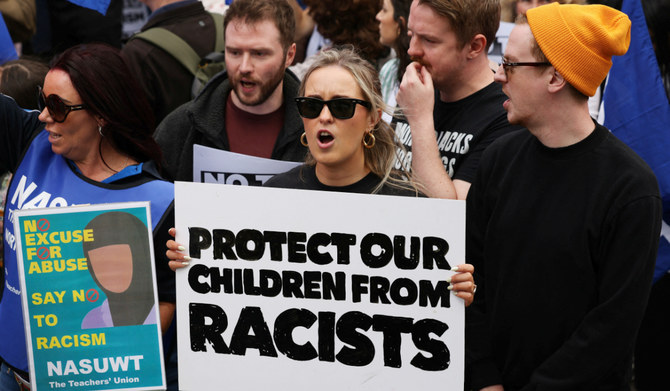
Protesters hold placards during the Belfast Welcomes Diversity anti-racism protest in Belfast, Northern Ireland, August 10, 2024. (REUTERS)
Short Url
Updated 12 August 2024
Follow

Northern Ireland violence shocks Muslims and stokes fears over sectarian divides

  • The violence has mirrored disorder across England, spurred by misinformation spread on social media about the suspected perpetrator of a knife attack in Southport on July 29 which killed three children
  • Three decades of violent sectarian conflict known as the “Troubles” largely ended in 1998, but bitterness and frictions persist between pro-UK Protestant loyalists and pro-Irish unity Catholic nationalists

BELFAST: A week of racism-fueled disorder in Northern Ireland, sparked by disturbances in English towns and cities, is proving harder to end, with fears the UK region’s sectarian divisions are feeding into the violence.
“They burned every single thing, there is nothing left inside, just ashes,” said Bashir, whose supermarket in Belfast was torched during attacks against foreign-owned shops and businesses.
A mosque in a town near Belfast was also targeted late Friday.
“We are scared at what may happen next, there is lots of hostility against the Muslim community,” said the 28-year-old from Dubai, who did not want to give his full name citing safety reasons.
Northern Ireland has seen nightly unrest, mainly in pro-UK loyalist neighborhoods, that began after an anti-immigration protest in Belfast on August 3.
The violence has mirrored disorder across England, spurred by misinformation spread on social media about the suspected perpetrator of a knife attack in Southport on July 29 which killed three children.
The Police Service of Northern Ireland (PSNI) said Saturday that 31 people have been arrested during the disturbances.
“On a fundamental level the Belfast attacks are similar in its dynamic to anti-immigration protests in white working class areas in England, the Republic of Ireland and elsewhere in Europe,” said Peter McLoughlin, a politics lecturer at Queens University Belfast.
“It is driven by racism and fear of the other, but in Northern Ireland it also interfaces with sectarian political dynamics,” he told AFP.

Three decades of violent sectarian conflict known as the “Troubles” largely ended in 1998, but bitterness and frictions persist between pro-UK Protestant loyalists and pro-Irish unity Catholic nationalists.
Outside Bashir’s smoke-scarred shopfront in the staunchly loyalist inner-city district of Sandy Row, British Union Jack flags flutter on lampposts and painted wall murals proclaim fierce allegiance to the UK.
“Within loyalism there is a sense that prevailed through Northern Ireland’s peace process that their community is in retreat, that their community and British identity is under attack,” McLoughlin explained.
Many loyalists feel they “must oppose outsiders coming into those areas, who are seen as taking supposedly Protestant jobs and houses, and encroaching on a community that was once dominant,” he added.
After last Saturday’s anti-immigration protest, rioters rampaged through streets looking for foreign-owned businesses to attack.
“What happened last week was crazy,” Yilmaz Batu, a 64-year-old Turkish chef who has been living in Northern Ireland for two years, told AFP.
“There was never any trouble before,” he said, sitting at the Sahara Shisha Cafe, one of several Middle Eastern and Turkish-owned businesses near Sandy Row that were hit.
The Northern Ireland Muslim Council said in a statement that “the vast majority of the violence has been whipped up and fueled by deliberate misinformation and disinformation on social media.”
“False and dangerous narratives” about Muslims who “constitute a small minority in Northern Ireland” led to the attacks, it added.

Northern Ireland has low rates of immigration compared to the rest of the UK and the Republic of Ireland.
The 2021 census showed about six percent of the population were born outside the UK or Ireland, with around 97 percent describing their ethnicity as white.
The disorder was “extremely shocking for the wider community,” said Fiona Doran, chair of the United Against Racism group which co-organized a solidarity rally in Belfast on Saturday.
The demonstration, which drew several thousand people, gave people “a chance to come out on the streets, to show that Belfast is a welcoming city, it’s a city that says no to racism and fascism,” she told AFP.
At an anti-immigration rally the previous day in Belfast, around a hundred protesters carried British flags and placards reading “respect our country or leave!“
Some chanted the name of Tommy Robinson, a notorious anti-Muslim agitator who has been accused of helping to fuel the unrest in England through constant social media posts about the events.
Nearby, behinds ranks of armored police vehicles, more than 1,000 counter-protesters chanted “racists out!“
Bashir told AFP on Saturday he is unsure if he will reopen his supermarket.
“My question is: are we able to do that? If we do, it will be because of all the people who came out to show us support,” he said following the solidarity demonstration.


US allows oil majors to broadly operate in Venezuela, new energy investments

Updated 14 February 2026
Follow

US allows oil majors to broadly operate in Venezuela, new energy investments

  • Treasury Department issues general license allowing Chevron, BP, Eni, Shell and Repsol to operate oil and gas operations in Venezuela
  • Move is the most significant relaxation of sanctions on Venezuela since US forces captured and removed President Nicolas Maduro

WASHINGTON: The US ​eased sanctions on Venezuela’s energy sector on Friday, issuing two general licenses that allow global energy companies to operate oil and gas projects in the OPEC member and for other companies to negotiate contracts to bring in fresh investments. The move was the most significant relaxation of sanctions on Venezuela since US forces captured and removed President Nicolas Maduro last month.
The Treasury Department’s Office of Foreign Assets Control issued a general license allowing Chevron, BP, Eni, Shell and Repsol to operate oil and gas operations in Venezuela. Those companies still have offices in the country and stakes in projects, and are among the main partners of state-run ‌company PDVSA.
The authorization ‌for the oil majors’ operations requires payments for royalties and Venezuelan ​taxes ‌to ⁠go through ​the US-controlled ⁠Foreign Government Deposit Fund.
The other license allows companies around the world to enter contracts with PDVSA for new investments in Venezuelan oil and gas. The contracts are contingent on separate permits from OFAC.
The authorization does not allow transactions with companies in Russia, Iran, or China or entities owned or controlled by joint ventures with people in those countries.
The licenses “invite American and other aligned companies to play a constructive role in supporting economic recovery and responsible investment, ” the US State Department said in a release. Additional authorizations may be issued “as necessary,” it said.
A spokesperson for Chevron, ⁠the only US oil firm currently operating in Venezuela, said the company welcomed ‌the new licenses.
“The new General Licenses, coupled with recent changes ‌in Venezuela’s Hydrocarbons Law, are important steps toward enabling the further development ​of Venezuela’s resources for its people and for advancing ‌regional energy security,” the spokesperson said in a statement.
Eni said it is assessing the opportunities in ‌Venezuela that the authorization opens up.

Oil law reform

The US licenses follow a sweeping reform of Venezuela’s main oil law approved last month, which grants autonomy for foreign oil and gas producers to operate, export and cash sale proceeds under existing joint ventures with PDVSA or through a new production-sharing contract model.
The US has had sanctions on Venezuela since ‌2019 when President Donald Trump imposed them during his first administration. Trump is now seeking $100 billion in investments by energy companies in Venezuela’s oil and gas sector. ⁠US Energy Secretary Chris Wright ⁠said on Thursday, during his second day of a trip to Venezuela, that oil sales from the country since Maduro’s capture have hit $1 billion and would hit another $5 billion in months.
Wright said the US will control the proceeds from the sales until Venezuela stands up a “representative government.” Since last month, the Treasury issued several other general licenses to facilitate oil exports, storage, imports and sales from Venezuela. It also authorized the provision of US goods, technology, software or services for the exploration, development or production of oil and gas in Venezuela.
The Venezuelan government expropriated assets of Exxon Mobil and ConocoPhillips in 2007 under then-President Hugo Chavez. The Trump administration is trying to get those companies to invest in Venezuela as well. At a meeting at the White House with Trump last month, Exxon Mobil CEO Darren Woods said Venezuela was “uninvestable” at ​the moment.
Wright said on Thursday that Exxon, ​which no longer has an office in Venezuela, is in talks with the government there and gathering data about the oil sector. Exxon did not immediately comment.