PM says visit of Imam of Prophet’s Mosque to further strengthen Pakistan-Saudi Arabia ties

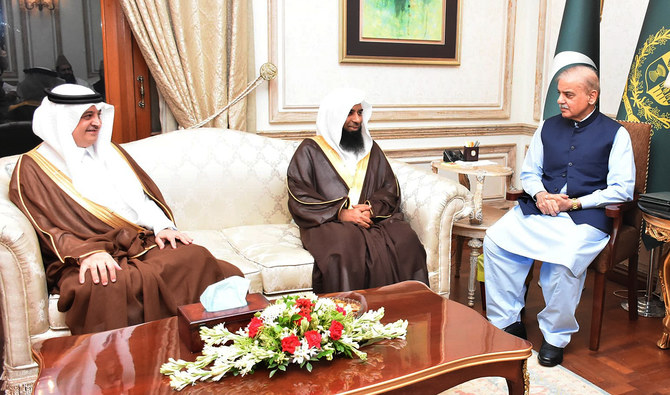
In this handout photograph, taken and released by Pakistan’s Press Information Department, Prime Minister Shehbaz Sharif (right) gestures during a meeting with Imam of the Prophet’s Mosque, Sheikh Dr. Salah bin Muhammad Al-Budair, in Lahore on August 11, 2024. (PID)
Short Url
Updated 11 August 2024
Follow

PM says visit of Imam of Prophet’s Mosque to further strengthen Pakistan-Saudi Arabia ties

  • Sheikh Dr. Salah bin Muhammad Al-Budair arrived on a seven-day visit to Pakistan on Thursday
  • He is also scheduled to meet prominent Pakistani scholars and visit universities during his stay

ISLAMABAD: Prime Minister Shehbaz Sharif on Sunday met with Imam of the Prophet’s Mosque, Sheikh Dr. Salah bin Muhammad Al-Budair, in Lahore and told him that his visit would further strengthen relations between Pakistan and Saudi Arabia, Sharif’s office said.
Sheikh Dr. Salah bin Muhammad Al-Budair arrived on a seven-day visit to Pakistan on Thursday. Since his arrival, the Imam of Prophet’s Mosque has met President Asif Ali Zardari, Army Chief General Asim Munir, and has led Friday prayers at Shah Faisal Mosque in the federal capital.
During their meeting, PM Sharif told Sheikh Salah that his visit was an “honor” for the South Asian country and expressed his best wishes for King Salman and Crown Prince Mohammed bin Salman, according to Sharif’s office.
“The people of Pakistan have immense respect for the Custodian of the Two Holy Mosques and the Saudi leadership,” Sharif’s office quoted him as telling the Imam of Prophet’s Mosque. “Your visit will further improve relations between the two countries.”
The Prophet’s Mosque, more popularly known as Al-Masjid an-Nabawi, holds profound historical and spiritual significance in Islam, having been built by the first Muslim community under the supervision of Prophet Muhammad (peace be upon him).
It is also his last resting place, making imams of this sacred mosque deeply respected across the Muslim world and widely viewed as embodiments of religious devotion and scholarly wisdom.
During the meeting, Sheikh Salah expressed his gratitude to the premier for the hospitality accorded to him in Pakistan, according to Sharif’s office. The meeting was also attended by members of PM Sharif’s cabinet and Saudi Arabia’s ambassador to Pakistan, Nawaf bin Saeed Al-Malki.
Pakistan and Saudi Arabia enjoy strong economic, defense and religious ties. The Kingdom is home to over 2.7 million Pakistani expatriates, serving as the top source of remittances for the cash-strapped South Asian country.
Pakistan has also been frequently visited by the prayer leader of the Grand Mosque in Makkah in the past. These visits, along with high-level official exchanges, have played a significant role in strengthening the relations between the two countries.
Saudi religious scholars, such as the prayer leaders of the two holy mosques, have fostered closer ties between the two countries, with many of them often taking a special interest in Islamic education and religious institutions in Pakistan.
Sheikh Salah is also scheduled to meet prominent Pakistani scholars and visit universities during his stay in the South Asian country.


Pakistan PM orders accelerated privatization of power sector to tackle losses

Updated 15 December 2025
Follow

Pakistan PM orders accelerated privatization of power sector to tackle losses

  • Tenders to be issued for privatization of three major electricity distribution firms, PMO says
  • Sharif says Pakistan to develop battery energy storage through public-private partnerships

ISLAMABAD: Pakistan’s prime minister on Monday directed the government to speed up privatization of state-owned power companies and improve electricity infrastructure nationwide, as authorities try to address deep-rooted losses and inefficiencies in the energy sector that have weighed on the economy and public finances.

Pakistan’s electricity system has long struggled with financial distress caused by a combination of factors including theft of power, inefficient collection of bills, high costs of generating electricity and a large burden of unpaid obligations known as “circular debt.” In the first quarter of the current financial year, government-owned distribution companies recorded losses of about Rs171 billion ($611 million) due to poor bill recovery and operational inefficiencies, official documents show. Circular debt in the broader power sector stood at around Rs1.66 trillion ($5.9 billion) in mid-2025, a sharp decline from past peaks but still a major fiscal drain. 

Efforts to contain these losses have been a focus of Pakistan’s economic reform program with the International Monetary Fund, which has urged structural changes in the energy sector as part of financing conditions. Previous government initiatives have included signing a $4.5 billion financing facility with local banks to ease power sector debt and reducing retail electricity tariffs to support economic recovery. 

“Electricity sector privatization and market-based competition is the sustainable solution to the country’s energy problems,” Prime Minister Shehbaz Sharif said at a meeting reviewing the roadmap for power sector reforms, according to a statement from the prime minister’s office.

The meeting reviewed progress on privatization and infrastructure projects. Officials said tenders for modernizing one of Pakistan’s oldest operational hubs, Rohri Railway Station, will be issued soon and that the Ghazi Barotha to Faisalabad transmission line, designed to improve long-distance transmission of electricity, is in the initial approval stages. While not all power-sector decisions were detailed publicly, the government emphasized expanding private sector participation and completing priority projects to strengthen the electricity grid.

In another key development, the prime minister endorsed plans to begin work on a battery energy storage system with participation from private investors to help manage fluctuations in supply and demand, particularly as renewable energy sources such as solar and wind take a growing role in generation. Officials said the concept clearance for the storage system has been approved and feasibility studies are underway.

Government briefing documents also outlined steps toward shifting some electricity plants from imported coal to locally mined Thar coal, where a railway line expansion is underway to support transport of fuel, potentially lowering costs and import dependence in the long term.

State authorities also pledged to address safety by converting unmanned railway crossings to staffed ones and to strengthen food safety inspections at stations, underscoring broader infrastructure and service improvements connected to energy and transport priorities.